How Much Protein to Build Muscle After 50 (It’s More Than You Think)
The RDA was never a muscle number, and anabolic resistance means your muscle needs a bigger dose after 50 — here’s how much protein it actually takes.

If you want to know how much protein to build muscle after 50, here’s the honest answer up front: more than the government number, more than you were told, and more than most men your age actually eat. The old RDA of 0.8 grams per kilogram of bodyweight was never a muscle-building number. It was a floor — the minimum to keep a sedentary person from slowly wasting away. It was never meant to grow anything.
Building muscle after 50 sits well above that floor, and the gap gets wider with every birthday. There’s a physical reason for it, and once you understand it, the plate makes sense. If you want the full eating picture first, start with my complete guide to building muscle after 50 — this piece goes deep on one number that matters more than any other: protein.
I’m 40. I’ve been on TRT since I was 35, and I already feel the difference from my competition days back in Sweden. The same food does less than it used to. Past 50, that curve gets steeper. So let’s put real numbers on it — per day, per meal, and on the plate — and let’s put the tired kidney fear to bed while we’re here.
The 0.8 number was never about muscle
The RDA — 0.8 g/kg — is a public-health minimum. It answers one question: how little protein can a healthy adult eat and not lose ground? That’s a survival number, not a growth number. Nobody built a set of shoulders on it.
Here’s the part that gets buried: the RDA fails older lifters harder than anyone. It was set on nitrogen-balance studies that lean young. When researchers pooled the modern evidence for older adults, they landed somewhere else entirely. The PROT-AGE expert group — the position paper most geriatric nutrition leans on — put healthy older adults at 1.0 to 1.2 g/kg per day, active older adults at 1.2 g/kg or more, and older adults dealing with illness at 1.2 to 1.5 g/kg.[1] That’s not a small bump. For a 90 kg man (about 198 lb), the RDA says 72 grams. The active-aging recommendation says 108 and up. Same man, a 50 percent difference — and the higher number is the one built on the newer science.
Anabolic resistance: why muscle listens less after 50
The reason older men need more protein has a name: anabolic resistance. Your muscle still responds to protein — it just responds less, to the same dose, than it did when you were 25. Feed a young man and an older man the identical amount of protein, and the young man’s muscle-protein synthesis switches on harder. The older man’s muscle is a little deaf. It needs a bigger knock to open the door.
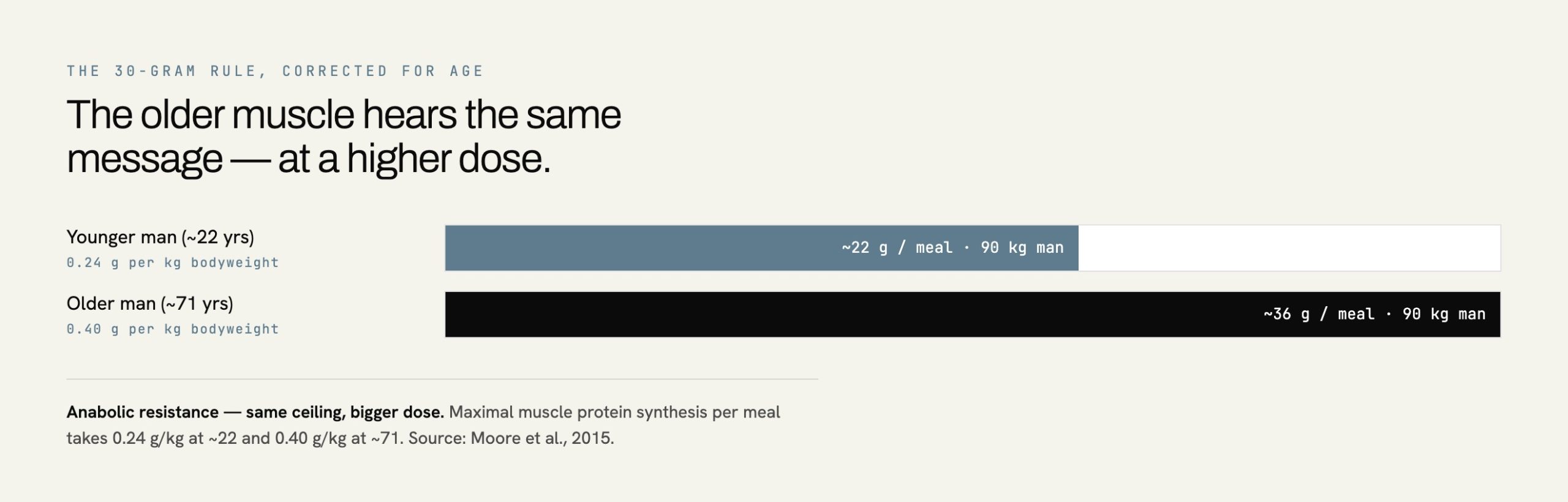
The clearest measurement of this came from a study that fed men graded doses of protein and measured how hard their muscle turned on. To maximally stimulate myofibrillar protein synthesis, younger men (around 22) needed about 0.24 g/kg of bodyweight in a meal. Older men (around 71) needed about 0.40 g/kg — roughly two-thirds more protein per meal to hit the same ceiling.[2] That single finding is why “just eat the RDA” quietly betrays men over 50. The RDA assumes an efficient machine. After 50, the machine costs more to run.
Two things drive this. First, aging muscle is less sensitive to the amino acid leucine — the specific trigger that flips the growth switch. Second, blood flow and nutrient delivery to muscle drop with age. Neither one means you can’t build. Both mean you need a stronger signal. And the way you send a stronger signal is more protein, in the right size dose, more often.
How much protein per day to build muscle after 50
Stack the active-aging recommendation on top of what we know about anabolic resistance, and a working daily target for a man over 50 who’s lifting to build muscle lands around 1.4 to 1.6 g/kg of bodyweight — the top of the expert band and a little past it. Not because more is magic, but because your muscle is charging you a tax and you’re paying it with food.
Protein per kg over 50 is the cleanest way to set the number, so here’s the math laid out by bodyweight:
| Bodyweight | RDA (0.8 g/kg) — the floor | Active aging (1.2 g/kg) | Lifting to build (1.6 g/kg) |
|---|---|---|---|
| 70 kg (154 lb) | 56 g | 84 g | 112 g |
| 82 kg (180 lb) | 66 g | 98 g | 131 g |
| 90 kg (198 lb) | 72 g | 108 g | 144 g |
| 100 kg (220 lb) | 80 g | 120 g | 160 g |
Look at that right-hand column and then think about what most men over 50 actually eat: a splash of milk in coffee, a sandwich, a normal dinner. That’s often 70 or 80 grams on a good day — the survival floor, dressed up as “eating fine.” No wonder the muscle won’t come. You’re feeding it to maintain, then wondering why it won’t grow.
If you’re lifting after 50 and the scale by the bathroom sink says 90 kg, your protein target isn’t 70 grams. It’s closer to 140. Write it on the fridge. That one number does more than any supplement in the cabinet.
The number that matters more than the daily total: per meal
Here’s where most men go wrong even when the daily total is right. They eat almost nothing until dinner, then land 90 grams on one plate at 8 p.m. The daily math checks out. The muscle-building doesn’t — because there’s a per-meal ceiling, and after 50 that ceiling sits higher.
Remember the 0.40 g/kg figure. That’s the per-meal dose an older man needs to fully switch on muscle-protein synthesis.[2] For a 90 kg man, that’s about 36 grams in a sitting — call it a clean 30 to 40 grams, every meal, with enough leucine in it to trip the switch. Leucine is why animal proteins, dairy, and whey pull their weight here: they’re leucine-dense, so they clear the older man’s higher bar more easily. In the trial that fed sarcopenic older adults a leucine-enriched whey protein, muscle mass and lower-body function both improved over 13 weeks.[3] The trigger is real, and it’s buyable at the grocery store — meat, eggs, dairy, fish.
Go below that per-meal dose and the meal barely registers for growth. Pile way above it in one sitting and you don’t get a bigger response — you just top out, and the rest gets used for energy or stored. That’s the case for spreading protein across the day instead of hoarding it for dinner.
Spread it out: four solid doses beat one big one
The practical version of everything above: aim for roughly four meals of 30 to 40 grams, spaced across your waking hours. Four times you clear the per-meal threshold. Four times your muscle gets the full signal. That’s a fundamentally different day from grazing all afternoon and feasting at night.
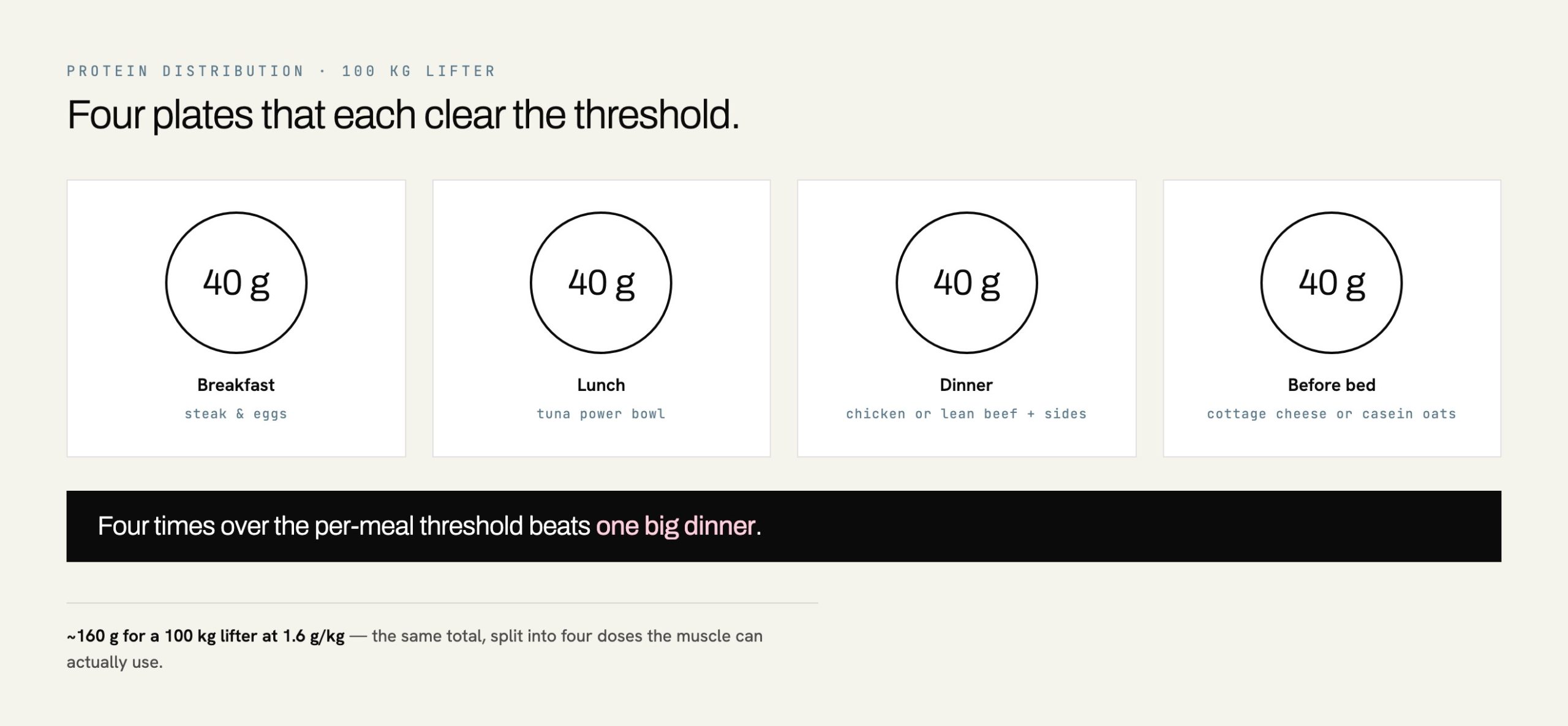
Front-load it. Older men tend to eat the least protein at breakfast and the most at dinner — exactly backwards. A real breakfast changes the day. My steak and eggs with spinach lands 40-plus grams before you’ve done anything, and it holds you till lunch. A tuna salad power bowl does the same job at midday without cooking. And the meal men forget is the last one — a slow-digesting dose before bed keeps the signal going overnight. That’s what my casein-loaded overnight oats are built for, and on a lazy night a bowl of my high-protein cottage cheese bowl does it in two minutes flat.
Best protein sources over 50, and what 40 grams looks like on a plate
The best protein sources over 50 are the leucine-dense, easy-to-chew, easy-to-digest ones: meat, poultry, fish, eggs, and dairy up front, with beans and soy backing them up. The goal isn’t exotic. It’s hitting 30 to 40 grams a meal without a struggle. Here’s what that actually looks like, with real numbers:
| Food | Protein per typical serving | To hit ~40 g |
|---|---|---|
| Cooked chicken breast | ~31 g per 100 g[5] | a 5–6 oz cooked breast |
| Lean (90/10) ground beef, cooked | ~26 g per 100 g | a 6 oz cooked patty |
| Canned tuna in water, drained | ~30 g per 5 oz can | 1 can plus a boiled egg |
| Large eggs | ~6 g each | 3 eggs + 2 oz cheese, or eggs + yogurt |
| Low-fat cottage cheese | ~25 g per cup | 1.5 cups, or 1 cup + a scoop of whey |
| Greek yogurt, nonfat | ~17 g per container | 2 containers, or 1 + a scoop |
| Whey protein | ~24 g per scoop | 1.5 scoops, or 1 scoop + milk |
Forty grams of protein is a real amount of food — a full chicken breast, not a garnish. If a “high-protein” meal fits in your palm, it isn’t one. This is why men undershoot without knowing it: they picture protein, but they plate a portion built for the RDA. Weigh it once or twice. You’ll recalibrate your eye fast.
A note for the men who can’t chew a steak three times a day, or whose appetite isn’t what it was: this is exactly where a scoop of whey, a tub of Greek yogurt, or blended cottage cheese earns its place. Soft, fast, leucine-rich protein counts every bit as much as the plate that took effort. After 50, getting the grams in beats being a hero about it.
“But is all that protein bad for my kidneys?”
You’ve heard it your whole life, probably from a well-meaning doctor or a brother-in-law: too much protein wrecks your kidneys. For a man with healthy kidneys, the evidence doesn’t back it. A systematic review and meta-analysis pooling dozens of trials found that higher-protein diets did not adversely change kidney function — measured as glomerular filtration rate — in healthy adults.[4] Yes, a high-protein diet raises filtration rate in the short term. That’s your kidneys working, the way your legs work harder on a hill. It isn’t damage, and when the researchers compared the actual change in function, there was no difference.
The honest exception matters, so I’ll say it plainly. If you already have chronic kidney disease, the rules change — protein does get managed in that situation, and that’s a conversation for your doctor and a dietitian, not a blog. And whatever you run, whatever your age, get your bloodwork done. I say that as a man who checks his own. Know your numbers before you change your plate.
This is nutrition from a cook and a lifter, not medical advice. I don’t diagnose and I don’t prescribe. If you have kidney disease, diabetes, or any medical condition — or you’re on medication — talk to your doctor before you overhaul your protein. Food is powerful. Respect it.
When I was competing back in Sweden — the B&K Classic, the Grand Prix stage — I weighed my protein to the gram because the stage doesn’t forgive lazy math. I was in my twenties then, and honestly, my body forgave a lot; the muscle came easy and it stayed. Then I hit 35, went on TRT, and something shifted that no dose fixes: the same food just did less. My appetite would drop on a heavier run and I’d coast on too little without noticing. That was my first real taste of the thing this whole article is about. I’m 40 now. I already eat like the older man in that research, because the mirror doesn’t lie and neither do the numbers. If it’s already true for me, big man, it’s true for you — and the fix isn’t a compound. It’s the plate.
None of this is complicated. It’s just bigger than you were told. Set your daily target by your bodyweight, hit 30 to 40 grams four times a day, lean on the leucine-dense foods, and stop fearing your own kidneys. Do that consistently and the muscle comes — slower than at 25, but it comes.
If you’d rather not do the arithmetic yourself, that’s what I’m here for. Grab my free eating plan and I’ll set the protein target and the four-meal structure for you, or browse the recipe kitchen and build your own day of 40-gram plates. Either way — you’re going to eat well, and I’ve got you.
Questions men actually ask
How much protein per day for a 55-year-old man building muscle?
Set it by bodyweight, not by age. For a man over 50 lifting to build muscle, aim for about 1.4 to 1.6 grams of protein per kilogram per day — the top of the active-aging recommendation and a little past it. A 90 kg (198 lb) man lands around 130 to 145 grams; a 100 kg (220 lb) man, around 145 to 160. That’s well above the 0.8 g/kg RDA, which was never a muscle-building number.
Is 100 grams of protein enough after 50?
For most lifting men over 50, no. A hundred grams is fine maintenance for a smaller or lightly active man, but if you weigh 90 kg and you’re training to grow, your target is closer to 140. The bigger and more active you are, the more 100 grams undershoots. Check it against your own bodyweight rather than treating 100 as a finish line.
Is too much protein bad for your kidneys?
For a man with healthy kidneys, the evidence says no — a meta-analysis of dozens of trials found higher-protein diets did not harm kidney function in healthy adults. The short-term rise in filtration rate is the kidney working, not the kidney failing. The real exception is existing chronic kidney disease, where protein is managed with your doctor. Get bloodwork, know your numbers, then eat.
What are the best protein sources over 50?
The leucine-dense, easy-to-digest ones: lean meat, poultry, fish, eggs, dairy, and whey lead the list, with beans and soy backing them up. Leucine is the amino acid that triggers muscle growth, and after 50 you need a stronger trigger — so animal and dairy proteins clear the bar more easily. If chewing or appetite is a limit, whey, Greek yogurt, and cottage cheese count just as much as a steak.
Does protein timing matter more after 50?
Spacing matters more than clock-precision. Because older muscle needs a bigger per-meal dose to fully respond — about 0.40 g/kg, versus 0.24 for younger men — you get more growth from four meals of 30 to 40 grams than from one huge dinner. Front-load breakfast, hit each meal’s threshold, and add a slow protein like casein or cottage cheese before bed. That beats obsessing over a post-workout window.
References
- Journal of the American Medical Directors Association — Bauer et al., Evidence-Based Recommendations for Optimal Dietary Protein Intake in Older People: A Position Paper From the PROT-AGE Study Group (2013)
- The Journals of Gerontology: Series A — Moore et al., Protein Ingestion to Stimulate Myofibrillar Protein Synthesis Requires Greater Relative Protein Intakes in Healthy Older Versus Younger Men (2015)
- Journal of the American Medical Directors Association — Bauer et al., Effects of a Vitamin D and Leucine-Enriched Whey Protein Nutritional Supplement on Measures of Sarcopenia in Older Adults (the PROVIDE Study) (2015)
- The Journal of Nutrition — Devries et al., Changes in Kidney Function Do Not Differ between Healthy Adults Consuming Higher- Compared with Lower- or Normal-Protein Diets: A Systematic Review and Meta-Analysis (2018)
- USDA FoodData Central — Food composition data, Agricultural Research Service (accessed 2026)

Magnus Olafsson
The cook behind Slim Diet Era. Former Swedish stage competitor (B&K Classic Body Show, Swedish Grand Prix), on TRT since 35, cooking high-protein food in Chicago for his husband, two kids, and you. He counts the macros so you don’t have to.
More about Magnus →Hungry for a plan, not just a post?
Start with the free plan — macros counted, grocery list written, in your inbox. You cook and eat; I’ll do the math.