How Much Protein Is in an Egg? (And How I Cook a Carton)
The real USDA numbers by egg size, whites vs yolks, raw vs cooked absorption, and the honest cost per gram.

Here is the plain answer to how much protein is in an egg: one large egg carries about 6.3 grams of protein — roughly 3.6 grams in the white and 2.7 grams in the yolk, on USDA numbers.[1][2][3] That is the figure to carry in your head. Everything else on this page is me showing my work so you can trust it and stop guessing.
But the size of the egg moves that number more than most men realize, a jumbo is worth almost two extra grams over a small, and how you cook it changes how much of that protein you actually keep. So let me lay a whole carton out on the counter and walk you through it, big man.
I cook through a dozen eggs a week in my Chicago kitchen, sometimes two dozen when I am eating heavier. By the end of this you will know exactly what each egg is worth, why the cooked one beats the raw one by a wide margin, and how I get through twelve of them without wanting to never see an egg again.
The short answer, before anything else
One large egg gives you about 6.3 grams of protein and roughly 72 calories.[1] Two large eggs get you to about 12.5 grams, three eggs to nearly 19. A whole carton of twelve large eggs holds around 75 grams of protein — that is most of a day’s target for a lot of men, sitting in a cheap cardboard box in your fridge door.
Here are the USDA reference figures I am building everything on, all per 100 grams of raw egg:
- Whole egg: 12.6 g protein · 143 kcal · 76.2 g water · 9.5 g fat[1]
- Egg white only: 10.9 g protein · 52 kcal · 87.6 g water · 0.2 g fat[2]
- Egg yolk only: 15.9 g protein · 322 kcal · 52.3 g water · 26.5 g fat[3]
Look at the yolk line for a second. It is the richest part of the egg in protein per gram — nearly 16 grams per 100 — and also where every bit of the fat and the calories live. People throw it out to “save protein,” and they are actually throwing protein away. We will get to that fight in a minute.
Protein in an egg, by size: small to jumbo
An egg is not one fixed thing. The carton grades — small, medium, large, extra large, jumbo — are sorted by weight, and since the protein sits at a steady density inside, a bigger egg simply holds more of it. USDA lists standard weights for each grade, so the math is clean. Here is every size, whole egg, no shell.[1]
| Egg size | Weight (no shell) | Protein per egg | Calories per egg |
|---|---|---|---|
| Small | 38 g | ~4.8 g | ~54 kcal |
| Medium | 44 g | ~5.5 g | ~63 kcal |
| Large | 50 g | ~6.3 g | ~72 kcal |
| Extra large | 56 g | ~7.0 g | ~80 kcal |
| Jumbo | 63 g | ~7.9 g | ~90 kcal |
Read the protein column top to bottom. A jumbo egg carries about 3.1 grams more protein than a small one — that is half an egg’s worth of difference hiding inside the same word, “egg.” If your recipe or your tracker says “2 eggs” and you are cracking jumbos, you are quietly eating closer to three small eggs’ worth of protein. Not a disaster. Just worth knowing which egg is in your hand.
Most cartons in a US store are labeled large. So when someone says “an egg has 6 grams of protein,” they are picturing a large egg, and they are basically right. I keep the whole table in the back of my mind because the eggs I actually buy at my market swing between large and extra large depending on the week.
Whites vs yolks: where the protein actually sits
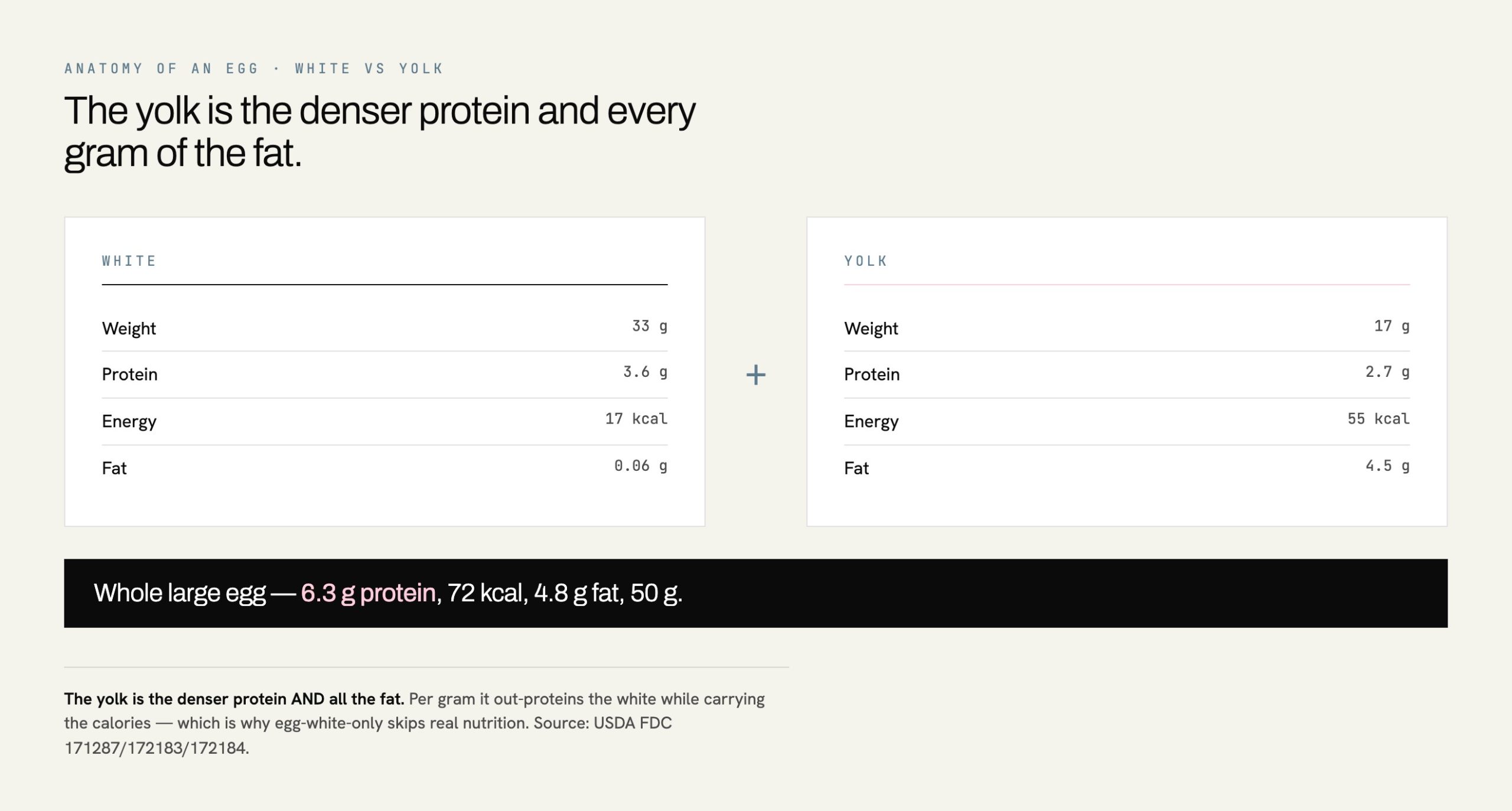
This is the question I get most, so let me settle it with numbers. The protein in an egg white from one large egg is about 3.6 grams, and the yolk carries the other 2.7 grams.[2][3] The white is the bigger single share — a large white weighs about 33 grams to the yolk’s 17 — but the yolk is more protein-dense per gram, because the white is nearly nine-tenths water.
So the popular idea that “the protein is all in the whites” is only half true. The whites hold a bit more than half the protein, yes. But the yolk is not some fat blob you tolerate — it is 43% of the egg’s protein, plus the fat-soluble vitamins, the choline, and the fats that make an egg taste like food instead of packing foam.
A large egg = ~6.3 g protein total. Whites give ~3.6 g for almost no calories; the yolk gives ~2.7 g but brings ~55 of the egg’s ~72 calories and nearly all its fat. Whites win on protein-per-calorie. The whole egg wins on almost everything else.
When do I actually separate them? Deep in a cut, when I am squeezing my calories and want a big pile of protein volume, I will run mostly whites and keep one or two yolks in for taste — that is the whole idea behind my egg white and spinach omelette, which gives you a real plate of protein for barely any calories. The rest of the year I eat the whole egg and do not think twice, and I will show you why the research backs that up in a moment.
Raw vs cooked: cooking nearly doubles the protein you absorb
Here is the part almost nobody tells you, and it matters more than the size of your egg. The protein number on the carton is not the protein your body keeps. Raw egg protein is poorly absorbed. Cook it, and you nearly double how much of it your gut actually pulls in.
Belgian researchers fed people a measured dose of egg protein, labeled with stable isotopes so they could track exactly how much crossed the gut wall, once raw and once cooked. The result was stark. Cooked egg protein was 90.9% digestible. Raw egg protein was only 51.3%.[4] Same egg. Cooking it took the protein you keep from roughly half to well over nine-tenths.
Put that on a real egg. A large egg’s 6.3 grams of protein turns into about 5.7 grams you actually absorb when it is cooked, versus only about 3.2 grams when it is raw. That raw egg in your morning shake is delivering barely more usable protein than the yolk alone would after cooking. The heat unfolds the proteins so your enzymes can get at them, and it knocks out avidin, a compound in raw white that ties up your biotin. Cooking wins twice.
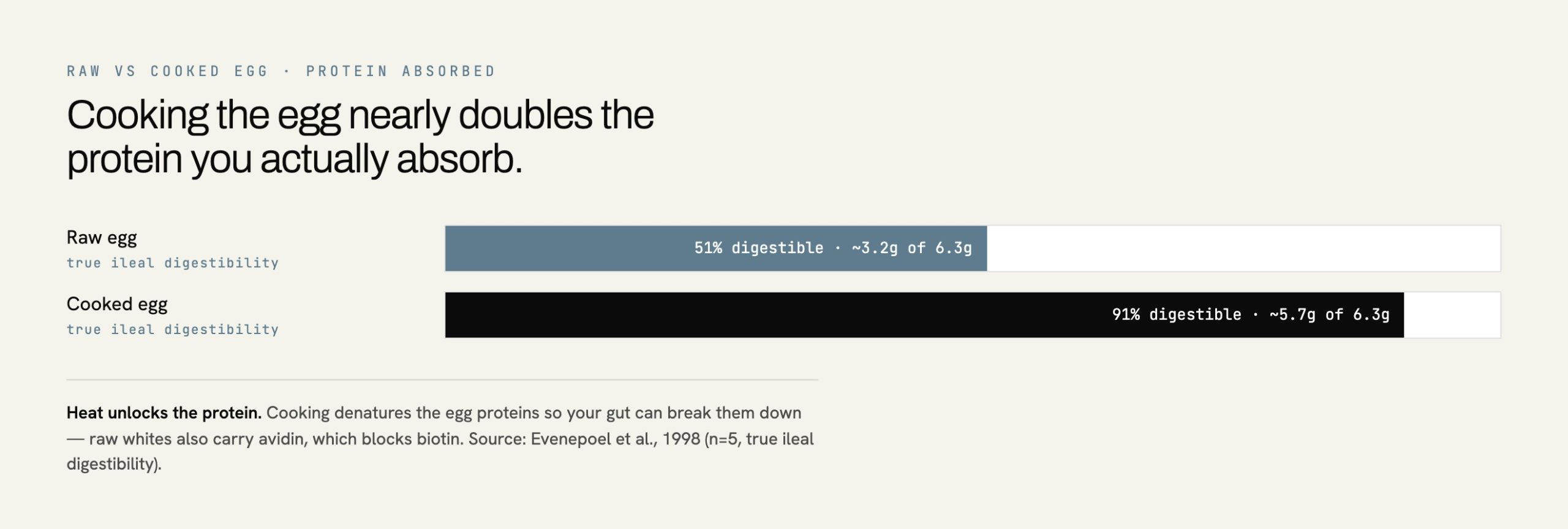
Never chug raw eggs for the protein. You are absorbing about half of it. Cook them — soft, hard, scrambled, does not matter — and you keep more than nine parts in ten. The Rocky thing was always for the drama, never for the gains.
Why egg protein counts more than its number suggests
Not all protein grams are equal, and this is where egg protein quietly beats a lot of things with a bigger number on the label. Egg is the protein nutritionists have used for a century as the reference standard — the yardstick everything else gets measured against. It is a complete protein: all nine essential amino acids, in a ratio your muscle can use almost entirely.
And there is a good reason not to toss the yolk that goes beyond the 2.7 grams it holds. When researchers gave trained young men 18 grams of protein after lifting — once as whole eggs, once as an equal amount of egg whites — the whole eggs drove a significantly greater muscle-building response than the whites, despite the identical protein dose.[5] The yolk brought something the whites could not: the fats, the micronutrients, the whole matrix of the food working together. It is a good, hard argument against the egg-white-only habit, at least on days when you can spend the calories.
So when I count an egg’s 6.3 grams, I am counting some of the most usable protein in my kitchen — and if I keep the yolk in, I may be getting more out of it than the number alone promises. That is the case for eating the whole egg most of the time and saving the whites-only trick for the leanest phase of a cut.
The budget case: eggs are some of the cheapest real protein there is
I care about this one because a lot of you are feeding a family and a training habit on a normal wage, and the internet keeps telling you to buy $40 tubs and grass-fed everything. You do not have to. Let me do the cost-per-gram honestly.
Say a dozen large eggs runs you around four dollars — egg prices swing hard by season and by where you live, so use your own number. A dozen large eggs holds about 75 grams of protein.[1] That is roughly 5 cents per gram of protein at four dollars a carton, closer to 4 cents if eggs are cheaper that week. To put that in company:
| Protein source | Rough price | Protein | Cost per gram protein |
|---|---|---|---|
| Large eggs (dozen) | ~$4.00 | ~75 g | ~5.3¢ |
| Chicken breast (per lb, raw) | ~$4.00 | ~102 g | ~3.9¢ |
| Whey protein (tub) | ~$40 | ~700 g | ~5.7¢ |
Eggs land right in the pocket with chicken breast and undercut most protein powder, while giving you fats, vitamins, and something that actually feels like a meal. Those numbers are illustrative — plug in the prices at your own store and the shape holds. If you want the full side-by-side on the other cheap anchor in that table, I broke down exactly how much protein is in a chicken breast the same honest way. Between eggs and chicken, most of a lifter’s protein bill is covered for pocket change.
I did not really learn to cook until the Covid lockdowns, and eggs were the first thing I got good at. Gyms shut, my stage days were long behind me, the kids were home climbing the walls, and I had a lot of quiet mornings and a carton in the fridge. So I taught myself eggs — scrambled soft, then omelettes, then a proper skillet — one slow morning at a time in a borrowed pink apron my family now refuses to let me retire. It sounds small. It was the door. A man who can cook a good egg can feed himself for the rest of his life for almost nothing, and everything else I know about cooking grew out of those mornings standing over a pan, learning to stop rushing the heat.
How I cook a carton: getting through twelve eggs a week
Twelve eggs a week is the floor for me, and eating the same scramble every morning is how you learn to hate a good food. So I rotate. Here is how a carton actually disappears in my kitchen.
Boil six on Sunday
Half the carton goes straight into a pot the day I shop. Twelve minutes at a bare simmer, into ice water, back in the fridge peeled or unpeeled. Now I have grab-and-go protein for the week — two hard-boiled eggs is about 12.5 grams for zero effort at 3pm when I am between things and would otherwise eat garbage. Cooked, so I keep over 90% of the protein.[4] This is the single highest-leverage thing I do with eggs.
Crack three or four into breakfast
Most mornings I cook whole eggs into something with weight to it. A few eggs scrambled soft in butter, or folded into leftover mince and rice. When I want breakfast to hit like a real meal — protein and fat and something to chew — I lean on my beef and egg breakfast skillet, which stacks the eggs’ 6.3 grams apiece on top of a proper base of beef so I walk out the door already thirty-plus grams into my day.
Whites when I am cutting
When calories are tight I split the carton and run the whites for volume, keeping a yolk or two for taste and for the muscle-building edge the whole egg carries.[5] A big whites-forward omelette full of spinach fills a plate for almost nothing — that is exactly what the egg white and spinach omelette is built to do.
The sweet trick when I am eating heavier
On a bulk, or when I am running a heavier cycle and my appetite is a bottomless thing, plain eggs get boring fast and I need the calories to go down easy. That is when whole eggs become batter. My anabolic french toast turns a few eggs into something that tastes like a cheat and quietly carries real protein — the easiest way I know to make big morning calories actually enjoyable instead of a chore.
Backstage in Sweden, in the last dry days before I stepped out in bronzer, egg whites were half my food — cheap, lean, endless. I still respect the whites. But those were the strictest days of my life, and unless you are literally about to be on a stage, you probably do not need to live like that. Eat the yolk.
That is a carton. Boil some, cook some whole into breakfast, whites on the tight days, batter when I need the calories to be fun. Twelve eggs, sometimes twenty-four, gone by the next shop, and I never get sick of them because they are never the same twice. You can find all of these and more in my full recipe kitchen if you want ways to spend your eggs.
Questions men actually ask
How much protein is in one egg?
About 6.3 grams in a standard large egg — roughly 3.6 grams from the white and 2.7 grams from the yolk, with around 72 calories total. Smaller eggs carry a little less (a small egg is about 4.8 grams) and jumbos a little more (about 7.9 grams), because the eggs are graded by weight.
How much protein is in an egg white?
The white of one large egg holds about 3.6 grams of protein for only about 17 calories and almost no fat. That is a bit more than half the egg’s total protein. The other 2.7 grams sit in the yolk, along with nearly all the egg’s fat, calories, and micronutrients.
Is the protein in eggs mostly in the white or the yolk?
Slightly more is in the white — about 3.6 grams versus 2.7 grams in the yolk of a large egg. But the yolk is more protein-dense per gram, since the white is close to 88% water. Throwing the yolk away discards roughly 43% of the egg’s protein, plus its fats and vitamins, so most of the time it is not worth doing.
Does cooking an egg change how much protein you get?
The gram count barely changes, but how much you absorb changes a lot. Cooked egg protein is about 90.9% digestible; raw egg protein only about 51.3%. So a cooked large egg gives you roughly 5.7 grams of usable protein versus about 3.2 grams raw. Always cook your eggs — chugging them raw wastes nearly half the protein.
Are eggs a cheap source of protein?
Very. A dozen large eggs holds about 75 grams of protein, which at typical prices works out to roughly 4 to 6 cents per gram of protein — right alongside chicken breast and cheaper than most protein powders, while also delivering fats and micronutrients that powder does not.
How many eggs should I eat to hit 30 grams of protein?
About five large eggs gets you to roughly 31 grams. If you are using extra large or jumbo eggs you can get there in four. Pairing eggs with another source — beef, cottage cheese, or oats — is usually an easier and more balanced way to build a 30-plus gram meal than eating five eggs alone.
References
- USDA FoodData Central — Egg, whole, raw, fresh (FDC ID 171287): 12.6 g protein per 100 g; large egg 50 g (2019)
- USDA FoodData Central — Egg, white, raw, fresh (FDC ID 172183): 10.9 g protein per 100 g (2019)
- USDA FoodData Central — Egg, yolk, raw, fresh (FDC ID 172184): 15.9 g protein per 100 g (2019)
- Evenepoel P, et al. — Digestibility of cooked and raw egg protein in humans as assessed by stable isotope techniques. Journal of Nutrition (1998)
- van Vliet S, et al. — Consumption of whole eggs promotes greater stimulation of postexercise muscle protein synthesis than isonitrogenous egg whites in young men. American Journal of Clinical Nutrition (2017)
- USDA FoodData Central — Egg, whole, cooked, hard-boiled (FDC ID 173424): 12.6 g protein per 100 g (2019)

Magnus Olafsson
The cook behind Slim Diet Era. Former Swedish stage competitor (B&K Classic Body Show, Swedish Grand Prix), on TRT since 35, cooking high-protein food in Chicago for his husband, two kids, and you. He counts the macros so you don’t have to.
More about Magnus →Hungry for a plan, not just a post?
Start with the free plan — macros counted, grocery list written, in your inbox. You cook and eat; I’ll do the math.