Category: Myths & Misconceptions

The anabolic-eating myths Magnus keeps having to un-teach — anabolic windows, dirty bulks, starvation mode, and other nonsense.

  • The 30g Protein Rule: How Much Can You Really Absorb Per Meal?

    The 30g Protein Rule: How Much Can You Really Absorb Per Meal?

    BlogMyths & Misconceptions12 min read

    The 30g Protein Rule: How Much Can You Really Absorb Per Meal?

    The ’30 grams a meal’ rule confuses your gut with your muscle — here’s the honest science, and how much protein per meal actually matters.

    The 30g Protein Rule: How Much Can You Really Absorb Per Meal?

    Somebody in every gym locker room will tell you the body can only use 30 grams of protein at a sitting, so your big steak dinner is half wasted. It’s one of the stickiest numbers in lifting. And when men ask me how much protein can you absorb per meal, that 30-gram figure is almost always sitting behind the question like a shadow.

    So let me put the pan down and settle it, because I lived by this myth for years and it cost me a lot of cold chicken. The short version: you absorb nearly all of it. The 30g protein rule confuses two completely different jobs your body does — pulling protein through the gut, and using it to build muscle. Those aren’t the same number, and they were never the same number.

    I’m a big man who competed back home in Sweden before I ever picked up an apron, and backstage I was the worst offender — eating tiny protein doses off a schedule like the whole thing would collapse if a meal hit 45 grams. It wouldn’t have. Here’s what the research actually says, and what it means when you’re standing at the counter trying to feed yourself well.

    Where the 30-gram rule actually came from

    The rule isn’t invented out of nothing. There’s real science underneath it — it just got mangled on the way to the locker room.

    In 2009, a group at McMaster fed young men different doses of egg protein after a leg workout and measured how fast their muscle built new protein. The synthesis climbed with the dose and then flattened out: 20 grams did the job, and 40 grams built muscle no faster than 20 did.[1] The extra amino acids past that point got burned for energy instead of packed into muscle. Later work nudged the ceiling a bit higher and tied it to bodyweight, but the shape was the same — muscle building per meal hits a plateau.

    Somewhere between the lab and the gym floor, “muscle protein synthesis plateaus around 20 to 40 grams” got rounded to a tidy “you can only absorb 30 grams,” and a real finding about one narrow process turned into a myth about your whole digestive system. That’s the telephone game of fitness advice. A careful sentence goes in one end and a bumper sticker comes out the other.

    Magnus’s rule

    The studies never said your gut can only handle 30 grams. They said muscle building, specifically, taps out per meal. “Absorb” and “use to grow muscle” are two different verbs, and the myth swapped one for the other.

    Absorption vs. muscle-building: two different questions

    This is the whole thing, so let me be clear. When you eat protein, two separate stories run.

    Absorption is your gut’s job. Enzymes break the protein into amino acids and small peptides, and your small intestine pulls them across into the blood. This system is enormous and patient. It handles the protein in a big meal the same way it handles the protein in a small one — it just takes longer for the bigger load. A large dose sits in the gut and gets absorbed over more hours; almost none of it exits the other end unused. Your body did not evolve to waste the back half of a mammoth leg because the front half already hit some quota.

    Muscle protein synthesis — the actual building of new muscle fiber — is a different machine downstream, and that machine does have a per-meal ceiling. Past roughly 20 to 40 grams of quality protein in one sitting, feeding it more doesn’t make it spin faster.[1] That’s the plateau the 30-gram crowd half-remembers.

    Here’s the piece they drop: the amino acids past the muscle-building ceiling don’t vanish. They’re absorbed, they’re in your blood, and your body has a long list of other things to do with them — repair your gut lining, make enzymes and immune cells, build the collagen in your tendons, top up the protein in your blood, or get burned for clean energy. Muscle is one customer. The amino acids serve a whole town.
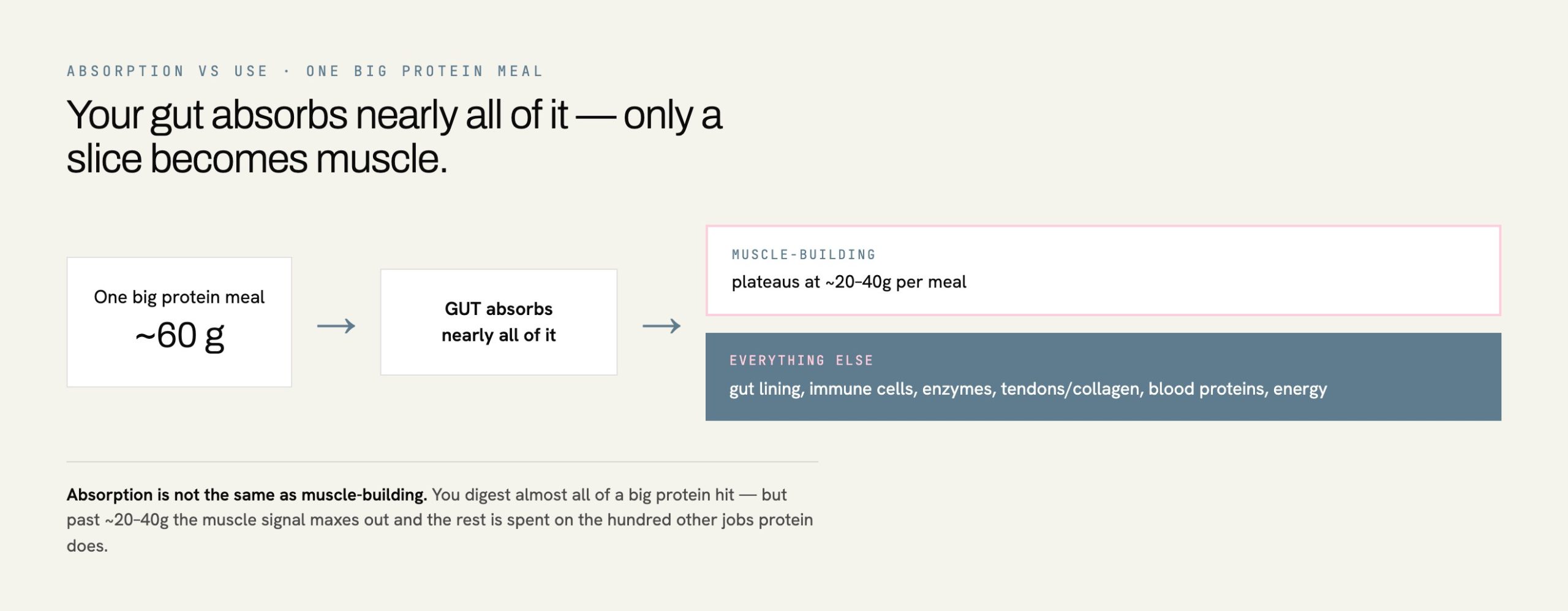
    Diagram showing how much protein you absorb per meal versus how much goes to muscle building
    Diagram showing how much protein you absorb per meal versus how much goes to muscle building

    The study that ate 100 grams and used almost all of it

    If the 30-gram wall were real, one experiment should have broken it wide open — and in 2023 one did, cleanly enough that the argument should be over.

    A team at Maastricht, led by researchers who’ve spent careers on this exact question, fed trained men either 25 grams or a full 100 grams of protein after a workout, then tracked the amino acids with isotope tracers to see where they actually went.[2] If 30 grams were a hard ceiling, the 100-gram group should have absorbed a little and wasted the rest.

    They didn’t. The 100-gram dose produced a bigger and much longer anabolic response — the body was still building tissue more than twelve hours later. The extra protein was absorbed and used, and here’s the kicker: it barely increased how much protein the body broke down or oxidized off. The researchers concluded flatly that the anabolic response to protein has “no upper limit” in the range they tested, and that the field had been underestimating how much a body can use.[2]

    Read that again. A hundred grams in one meal. Absorbed. Used. Not wasted. The 30-gram rule didn’t just get bent — it got demolished by a study designed specifically to test it.

    I wish I’d had that paper backstage in Sweden. In my stage days I carried a cooler of identical little tubs — plain chicken, measured to the gram, one every two and a half hours whether I was hungry or not — because everyone “knew” a bigger meal was throwing protein away. I ate cold, joyless, on a stopwatch, terrified a 50-gram plate would flush half of it down the drain. It wouldn’t have. All that misery was built on a number somebody misquoted from a study I never read. When I found real cooking during lockdown years later, letting a meal just be a proper meal — 45, 50 grams, hot, at a table — was the first thing that felt like freedom.

    The plateau that IS real — and why it still matters

    Now let me be honest in the other direction, because the answer to a myth is never the opposite myth. There is a real ceiling, and it’s worth respecting — it just isn’t about absorption.

    The muscle-building plateau per meal is real. The best current read on it comes from a 2018 meta-analysis by Schoenfeld and Aragon, who pooled the dose studies and landed on a practical number: to maximize muscle building, aim for about 0.4 grams of protein per kilo of bodyweight per meal, spread across at least four meals a day.[3] For most lifters that’s somewhere in the 30-to-50-gram range per sitting. Past that, the marginal muscle-building return per meal drops — even though the protein is still absorbed and still doing other useful work.

    Distribution matters too, at least for squeezing out the last bit of muscle. When Australian researchers gave men the same 80 grams of daily protein three ways — small frequent sips, medium regular meals, or two big boluses — the medium pattern won. Twenty grams every three hours built more muscle over the day than either eight tiny doses or two huge ones.[4] So spreading protein across the day is genuinely smart. Grinding it into eight microscopic doses is not.

    So both things are true, and holding both is the mark of someone who actually read the research:

    The myth saysThe research actually says
    You can only absorb ~30g of protein per mealYou absorb nearly all of it; 100g in a meal is used, not wasted[2]
    Protein over 30g is flushed awayThe “extra” builds gut, immune, tendon, blood proteins or fuels you
    There’s no ceiling worth thinking aboutMuscle-building per meal plateaus around 0.4 g/kg (~30–50g)[3]
    Eat 6–8 tiny protein doses to stay “anabolic”~4 solid meals beats both tiny sips and giant boluses[4]
    Hit the per-meal number or the meal is pointlessDaily total (~1.6 g/kg) is the number that decides your gains[5]

    How much protein per meal you should actually aim for

    Let’s turn the science into something you can weigh out. The target that covers both truths is roughly 0.4 grams per kilo of bodyweight at each of your main meals — enough to max out muscle building, spread across the day so you’re never running on empty, and not so obsessive that you’re eating on a stopwatch.

    Here’s what that looks like for real men at real bodyweights, across four meals:

    Bodyweight~Protein per meal (0.4 g/kg)~4 meals = daily totalRoughly 1.6 g/kg check
    70 kg (154 lb)~28 g~112 g~112 g ✓
    80 kg (176 lb)~32 g~128 g~128 g ✓
    90 kg (198 lb)~36 g~144 g~144 g ✓
    100 kg (220 lb)~40 g~160 g~160 g ✓
    110 kg (243 lb)~44 g~176 g~176 g ✓

    Notice how the per-meal target and the daily target line up on their own when you eat four solid meals. That’s not an accident — the per-meal number was reverse-engineered to add up to the daily one. The daily total is what the research says actually decides your muscle over months: gains from more protein flatten out past about 1.6 grams per kilo per day.[5] If you want your own numbers instead of a table, run them through my protein calculator and it’ll set both the daily total and a sane per-meal split.

    And if a meal runs over the per-meal number — a big weekend ribeye, a post-training feast — relax. That protein isn’t lost. You just won’t get extra muscle from the overflow; you’ll get everything else the body uses amino acids for. There’s no penalty box. Miss high once in a while and the day still adds up fine.

    One more honest note, because I coach a lot of older lifters and men on TRT. The quality of the protein matters more the closer you sit to the per-meal target. Animal proteins — meat, fish, eggs, dairy — are richer in leucine, the amino acid that actually flips the muscle-building switch, so they hit the plateau at a smaller dose than most plant proteins do. If you eat mostly plants, aim a little higher per meal and lean on the higher-leucine sources like soy to make up the difference. And if you’re past fifty, skew toward the top of the per-meal range on purpose: aging muscle needs a firmer knock before it answers, which is a dose argument, never an absorption one. The gut never got old on you. The muscle just got a little harder of hearing.
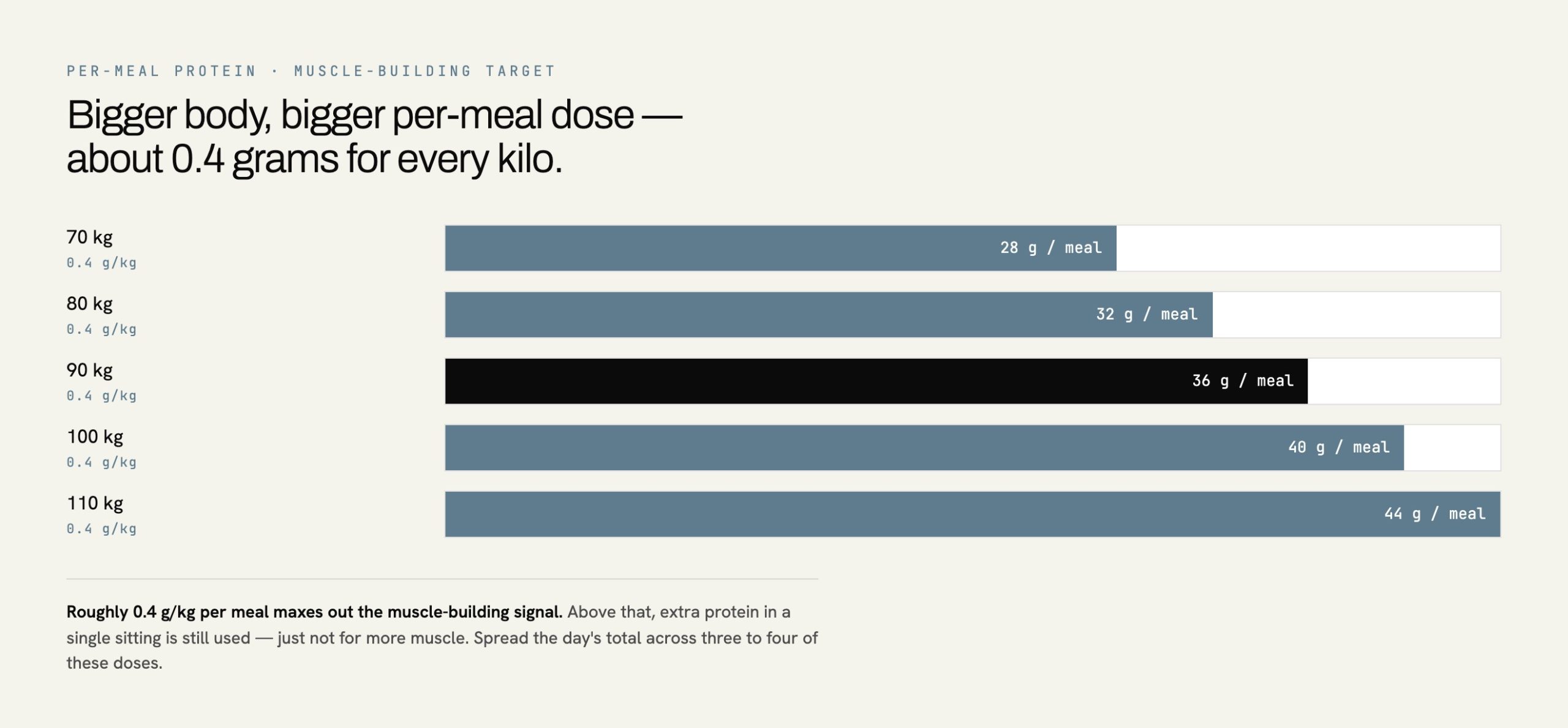
    Bar chart of protein per meal targets by bodyweight for maximizing muscle protein synthesis
    Bar chart of protein per meal targets by bodyweight for maximizing muscle protein synthesis

    The cook’s version: what this means at the counter

    Here’s why I love this myth dying, as a man who cooks for a living now. The 30-gram rule made eating anxious. It turned every plate into a math test you could fail. Killing it hands you back the two things that actually make protein easy: fewer meals, and real ones.

    You don’t need six meals. If your life fits four — or even three big ones — that’s plenty. A 50-gram breakfast is not wasteful; it’s efficient. One of my go-to mornings is a high-protein cottage cheese bowl that lands north of 35 grams before I’ve done anything clever, and I don’t lose a wink of sleep that it “overshot.”

    One big protein meal can carry a chunk of your day. When I make a proper grilled chicken and a big salad, that’s easily 45 to 55 grams of protein on one plate. The myth says half of that is down the drain. The research says all of it’s working — some on muscle, the rest on the hundred other jobs your body runs. Cook the big plate. Enjoy it hot.

    Slow protein is a real tool, not a cheat. The old rule made men afraid of big overnight doses. But a slow-digesting protein like casein trickles amino acids for hours, which is exactly what you want across a long gap like sleep. My casein-loaded overnight oats put a serious slug of protein down before bed on purpose. Your gut handles it fine overnight, precisely as the 100-gram study would predict.

    Kitchen math

    A 200-gram cooked chicken breast is about 60 grams of protein. Under the old myth, half of that was “wasted.” Under the real research, all of it’s absorbed — roughly 40g goes to the muscle-building job and the rest to gut, immune, tendon and blood repair. One breast, one meal, zero waste. Stop cutting your plates in half over a number somebody misquoted.

    None of this changes the fundamentals I bang on about everywhere else. Hit a real protein source at each meal, get your daily total, and let the plate be a plate. If you want that built for you already — the protein, the portions, the whole rhythm across a week — my free 7-day plan does the counting so you don’t have to eat on a stopwatch like I used to. If you’re still not sure whether timing matters at all, I took the wider swing at it in the anabolic window myth — same lesson, different clock. Come get fed, big man. Eat the whole steak.

    Questions men actually ask

    Can your body really only absorb 30 grams of protein per meal?

    No. Your gut absorbs nearly all the protein you eat, regardless of dose — a bigger meal just gets absorbed over more hours. A 2023 study fed men 100 grams of protein in one sitting and found it was absorbed and used, with almost none wasted. The 30-gram figure is a garbled memory of a different finding: that muscle-building per meal, specifically, plateaus around 20–40 grams. Absorption and muscle-building are two separate processes.

    What happens to protein over 30 grams in a meal?

    It gets absorbed like the rest. The portion beyond what maximizes muscle protein synthesis doesn’t disappear — your body uses it to repair the gut lining, make immune cells and enzymes, build tendon collagen, top up blood proteins, or burn it for clean energy. You just don’t get extra muscle from the overflow. Nothing is flushed away unused.

    How much protein per meal is best for building muscle?

    Around 0.4 grams per kilogram of bodyweight per meal maximizes the muscle-building response — roughly 30 to 50 grams for most lifters — spread across about four meals a day. Going higher in a single meal isn’t harmful and isn’t wasted, but it won’t add more muscle from that meal. The number that decides your gains over months is your daily total, which flattens out past about 1.6 g/kg per day.

    Do I need to eat protein every two or three hours?

    No. Research on protein distribution found that medium meals every three hours beat both tiny frequent sips and two giant boluses — but that’s fine-tuning, not a rule you’ll fail by breaking. Three or four solid, protein-anchored meals across your day cover it. You do not need to set an alarm and eat cold chicken on a schedule. I did that for years on stage; it was miserable and it wasn’t necessary.

    Is it bad to eat most of my protein in one or two big meals?

    It’s not harmful, and the protein isn’t wasted — but if maximizing muscle is the goal, spreading it across more meals edges out the concentrated approach slightly. If your schedule only allows two big meals, still eat them; hitting your daily protein total matters far more than perfect spacing. Perfect distribution is the polish, not the foundation.

    Does the 30-gram rule change as I get older?

    Older muscle is a bit more resistant to protein — it takes a slightly larger dose to fully switch on muscle building, which is one reason per-meal targets skew toward the higher end (0.4 g/kg or more) as you age. But that’s an argument for eating more protein per meal, not less, and it still says nothing about an absorption limit. Your gut works fine; your muscle just wants a firmer knock to answer the door.

    References

    1. American Journal of Clinical Nutrition — Moore et al., Ingested protein dose response of muscle and albumin protein synthesis after resistance exercise in young men (2009)
    2. Cell Reports Medicine — Trommelen et al., The anabolic response to protein ingestion during recovery from exercise has no upper limit in magnitude and duration in vivo in humans (2023)
    3. Journal of the International Society of Sports Nutrition — Schoenfeld & Aragon, How much protein can the body use in a single meal for muscle-building? (2018)
    4. Journal of Physiology — Areta et al., Timing and distribution of protein ingestion during prolonged recovery from resistance exercise alters myofibrillar protein synthesis (2013)
    5. British Journal of Sports Medicine — Morton et al., A systematic review, meta-analysis and meta-regression of the effect of protein supplementation on resistance training-induced gains in muscle mass and strength (2018)

    The honest fine print: I’m a cook and a lifter, not your doctor. Nothing here is medical advice, and nothing here tells you how to obtain or use any substance — that conversation belongs to you, your bloodwork, and a physician. Full details: Nutrition Disclaimer · Medical Disclaimer.
    Magnus Olafsson, the cook behind Slim Diet Era
    Written by

    Magnus Olafsson

    The cook behind Slim Diet Era. Former Swedish stage competitor (B&K Classic Body Show, Swedish Grand Prix), on TRT since 35, cooking high-protein food in Chicago for his husband, two kids, and you. He counts the macros so you don’t have to.

    More about Magnus →

    Hungry for a plan, not just a post?

    Start with the free plan — macros counted, grocery list written, in your inbox. You cook and eat; I’ll do the math.
  • The Anabolic Window: Myth or Real? What the Research Actually Says

    The Anabolic Window: Myth or Real? What the Research Actually Says

    BlogMyths & Misconceptions11 min read

    The Anabolic Window: Myth or Real? What the Research Actually Says

    The 30-minute panic was marketing in a lab coat. Here’s what the real literature says about protein timing, and when it actually matters.

    The Anabolic Window: Myth or Real? What the Research Actually Says

    The anabolic window myth is the reason a whole generation of us learned to panic. You finish your last set, and somewhere in the back of your skull a clock starts ticking. Thirty minutes. Maybe forty-five if you’re feeling brave. Miss it and the workout was wasted — that’s what we were told, backstage and in every magazine and in every gym bag that rattled with a half-mixed shaker.

    I believed it for years. I chugged in the parking lot. I’ve mixed whey in a gas-station bathroom because the drive home was thirty-five minutes and I wasn’t about to lose the growth.

    Here’s what the research actually says now, and it’s kinder than the story I grew up on: the window isn’t a window. It’s more like a garage door — hours wide, wider still if you ate before you trained. So put the shaker down for a second, big man. Nobody’s getting shamed for carrying one. Let me walk you through what changed.

    Is the anabolic window real? The short answer, then the honest one

    Short answer: yes, there’s a real thing under the myth. Your muscle is more sensitive to protein after you train it. That part isn’t made up. The question is the anabolic window real was never the interesting one — the interesting question is how long it stays open and how much the exact minute matters.

    The honest answer is that the “30 minutes or it’s wasted” version was marketing wearing a lab coat. When Alan Aragon and Brad Schoenfeld went back through the literature in 2013, they found the importance — and even the existence — of a tight post-workout window depends heavily on context, and that meeting your total daily protein matters far more than hitting a stopwatch.[1]

    So the window is real. It’s just enormous, and forgiving, and most of you are already standing inside it without knowing.

    Where the 30-minute panic actually came from

    I want to be fair to my younger self and to yours, because the panic wasn’t stupid. It came from real science that got stretched too far.

    Early studies fed people protein or carbs right after training and measured a spike in muscle protein synthesis. Real result. Then someone in a marketing meeting turned “your muscle responds after training” into “you have thirty minutes before the anabolic window slams shut,” slapped it on a tub, and sold it to a sixteen-year-old me who’d have believed anything with a Swedish flag and a big arm on the label.

    The worst I ever saw it was backstage in Sweden, at a show, in full bronzer, two of us hunched over a cooler like it was a life-support machine. My buddy had timed his shake to the minute — post-pump, pre-pump, some third shake I never understood — and he spilled half of it down his front with shaking hands and genuinely, actually, almost cried. Not because he was tired. Because he thought he’d missed the window and thrown away a week of prep. That’s what the myth does to a good man. It turns food, the one thing that’s supposed to take care of you, into a threat.

    He hadn’t missed anything. He’d eaten all day. He was fine. But nobody had ever told him the door was wider than a shot glass, so he lived every session braced for a failure that was never coming.

    That’s the part that stays with me. The myth didn’t make him train harder or eat better. It just added fear to something that should have been simple. I moved to Chicago at 16 and kept believing it there too, for years, in a different accent — the panic translated fine. It took actual research, read slowly, to un-learn it.

    How long is the anabolic window, really?

    Here’s the number people actually want. If you’re asking how long is the anabolic window, the useful answer is somewhere in the range of a few hours on either side of your session — not thirty minutes, and not a hard cliff at any point.

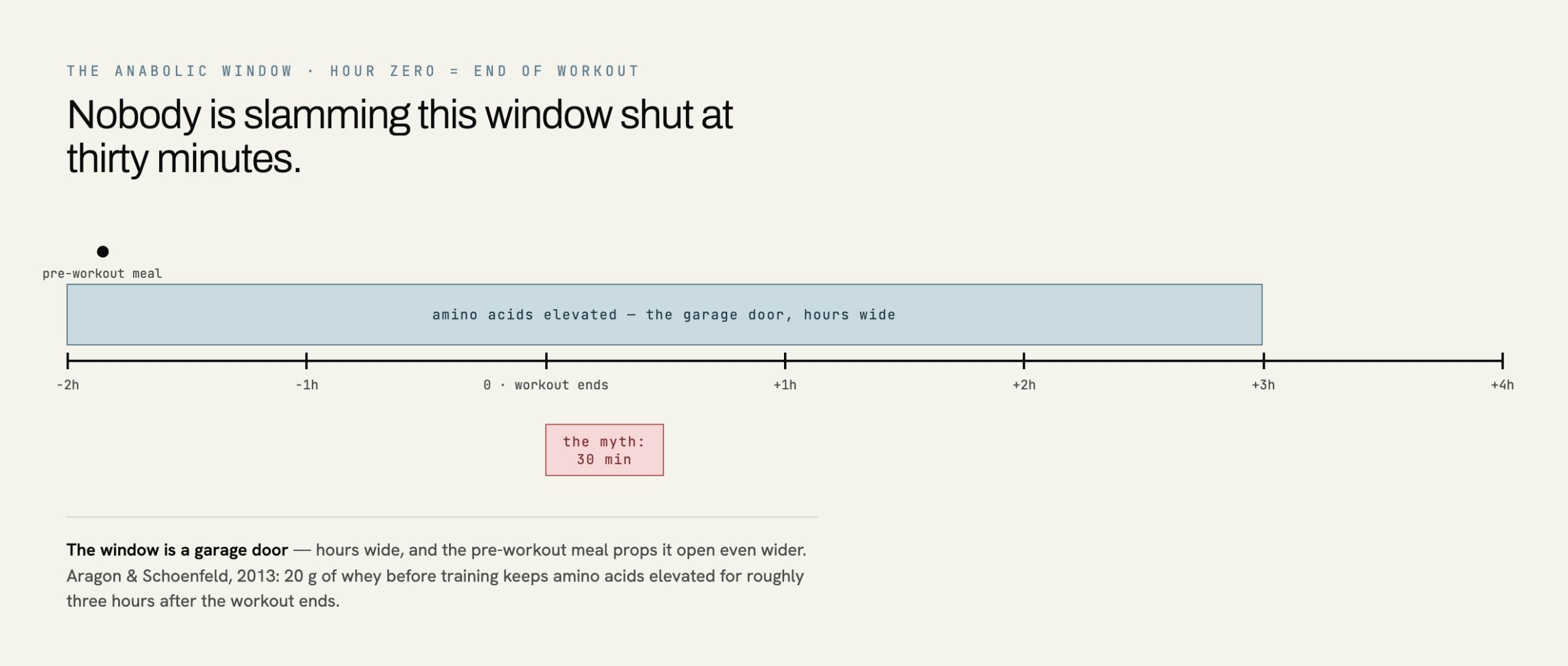
    Aragon’s own analogy is the one I use with everyone in my kitchen: it’s less like a window that snaps shut and more like a garage door that stays open for hours. And what props it open widest is the meal you ate before you trained. In the 2013 review they point to work showing that 20 g of whey taken right before exercise kept muscular amino-acid uptake elevated well into recovery — it didn’t drop back to baseline until about 3 hours after the session.[1]

    Read that again, because it’s the whole thing. If you ate a proper meal one or two hours before you lifted, those amino acids are still circulating on the drive home. The “post-workout window” and the “pre-workout meal” overlap. You could take your time, get home, shower, and eat like a human, and still be well inside it.

    Anabolic window timeline showing the real post-workout window is several hours wide, extended by a pre-workout meal, versus the 30-minute myth
    Anabolic window timeline showing the real post-workout window is several hours wide, extended by a pre-workout meal, versus the 30-minute myth
    Kitchen math

    If your pre-lift meal had 30–40 g of protein in it, your muscle is still working with those amino acids for a couple of hours after your last rep. That’s not me being generous. That’s the timeline in the paper. The stopwatch was never the point.

    What the research says: total protein beats the stopwatch

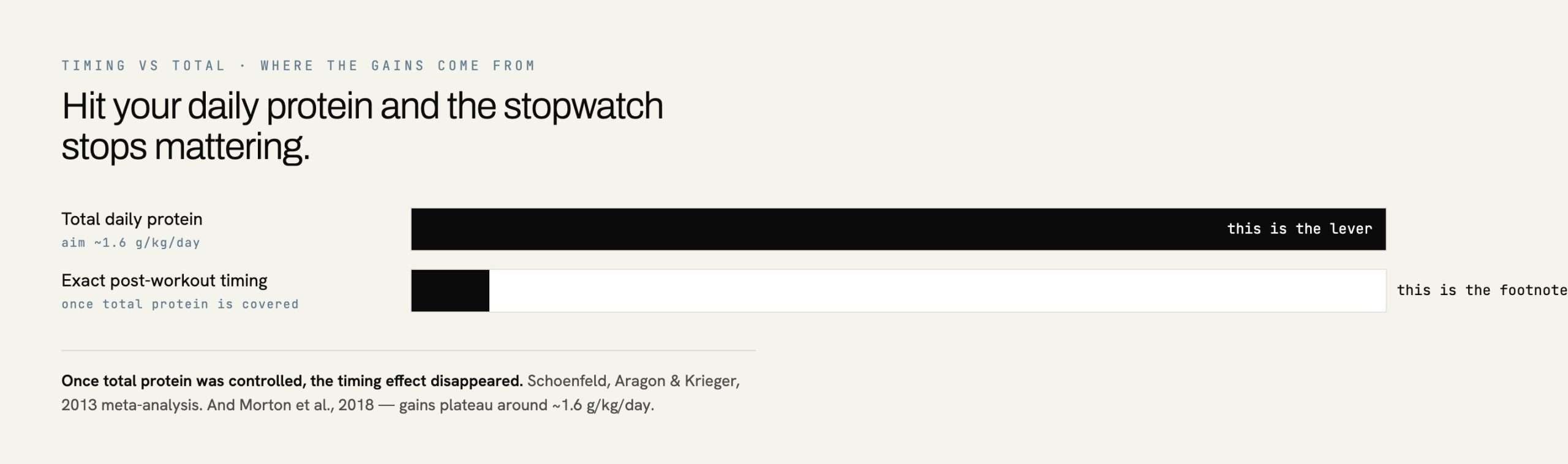
    This is where the myth really falls apart. In 2013, Schoenfeld, Aragon, and Krieger ran a meta-analysis pooling 20-plus studies on protein timing and muscle growth. On the surface, eating protein close to training looked like it helped hypertrophy a little. Then they controlled for one thing — how much total protein each group ate per day — and the timing effect all but vanished.[2]

    Plain version: the groups that “timed” their protein also happened to eat more of it overall. Once you match the total, the clock stops mattering. It was the daily amount doing the work the whole time.

    A bigger 2018 review backs this up from the other direction. Morton and colleagues pooled 49 trials — nearly 1,900 people — and found that gains in muscle and strength kept climbing with protein intake up to about 1.6 g per kg of bodyweight per day, then flattened out. Total intake mattered. Timing and protein source did not move the needle in the pooled data.[3]

    Bar comparison showing total daily protein drives muscle growth far more than exact post-workout timing
    Bar comparison showing total daily protein drives muscle growth far more than exact post-workout timing

    So here’s the hierarchy, honestly ranked, from what actually moves the needle to what barely does:

    What you’re worried aboutHow much it actually mattersWhat to do
    Total protein across the dayMost of itHit roughly 1.6–2.2 g/kg/day, every day
    Spreading it over the daySome3–5 meals, ~0.4 g/kg each
    Eating protein sometime around trainingA littleA meal within a few hours either side
    Hitting a 30-minute post-workout shakeAlmost nothing on its ownDo it if it’s convenient. Don’t panic if it isn’t.

    Notice the shake is on the list. It’s not useless. It’s just at the bottom, and it only ever mattered as a way to help you hit the thing at the top.

    When protein timing genuinely does matter

    I’m not going to pretend timing is nothing, because that’s its own kind of lie, and you’d catch me on it. There are real situations where getting protein around your session earns its keep. If any of these are you, pay a bit more attention to your post workout meal — not with panic, just with a plan.

    You trained fasted

    If you lifted first thing on an empty stomach, the garage door doesn’t have a pre-workout meal propping it open. Amino acids aren’t already circulating. Aragon and Schoenfeld are clear that in this case, eating protein reasonably soon afterward makes more sense — you’re opening the door rather than walking through one that’s already up.[1] This is the one scenario where the old advice was pointing at something true.

    You’re doing two-a-days, or training again soon

    Back when I was prepping for a show in Sweden, I’d sometimes train twice in a day. When your next session is only a handful of hours away, recovery between them matters more, and you don’t want to leave a long gap with no protein in you. Feed the first session so it’s ready for the second.

    You’re an older lifter

    This one’s personal, and it’s why I take it seriously. As we age, muscle gets a little deaf to protein — it takes more to get the same anabolic signal. I’m 40, I’ve been on TRT since I was 35, and I feel the difference in how I have to eat now versus at 22. Older muscle responds better to solid, protein-forward meals spread through the day rather than one big hit and a long fast. Timing here is really just insurance that you don’t go too long without feeding it.

    Anyone who wants the last 5%

    And there’s distribution — the quiet middle ground between “timing is everything” and “timing is nothing.” Areta and colleagues fed trained men 80 g of whey over 12 hours in three patterns: little and often, medium and steady, or big and rare. The winner was the sensible middle: 20 g every 3 hours beat both eight tiny 10 g feeds and two giant 40 g ones for keeping muscle protein synthesis high.[4]

    That’s the practical takeaway hiding under all the noise. Not “chug within 30 minutes.” Just: eat a real amount of protein every few hours, and your training will always land inside a fed window without you thinking about it.

    Schoenfeld and Aragon put a number on that middle ground in a later paper. Their recommendation is to aim for about 0.4 g of protein per kg of bodyweight per meal, across at least four meals, to comfortably clear a good daily total.[5] For a 90 kg man that’s roughly 35 g a meal, four times a day. Do that and one of those meals lands near your workout by default — no timing required, no clock, no shaker anxiety in a parking lot. You built the window into your day without trying.

    And notice what that quietly kills: the old “you can only use 30 g of protein per meal, the rest is wasted” line. Same family of myth as the window. The 2018 paper walks through why a bigger meal isn’t thrown away — slower-digesting protein eaten with other food keeps feeding you for hours.[5] Your body is smarter and more patient than the supplement ad wanted you to believe.

    What happens if you miss the anabolic window?

    Nothing dramatic. That’s the honest answer, and I wish someone had said it to my crying friend backstage.

    If you hit your total protein for the day, missing the “immediate post-workout shake” costs you next to nothing measurable. The meta-analysis found the timing effect disappeared once total intake was matched.[2] One missed shaker against a whole day of good eating is a rounding error. You did not throw away the session. You did not throw away the week.

    The only version of “missing it” that actually costs you is chronic — going most of the day eating too little protein, session after session, week after week. That’s not a timing problem. That’s a total problem, and it’s fixable at any meal, not just the one after the gym.

    Magnus’s rule

    Don’t chase the perfect post-workout minute. Chase the honest daily total. Get your protein in across the day — three, four, five real meals — and every workout you do will already be sitting comfortably inside the window. The stopwatch was a tax on people who were already doing fine.

    How I actually eat around a lift

    Since I’m telling you not to panic, let me show you what “not panicking” looks like on a plate. This is roughly how I do it, whether I’m just on my TRT dose or running something heavier.

    • A real meal one to two hours before. Protein and carbs. That’s the meal doing most of the work of “post-workout nutrition” before you’ve even started.
    • Water and maybe some carbs during, if it’s a long one. No heroics.
    • A proper meal within a couple of hours after. Not a stopwatch. A shower, a drive, then food. On a lazy day it’s a bowl of high-protein cottage cheese with fruit while I get dinner going.
    • The rest of the day’s protein spread out. Breakfast pulls its weight — peanut butter protein oats or a stack of high-protein pancakes — so I’m never scrambling to cram it all in around the gym.

    On heavy training blocks when I’m genuinely hungry and chasing calories, I lean on things that make the total easy without a fight: mass-gainer overnight oats the night before, ready in the fridge. And yes, I still keep a tub of whey. Not for the magic 30-minute window — because it’s a fast, easy 25 g when a meal isn’t practical. That was always all the shaker was for.

    If you want the whole thing planned so you never have to think about timing again, that’s exactly what our recipe kitchen is built for — protein-forward meals with honest numbers, so your total takes care of itself and the window takes care of itself right along with it.

    Questions men actually ask

    Is the anabolic window a real thing?

    There’s a real effect under it — muscle is more sensitive to protein after training. But the “30 minutes or it’s wasted” version is a myth. The window is hours wide, not minutes, and hitting your total daily protein matters far more than the exact timing.

    How long is the anabolic window?

    Roughly a few hours on either side of your session, not 30 minutes. If you ate a protein meal one to two hours before training, amino acids stay elevated into recovery — one study kept them up until about 3 hours after exercise. Think garage door, not window.

    What happens if you miss the anabolic window?

    If you hit your protein total for the day, almost nothing. When researchers matched total daily protein between groups, the timing effect essentially disappeared. One missed post-workout shake against a full day of good eating doesn’t cost you the session.

    Does the anabolic window matter more on TRT or on cycle?

    The timing rules don’t change — total daily protein still leads. What changes with age and hormones is appetite and how much protein it takes to get a response. Older and enhanced lifters do better with steady, protein-forward meals through the day. That’s about distribution, not a magic post-workout minute.

    Should I drink a protein shake right after lifting?

    You can, and it’s a fine habit — a shake is an easy 25 g of protein. Just know you’re doing it to help hit your daily total, not to beat a closing window. If you trained fasted, a shake soon after makes more sense. If you ate before you lifted, there’s no rush.

    References

    1. Journal of the International Society of Sports Nutrition — Aragon AA, Schoenfeld BJ. Nutrient timing revisited: is there a post-exercise anabolic window? (2013)
    2. Journal of the International Society of Sports Nutrition — Schoenfeld BJ, Aragon AA, Krieger JW. The effect of protein timing on muscle strength and hypertrophy: a meta-analysis (2013)
    3. British Journal of Sports Medicine — Morton RW, et al. A systematic review, meta-analysis and meta-regression of protein supplementation on resistance training-induced gains in muscle mass and strength (2018)
    4. The Journal of Physiology — Areta JL, et al. Timing and distribution of protein ingestion during prolonged recovery from resistance exercise alters myofibrillar protein synthesis (2013)
    5. Journal of the International Society of Sports Nutrition — Schoenfeld BJ, Aragon AA. How much protein can the body use in a single meal for muscle-building? Implications for daily protein distribution (2018)
    The honest fine print: I’m a cook and a lifter, not your doctor. Nothing here is medical advice, and nothing here tells you how to obtain or use any substance — that conversation belongs to you, your bloodwork, and a physician. Full details: Nutrition Disclaimer · Medical Disclaimer.
    Magnus Olafsson, the cook behind Slim Diet Era
    Written by

    Magnus Olafsson

    The cook behind Slim Diet Era. Former Swedish stage competitor (B&K Classic Body Show, Swedish Grand Prix), on TRT since 35, cooking high-protein food in Chicago for his husband, two kids, and you. He counts the macros so you don’t have to.

    More about Magnus →

    Hungry for a plan, not just a post?

    Start with the free plan — macros counted, grocery list written, in your inbox. You cook and eat; I’ll do the math.