
Creamy Chicken Pasta (the bulk one)
A proper creamy chicken pasta that loves you back on a bulk — 53 grams of protein and 710 calories a plate, with the sauce made from cottage cheese instead of a tub of double cream. Big, comforting, and easy to eat a lot of when you’re trying to grow.
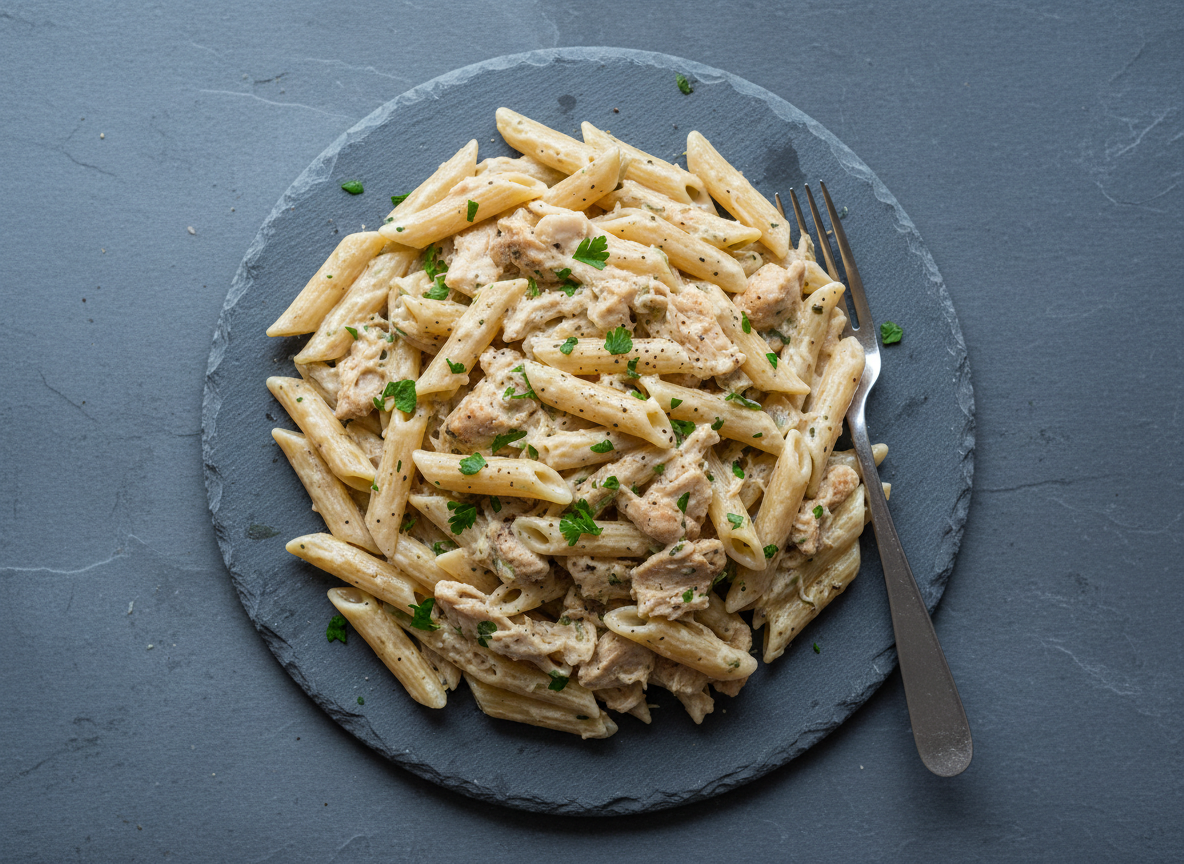 Plate 01 / Finished
For years I thought a bulk meal had to be either delicious or sensible, never both. I’d choke down dry chicken and rice all week to keep my numbers clean, and then on a Friday I’d cave and eat a creamy pasta so heavy it sat in my chest till morning. One or the other. That was the deal I’d made with myself, and it was a bad deal.
The fix came on a slow afternoon in my kitchen in Stockholm, when I had a tub of cottage cheese in the fridge and no cream, and I was too lazy to go out into the cold for it. So I blended the cottage cheese smooth, warmed it gently with a little pasta water and garlic, and folded it through the noodles with the chicken. It went silky. It clung to the pasta like a real cream sauce. And it carried about three times the protein of the thing I’d been hiding from.
This is the bulk one, love — the version I cook when I want to grow and still want to enjoy my dinner like a person. It’s big, it’s warm, it’s properly creamy, and the macros do real work. I’ve fed it to lifters twice my appetite and watched them go quiet and happy. Cook it once on a cold night and I think it’ll earn a permanent spot in your week. I’ve got you.
01Who it’s for & when to eat it
This plate is built to add calories without making you miserable. The sauce and chicken stay the same; what you change is how much pasta sits underneath. Here’s how I steer it.
The default plate
A full 100g of dry pasta per person, the whole sauce, plenty of chicken. This is easy, calorie-dense fuel that still lands over 50g of protein. My go-to on a heavy training day when the appetite is finally there.
Pull it back
Drop the pasta to 60g dry and swap in a pile of courgette ribbons for volume. Same creamy sauce, far fewer calories, still a lot of protein. See the variations below for the numbers.
Steady portion
A middle plate — 75g dry pasta, a normal serving of chicken, a handful of spinach stirred in. Balanced carbs and protein for a satisfying evening meal that won’t overshoot.
Timing: this is a brilliant post-training dinner — the carbs help you recover and the protein does the building. It’s also one of the few pasta dishes that reheats genuinely well, so it pulls double duty as next-day lunch.
02Ingredients
Makes 2 big plates. The sauce is built on cottage cheese, so keep that the star — everything else scales around it. Want more? Multiply every line and keep the ratio.
Servings 2 · adjust on the live recipe card- Chicken breast, diced300 g · 10.6 oz
- Dried pasta penne or fusilli200 g · 7 oz
- Cottage cheese full-fat or low-fat250 g · 8.8 oz
- Garlic, grated3 cloves
- Grated parmesan30 g · 1 oz
- Olive oil1 tbsp · 15 ml
- Reserved pasta water120 ml · ½ cup
- Baby spinach2 handfuls · 60 g
- Black pepperto taste
- Saltto taste
Swaps I actually use: blended low-fat cottage cheese shaves fat for a leaner plate; full-fat eats richer. No parmesan? A spoon of nutritional yeast or any hard cheese works for the savoury hit. Chicken thigh in place of breast eats juicier but adds fat — fine on a bulk. For a higher-protein noodle, reach for a chickpea or lentil pasta; it changes the flavour a little but pushes the protein up.
03Step by step
Get the water on first
Bring a big pot of salted water to the boil and cook the pasta to just shy of the packet time — you want it with a little bite, because it’ll finish in the sauce. Before you drain, scoop out a mug of the starchy water. That water is the secret to a silky sauce, so don’t tip it all away.
Magnus says: reserve more pasta water than you think you need. You can always leave it; you can’t get it back.
Cottage cheese, smooth as cream
While the pasta cooks, blitz the cottage cheese in a blender or with a stick blender until it’s completely smooth — no curds left. This is what turns a lumpy tub into a glossy cream sauce. Set it aside for now.
Magnus says: don’t skip the blending. Smooth is the whole trick; lumpy cottage cheese stays lumpy in the pan.
Sear it golden in one layer
Heat the olive oil in a wide pan over a medium-high heat. Season the diced chicken and lay it in one layer so it browns rather than steams. Leave it alone for a couple of minutes, then turn and cook through. Pull it out onto a plate.
Garlic, then the blended cheese
Lower the heat. Add the grated garlic to the same pan and stir for thirty seconds until it smells sweet — don’t let it brown. Pour in the blended cottage cheese and a splash of the reserved pasta water, then stir in the parmesan. Warm it gently; keep it on a low heat so it stays creamy and doesn’t split.
Magnus says: low and slow with the sauce. Boil it hard and the cheese can turn grainy.
Pasta, chicken, spinach, toss
Add the drained pasta, the chicken and the spinach to the pan. Toss everything through the sauce, loosening with more pasta water a splash at a time until it coats every piece. The spinach will wilt in under a minute. Taste and season.
Plate it hot, crack of pepper on top
Divide between two warm bowls, grate a little more parmesan over if you like, and finish with a generous crack of black pepper. Eat it straight away while the sauce is glossy and loose.
Magnus says: it thickens as it sits, so serve it slightly looser than you think. A splash of water revives leftovers too.
04The spec sheet
Real numbers, calculated — not guessed. The recipe makes 2 plates, about 700g of finished food total. Here’s what one serving (~350g) and a flat 100g actually give you.
| Nutrient | Per serving | Per 100g |
|---|---|---|
| Energy | 710 kcal | 203 kcal |
| Protein | 53.0 g | 15.1 g |
| Carbohydrate | 78.0 g | 22.3 g |
| — of which sugars | 5.0 g | 1.4 g |
| Fat | 18.0 g | 5.1 g |
| — of which saturates | 6.5 g | 1.9 g |
| Fibre | 4.5 g | 1.3 g |
| Sodium | ~0.62 g | ~0.18 g |
Moderate. High enough to make hitting a surplus easy, but not so dense you can’t finish a satisfying bowl — exactly what you want when you’re trying to grow without forcing food.
Strong for a creamy pasta. The cottage-cheese sauce is doing the heavy lifting here — it turns a carb-heavy plate into a genuinely high-protein meal.
- Calcium~280 mg · 28% DV
- Selenium~52 µg · 95% DV
- Niacin (B3)~16 mg · 100% DV
- Phosphorus~480 mg · 69% DV
- Vitamin B12~1.4 µg · 58% DV
- Folate~95 µg · 24% DV
Macros are calculated from standard food-composition data and will shift a little with your exact ingredients and brands. Micronutrient figures are estimates against general adult Daily Values. Numbers are for guidance, not medical advice — see our Nutrition Disclaimer.
05Bulk / Cut / TRT variations
One sauce, three jobs. The creamy base and chicken stay the same — you move the pasta up or down and add or drop volume. Macros below are for a full serving.
The full plate
The recipe as written — 100g dry pasta per person, the whole sauce, plenty of chicken. Add a second drizzle of olive oil if you need the calories higher still. Easy, comforting fuel for growing.
Lighter & loaded with veg
Drop the pasta to 60g dry and bulk the bowl out with courgette ribbons or extra spinach. Use low-fat cottage cheese. You keep the creamy comfort and most of the protein for far fewer calories.
Steady & balanced
A middle plate — 75g dry pasta, a normal portion of chicken, spinach stirred through. Balanced carbs and protein that fill you up for an evening meal without pushing the calories too high.
06Meal prep & storage
This is one of the rare creamy pastas that genuinely reheats well, because the cottage-cheese sauce doesn’t break the way a flour-and-cream one does. I batch it for two or three days at a time.
Store in an airtight container once cooled. The sauce tightens as it chills — that’s normal, it loosens back up on reheat.
Freezes acceptably, though the texture is best fresh. Thaw overnight in the fridge before reheating gently.
Reheat in a pan over low heat with a good splash of water or milk, stirring until the sauce goes creamy again. Microwave works too — add liquid first.
For meal prep, I portion it into boxes the moment it’s cooled and always tuck a little splash of water in to add when I reheat. That one move is the difference between a creamy lunch and a dry one on day three.
Want a whole week built around food like this?
Drop your email and I’ll send you my free 7-day plan — meals, macros already counted, grocery list written. No spam, no lectures.
No spam. Unsubscribe whenever. See what’s in the plan →
07Common questions
Won’t the cottage cheese taste sour? +
Once it’s blended smooth and warmed with garlic and parmesan, the tang mellows right out — most people can’t tell it isn’t cream. If you’re sensitive to it, use a milder full-fat cottage cheese and lean on the parmesan and pepper. It reads as a savoury, creamy sauce, not a sour one.
My sauce went grainy — what happened? +
Two usual culprits: the cheese wasn’t blended smooth to start with, or the pan got too hot and the sauce boiled. Keep the heat low once the cheese goes in, and always blitz it first. If it has split a little, a splash of cold pasta water and a brisk stir off the heat usually brings it back.
Can I make this higher protein still? +
Yes. Swap the regular pasta for a chickpea or lentil one and you’ll add roughly 10–15g of protein per serving, plus more fibre. You can also stir an extra 50g of blended cottage cheese into the sauce. Both keep the creamy texture and push the numbers up.
What pasta shape works best? +
Anything with ridges or hollows that grab the sauce — penne, fusilli, rigatoni. Long pasta like spaghetti works too but holds less sauce per bite. Cook it just shy of done so it finishes in the pan and soaks up flavour.
Can I use leftover or rotisserie chicken? +
Absolutely — it makes this a ten-minute meal. Skip the searing step, build the sauce, and fold the shredded cooked chicken in at the end just to warm through. The macros land in the same ballpark depending on the cut you use.
This pasta lives inside a full week of meals.
This creamy chicken pasta is one plate in my 7-day bulking plan — seven days of high-protein, calorie-dense meals with the macros counted and the grocery list written. You pick the goal; I do the maths.
See the bulking meal plan →08Pairs well with

Magnus Olafsson
I’m Magnus — twenty years under the iron, from a cold gym in Stockholm to the classic-physique stage, and now mostly in my kitchen in a pink apron. I’ve cut for shows, bulked through winters, and I’ve been on TRT since I was thirty-five. I know what it takes to eat for the body you’re chasing, and I know it shouldn’t come with a side of shame.
Everything here is food I actually cook and macros I actually count. I don’t diagnose, I don’t promise, and I never make a number up. I just feed you well and tell you the truth.
Slim Diet Era shares recipes and general nutrition information. It is not medical or dietetic advice, and we do not provide guidance on obtaining or using any controlled substance. See our Medical Disclaimer and Nutrition Disclaimer.