Dirty Bulk vs Clean Bulk: The False War
The war is fake: your surplus size and protein decide your gains, not whether the food is ‘clean’ or ‘dirty.’

Dirty bulk vs clean bulk. I’ve watched grown men argue about this in gym car parks like it’s a matter of faith. One camp says shovel in everything that isn’t nailed down and let the size come. The other says every gram has to be pristine — chicken, rice, broccoli, no exceptions, or you’re doing it wrong. Both of them are half-right, and both of them are missing the one number that actually decides how the next few months go.
Here’s the thing nobody wants to hear: the war between clean and dirty is mostly fake. The word “clean” doesn’t have a magic muscle-building property, and the word “dirty” doesn’t carry a curse. What separates a good bulk from a soft, regrettable one isn’t the label on the food. It’s the size of the surplus you’re eating in, and whether you’re getting enough protein to build with.
Let me walk you through it, because I’ve done this the stupid way and the sane way, and I’d rather you skip the stupid part.
What “clean bulk” and “dirty bulk” actually mean
Strip the tribalism off and the two words are describing food quality, not physics.
A dirty bulk is eating in a big surplus without much regard for what the food is. Pizza, ice cream, fast food, whatever gets the calories in fast. The logic is simple and not entirely wrong: more calories, more raw material, more size.
A clean bulk is eating in a surplus while keeping the food mostly whole and lean. Rice, oats, potatoes, meat, eggs, fruit. The logic there is also not entirely wrong: better food, better digestion, more nutrients, less fat.
Notice what neither word actually tells you. Neither one tells you how big the surplus is. And that omission is where the whole clean bulk vs dirty bulk debate quietly falls apart, because the surplus size is the part that decides whether you end up muscular or just heavier.
The size of the surplus decides your fat gain — not the food’s reputation
This is the heart of it. When researchers actually feed people different amounts and measure what happens, the story isn’t “clean food good, dirty food bad.” The story is “how far over maintenance you ate.”
Garthe and colleagues took elite athletes through a weight-gain block. One group got structured nutritional counseling pushing a real surplus; the other ate more casually. The counseling group ate more, so they gained more bodyweight — but here’s the punchline: their fat mass shot up about five times more than the other group’s (a 15% rise versus 3%), while the actual lean body mass gain was no different between the two.[1] The extra calories didn’t buy extra muscle. They bought fat.
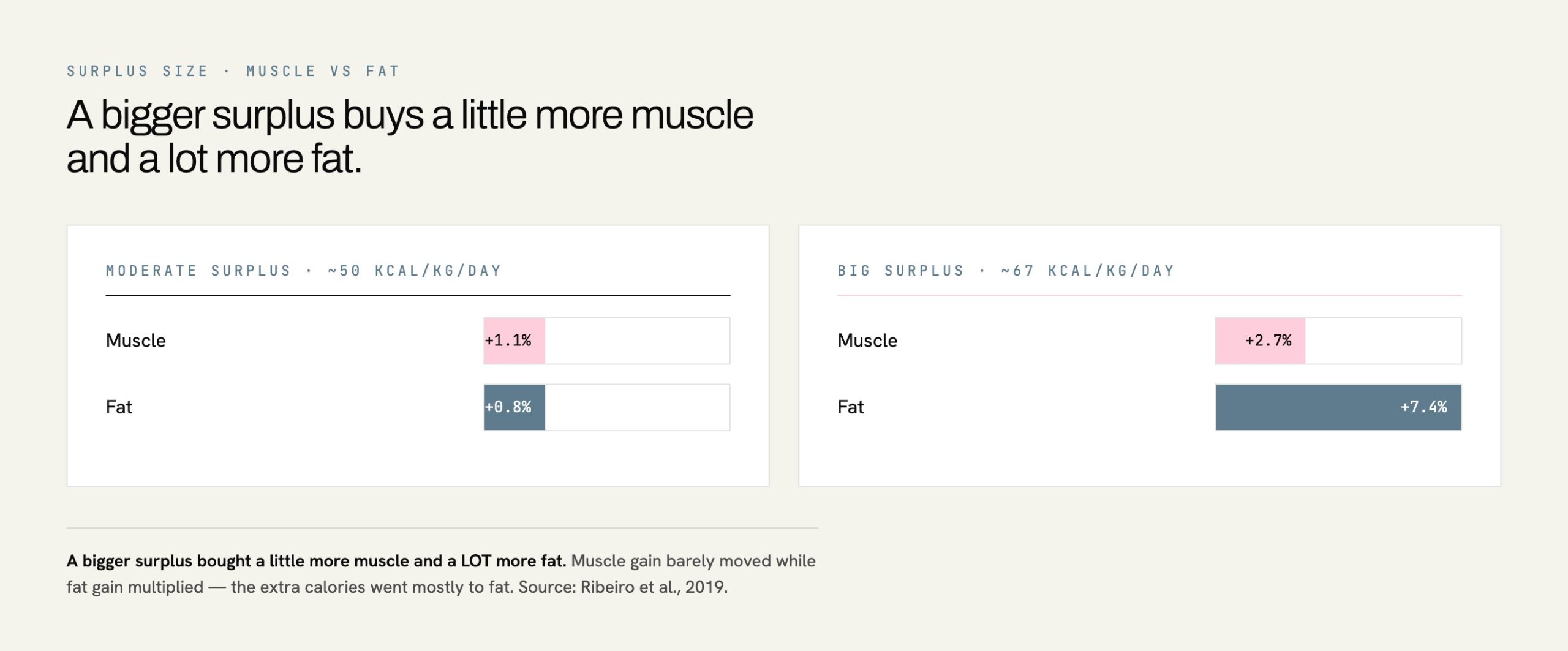
Ribeiro’s team ran the same idea with competitive male bodybuilders. Two groups, both lifting hard six days a week for a month, both in a surplus — one moderate, one big. The big-surplus group did gain a little more muscle (about 2.7% versus 1.1%). But look at what came with it: body fat jumped 7.4% in the big group versus 0.8% in the moderate one.[2] A sliver more muscle, and a mountain more fat to diet off later.
Read those two studies together and the moral writes itself. Push the surplus higher and you don’t get proportionally more muscle. You mostly get more of the stuff you’ll spend all spring cutting away. The dirty-bulk promise — “more is more” — is true only for the fat.
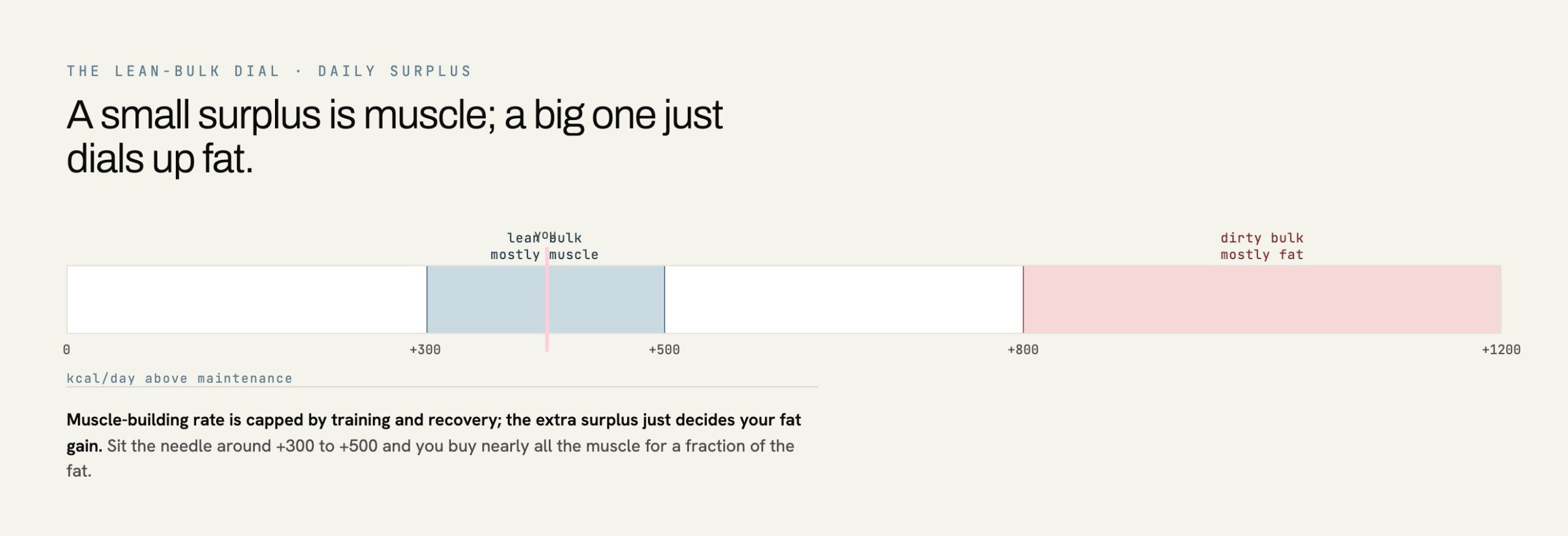
A “clean” chicken-and-rice plate and a “dirty” burger can land on the exact same calories and the exact same protein. If they do, your body can’t tell them apart at the scale that matters. Eat either one in a 1,200-calorie daily surplus and you’ll gain fat. Eat either one in a moderate 300–500 surplus and you’ll gain mostly muscle. The food’s reputation was never the variable. The math was.
A bigger surplus doesn’t grow muscle faster
The unspoken belief under every dirty bulk is that muscle grows faster if you flood the system. Eat enough and the extra has to go somewhere good, right?
Muscle doesn’t work on a shovel. It grows at a rate set by your training, your recovery, your age, your hormones — and above a fairly modest amount of extra food, more calories don’t speed it up. Slater and colleagues went looking for how big a surplus you truly need to maximize hypertrophy, and their honest answer was: not much. They point out that muscle growth is even possible in a slight energy deficit for some lifters, especially those newer to training or carrying extra body fat, and they advise a conservative surplus of roughly 1,500–2,000 kJ a day — call it 360–480 calories — to keep fat gain in check.[3]
That’s it. A few hundred calories over maintenance. The building rate is capped by biology, not by how much you can force down. Anything beyond that ceiling isn’t extra fuel for muscle — it’s just storage.
So the clean-bulk purists and the dirty-bulk gluttons are arguing about the wrong thing. Neither the pristine plate nor the pile of junk changes the ceiling. Only the surplus size decides how much fat rides along under it.
Where “clean” eating genuinely earns its keep
Now let me defend the clean-eating camp, because I don’t want you to hear “the food doesn’t matter” and go face-first into a month of drive-thru. Food quality matters. It just doesn’t matter in the way the myth claims. It’s not a magic anabolic switch. It’s four practical things.
Satiety — can you even eat this much?
Whole foods fill you up. That’s a problem on a cut and a gift on a bulk, depending on the day. Lean meat, oats and potatoes let you hit a real surplus without feeling sick, and they stop you from accidentally eating a 1,500-calorie surplus off ice cream because it never filled you up in the first place. Clean food helps you control the surplus — which, as we just covered, is the thing that actually counts.
Digestion — the unglamorous truth
Eat a genuine surplus off greasy junk for a couple of weeks and your gut lets you know. Bloat, sluggishness, sleep that doesn’t feel like sleep. Try training hard through that. Mostly-whole food keeps the plumbing calm, and calm plumbing means you actually recover from the sessions that grow you.
Micronutrients — the part you don’t feel until it’s gone
A dirty bulk can be a vitamin desert. You can be eating 4,000 calories a day and still be short on the potassium, magnesium, fiber and micronutrients that keep your blood pressure, your energy and your recovery where they should be. This is exactly why the off-season nutrition reviews put real weight on food quality and micronutrient coverage even during a mass phase.[4] Whole food isn’t magic for muscle. It’s insurance for everything else.
Body composition you can live with
Eat mostly well and your surplus tends to stay honest, because whole food is self-limiting. Eat mostly junk and the surplus tends to creep, because junk isn’t. That’s the real mechanism behind “clean bulkers stay leaner.” It was never the cleanliness. It was that clean food quietly kept the surplus small.
Protein is the one thing you can’t fudge either way
Whatever camp you sit in, there’s one input that isn’t optional, and it’s the input both camps forget to actually count. You can’t build the muscle without enough protein, and no amount of surplus — clean or dirty — makes up for coming in short.
Morton’s big meta-analysis pooled 49 studies and found gains in muscle and strength climbing with protein intake up to about 1.6 grams per kilo of bodyweight per day, then leveling off.[5] The off-season bodybuilding review lands in the same neighborhood, recommending 1.6–2.2 g/kg/day during a growth phase.[4] For a 90 kg man that’s roughly 145–200 g of protein a day, every day, whether the rest of the plate is quinoa or a cheeseburger.
Here’s the trap. A dirty bulk is easy to do with rubbish protein — a day of pizza and soda can hit 4,000 calories and still leave you 60 g of protein short. And a paranoid clean bulk can be so obsessed with “clean” that it forgets to count the total. Both miss because both stopped watching the two numbers that decide everything: the surplus and the protein. Get those right and the clean-versus-dirty question stops being interesting.
Lean bulk: the sane middle that ends the war
So we throw out the false choice and keep what’s true from both sides. Take the moderate surplus that keeps fat off, take the food quality that keeps you full, recovered and nourished, and pin the protein. That’s a lean bulk, and it’s what I’d steer any man toward who asks me clean bulk vs dirty bulk like there’s a right team to join.
The numbers, from the off-season research, are refreshingly plain. Run a hyper-energetic diet of about 10–20% over maintenance, aim for a weight gain of roughly 0.25–0.5% of your bodyweight per week if you’re a beginner or intermediate, and go more conservative than that if you’re already advanced and closer to your ceiling.[4] For a 90 kg lifter that’s about a pound of gain every week or two, not five pounds a month of who-knows-what.
| Dirty bulk | Strict clean bulk | Lean bulk (the sane middle) | |
|---|---|---|---|
| Surplus size | Big & uncounted | Often too timid to grow | ~10–20% (≈300–500 kcal) |
| Weekly weight gain | Fast, mostly fat | Slow or none | ~0.25–0.5% bodyweight |
| Muscle gained | Capped by biology anyway | Capped if surplus too small | Same ceiling, hit cleanly |
| Fat gained | A lot to diet off later | Minimal | Minimal |
| Protein | Often accidentally low | Usually fine | 1.6–2.2 g/kg/day, counted |
| What actually varies | Not the food’s label — the surplus size and whether you hit protein | ||
I earned this opinion the expensive way. As a young lifter back home in Sweden, chasing size before a show, I dirty-bulked with real conviction. Everything went in. I was proud of the scale. Then I stood in front of a mirror under stage lights and realized most of what I’d “gained” was a coat I now had to peel off, week after miserable week of dieting, while my strength drained out with the fat. I’d bought fat at full price and paid for it twice. Years later, on TRT since I was 35 and running something heavier from time to time, the temptation came back louder — the appetite on a cycle is a real thing, and it whispers “just eat, you’ll grow into it.” I don’t listen anymore. I hold the surplus moderate and let the training do the growing. The pink apron came out during lockdown, and cooking taught me the lesson the stage started: you don’t need a bigger plate. You need the right-sized one.
You don’t need expensive “clean” food to do this right
Here’s the part that matters if you’re a beginner or watching your grocery bill, because the clean-bulk crowd has quietly convinced a lot of men that building muscle requires a cart full of pricey health-store food. It doesn’t.
Your body responds to calories, protein and micronutrients — not to how much the food cost or how photogenic it is. Some of the best bulking food on earth is dirt cheap:
- Eggs and whole milk — protein, calories and micronutrients per dollar that almost nothing beats.
- Rice, oats and potatoes — clean, cheap surplus calories that fill you without wrecking you.
- Ground beef and chicken thighs — the thigh and the 80/20 mince are cheaper than the “lean” cuts and get the protein and the calories in at the same time, which is exactly what a bulk wants.
- Beans, lentils and canned fish — protein, fiber and minerals for pocket change.
None of that is expensive, and none of it is “dirty.” The whole premium-food story was always a bit of theater. What builds you is boring, affordable, and sitting in the cheap aisles.
Stop asking whether the food is clean or dirty. Ask two questions instead. Am I in a moderate surplus, gaining maybe half a percent of bodyweight a week? And am I hitting my protein, north of 1.6 grams per kilo? If both answers are yes, you’re doing it right, whether tonight’s plate is grilled cod or a burger. If either answer is no, no amount of “clean” fixes it.
How I actually build a plate on a bulk
Let me show you what the sane middle looks like as food, because “moderate surplus, high protein” is easy to say and easy to fumble on a Tuesday night.
The move I lean on hardest is building meals that carry real calories and real protein without turning into a fat-only feast. A bulking smash burger bowl is my answer to the dirty-bulk craving — it scratches the exact itch a fast-food run does, but the protein’s counted and the surplus stays honest. When I’m just chasing volume of clean calories, high-volume beef and rice power bowls do the heavy lifting: cheap, huge, easy to hit a big protein total in one bowl. And on the days I want the flavor of a “cheat” without the guilt-and-diet-later tax, a loaded beef burrito bowl lands the calories with the beans and rice doing honest work.
That’s the whole trick. Food that feels like a dirty bulk — big, satisfying, the stuff you actually want to eat — built to the numbers of a lean one. If you want the surplus and protein figured out for your bodyweight instead of guessed at, run your numbers through the bulking calculator first, and if you want the whole week of plates built around a moderate surplus, my bodybuilding meal prep approach is how I keep it repeatable without thinking about it.
The false war between clean and dirty was always a distraction from the two numbers that decide the whole thing. Get the surplus right, get the protein in, and eat food you’ll actually keep eating. If you’d rather not do the math yourself, grab a free plan and I’ll set the surplus and the protein for you — then you can stop arguing about the label on the food and get on with the growing.
Questions men actually ask
Is a clean bulk or a dirty bulk better for building muscle?
Neither, on its own. The food label isn’t what builds muscle — the size of your calorie surplus and your total protein are. Studies show a bigger surplus adds mostly fat, not proportionally more muscle. A “lean bulk” (moderate surplus, high protein, mostly whole food) takes the best of both and is what I’d recommend to almost anyone.
How big should my calorie surplus be on a bulk?
Modest. The research points to roughly 10–20% over maintenance, or about 300–500 calories a day, aiming for around 0.25–0.5% of your bodyweight gained per week. Go bigger and you mostly buy fat you’ll have to diet off later, because your muscle-building rate is capped by training and recovery, not by how much you can eat.
Do I gain muscle faster if I eat way more calories?
No. Above a modest surplus, extra calories don’t speed muscle growth — they just add fat. In one bodybuilder study the big-surplus group gained a tiny bit more muscle but nearly ten times the body fat of the moderate group. The ceiling on muscle is set by your training, not your plate size.
Do I need expensive “clean” food to bulk properly?
Not at all. Your body responds to calories, protein and micronutrients, not to price tags. Eggs, whole milk, rice, oats, potatoes, ground beef, chicken thighs, beans and canned fish are cheap, effective bulking foods. The premium-food story is mostly marketing.
How much protein do I need on a lean bulk?
Around 1.6–2.2 grams per kilo of bodyweight per day. Muscle and strength gains climb with protein up to about 1.6 g/kg and then flatten, so there’s little point going much higher. For a 90 kg man that’s roughly 145–200 g a day, whether the rest of the meal is “clean” or not.
Will a dirty bulk make me stronger even if I get fat?
You’ll gain some strength from the training and the extra bodyweight, but you’d get nearly the same muscle from a lean bulk with a fraction of the fat. The fat you pile on dirty bulking has to come back off in a cut, and strength tends to slide while you diet it away. It’s a worse deal for the same result.
References
- European Journal of Sport Science — Garthe I, et al. Effect of nutritional intervention on body composition and performance in elite athletes (2013)
- Journal of Human Kinetics — Ribeiro AS, et al. Effects of Different Dietary Energy Intake Following Resistance Training on Muscle Mass and Body Fat in Bodybuilders: A Pilot Study (2019)
- Frontiers in Nutrition — Slater GJ, et al. Is an Energy Surplus Required to Maximize Skeletal Muscle Hypertrophy Associated With Resistance Training? (2019)
- Sports — Iraki J, Fitschen P, Espinar S, Helms E. Nutrition Recommendations for Bodybuilders in the Off-Season: A Narrative Review (2019)
- British Journal of Sports Medicine — Morton RW, et al. A systematic review, meta-analysis and meta-regression of protein supplementation on resistance training-induced gains in muscle mass and strength (2018)

Magnus Olafsson
The cook behind Slim Diet Era. Former Swedish stage competitor (B&K Classic Body Show, Swedish Grand Prix), on TRT since 35, cooking high-protein food in Chicago for his husband, two kids, and you. He counts the macros so you don’t have to.
More about Magnus →Hungry for a plan, not just a post?
Start with the free plan — macros counted, grocery list written, in your inbox. You cook and eat; I’ll do the math.