Foods to Avoid While on Steroids: What Stays Out of My Kitchen on Cycle
On cycle your margins shrink, so the food that was fine off cycle starts to cost you — here’s my honest out-list and the why behind each one.
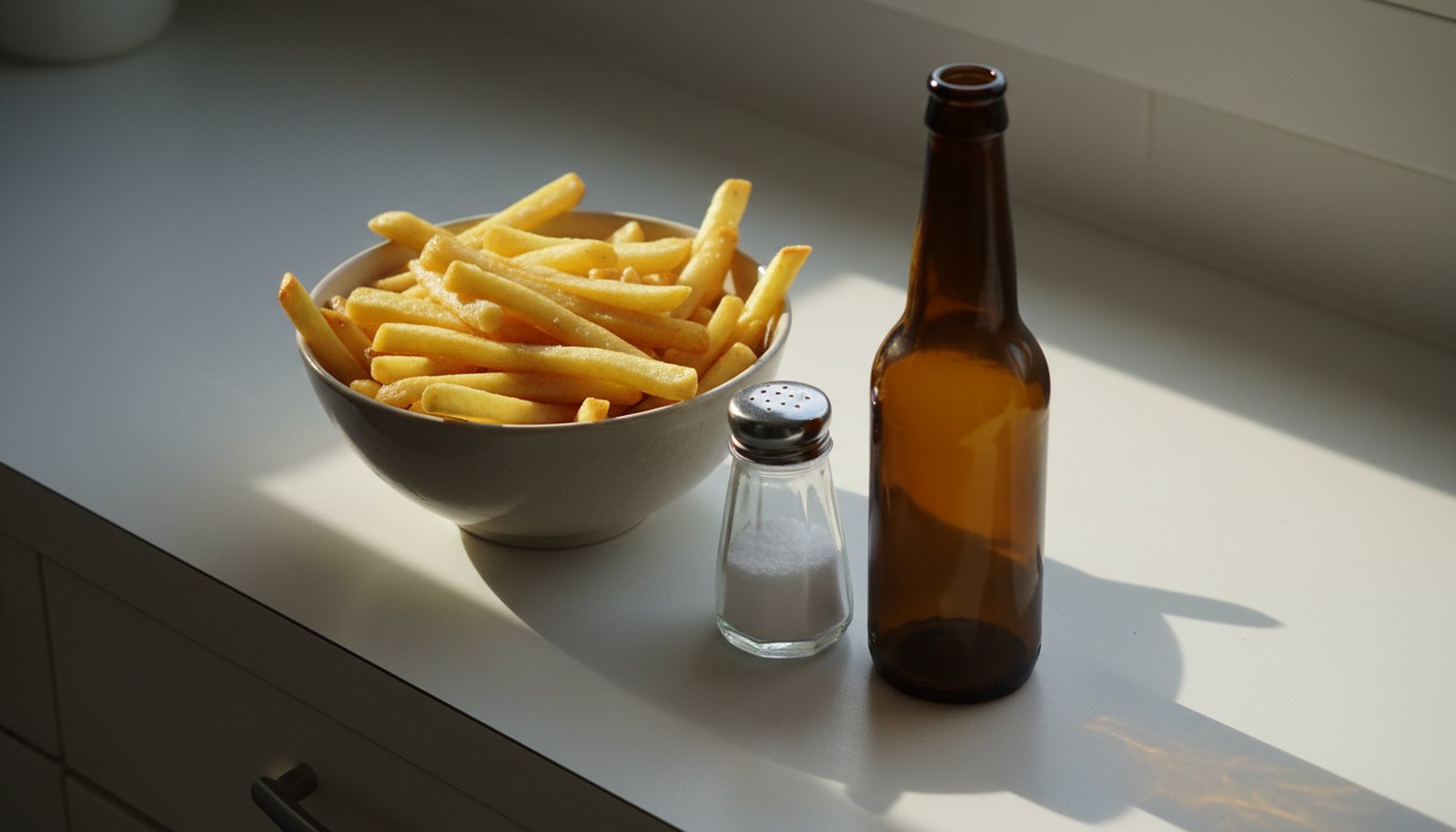
Off cycle, a Friday burger is just dinner. On cycle, it’s a line on a blood panel.
Nobody gets shamed in my kitchen for a burger — hear that first. But when you’re running something, your body is already working overtime on the quiet things food touches: blood pressure, your lipids, your liver, the water sitting under your skin. So the honest answer to which foods to avoid while on steroids has nothing to do with willpower or being “clean.” It’s about margins. On cycle your margins shrink, and food that was neutral off cycle stops being neutral.
I’ve been on TRT since I was 35, and I still run a heavier cycle now and then, off the competitive stage. I’ve watched my own bloodwork move because of what was on my plate, not just what was in the syringe. This is the out-list I actually keep — every item, and exactly why it earns its place.
Why “fine” food stops being fine on cycle
Here’s the thing I wish someone had said to me plainly years ago. Testosterone and the compounds stacked with it push on a handful of markers at once. They tend to drop your good cholesterol, nudge your blood pressure up, park extra water under the skin, and lean on the liver — especially with orals in the mix. None of that is the food’s fault. But it means you start every day with less headroom than a natural lifter has.
So what not to eat on cycle isn’t a moral list. It’s a math problem. If your blood pressure is already sitting higher than you’d like, a 2,000 mg-sodium takeout meal is a bigger deal than it was last year. If your HDL is already suppressed, the deep-fryer isn’t a treat — it’s a second hit on a marker that’s already down. Same food, different body, different cost.
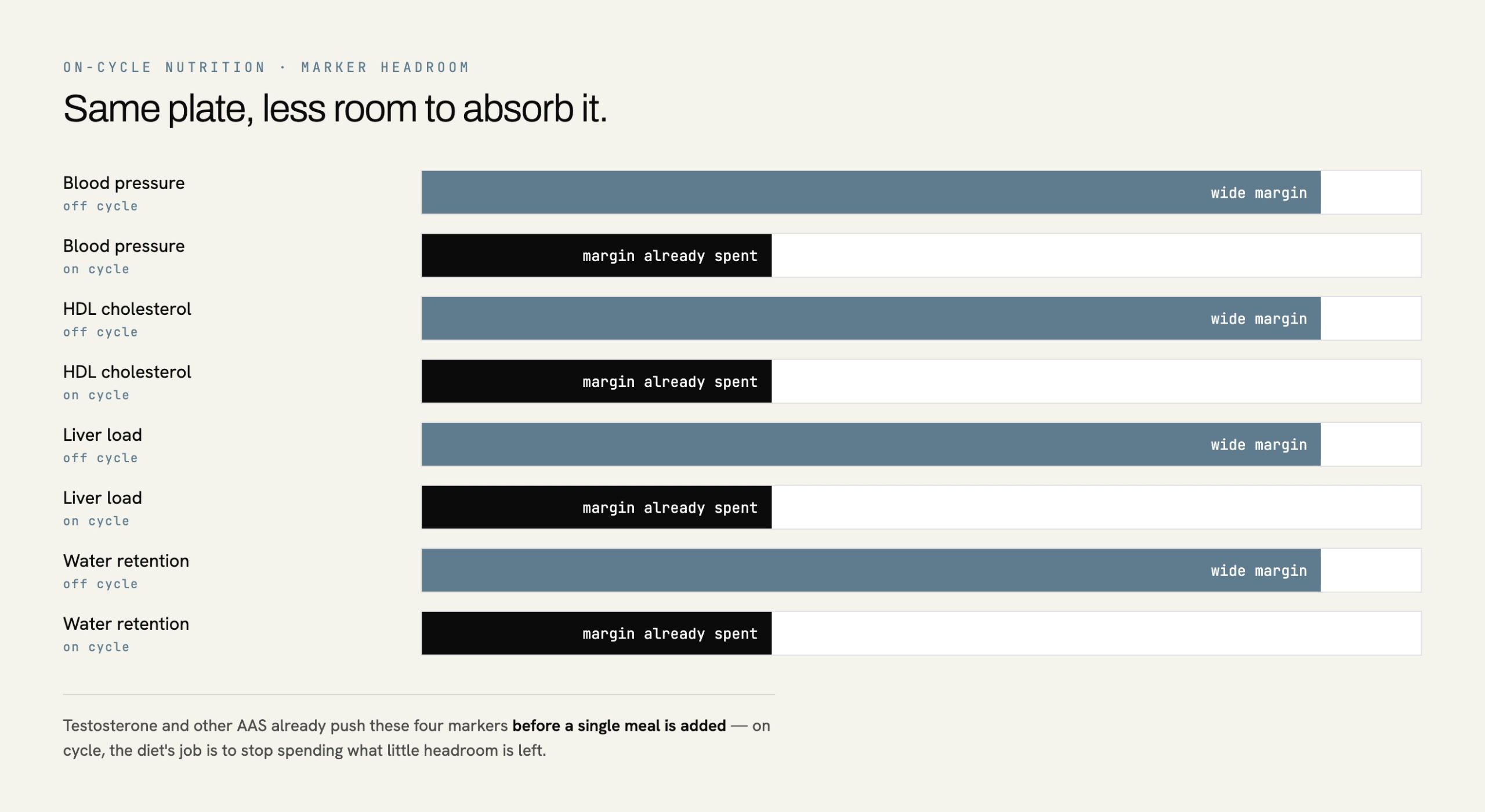
Read the table below as the short version. The rest of the article is me explaining each line, because you deserve the why, not just the “don’t.”
| What I keep out (or way down) | The marker it leans on | What I reach for instead |
|---|---|---|
| Alcohol | Liver load, estrogen, recovery, sleep | Sparkling water, or nothing, on the heavy weeks |
| Sodium bombs (fast food, cured meats, salty snacks) | Blood pressure, water retention | Home-salted whole food, potassium-rich plates |
| Trans fats and deep-fried food | Cholesterol (raises LDL, lowers HDL) | Olive oil, oily fish, air-fryer or oven |
| Added-sugar floods (soda, candy, sweet coffee) | Blood pressure, triglycerides, appetite | Fruit, real carbs around training |
| Grapefruit, if you take daily meds | Drug metabolism (a caveat, not a ban) | Other citrus — check with your doctor |
Alcohol on cycle: the one I dig my heels in on
If I could only pull one thing off your plate on a heavy week, it’d be the drink. Alcohol on cycle hits three of the exact systems your cycle is already stressing, all at once.
Start with the liver. Your liver is already the busiest organ on a cycle, and it’s the one clearing your alcohol too. Ask it to process a stack and a night of drinking on the same shift and something gives. The literature on alcohol and the male reproductive system is blunt about it: heavy drinking damages hormone handling at the liver, the testes, and the brain’s signalling all together[4]. That’s not a moral point. That’s your recovery organ doing two hard jobs at once.
Then estrogen. Your liver is where a chunk of your hormone metabolism happens, and drinking tilts that balance in the direction most guys on cycle are already fighting. A systematic review and meta-analysis found that heavy alcohol intake is associated with lower testosterone in men, and named alcohol overuse a genuinely destructive factor for the whole testosterone axis[3]. On cycle you’ve got exogenous test covering the T side, but the estrogen tilt and the recovery cost don’t care that your levels look fine on paper.
Last, recovery. Booze wrecks the sleep you’re counting on to actually turn food and training into muscle. You didn’t run a cycle to sleep badly and eat worse the next day. That’s the real tax — not the calories in the beer, but the loose, salty, late-night eating that rides in behind it.
Less is always safer than more, with everything we’re talking about here. I’m not going to pretend I’ve never had a glass of wine with my husband. But on a heavy week, I keep it off the table — not out of guilt, out of respect for the organ doing the cleanup. More was never the thing that helped me.
Sodium on cycle: the bombs that puff you up and push your pressure
Salt gets a bad name it only half deserves. Sodium isn’t poison — you need it, and if you train hard and sweat you need a fair bit. The problem with sodium on cycle is two-sided: it pulls water, and it leans on blood pressure that your compounds may already be raising.
The water piece is the one you see in the mirror. That puffy, smooth, blurry look — the face that isn’t quite yours — is often a sodium swing riding on top of the water your cycle already holds. It’s not fat. It moves in a day. But it tells you your balance is off.
The blood pressure piece is the one you don’t see, and it’s the one that matters more. The American Heart Association puts the ceiling at 2,300 mg of sodium a day, with an ideal closer to 1,500 mg for most adults, and notes that cutting back by about 1,000 mg a day measurably improves blood pressure[1]. Now look at where sodium actually comes from — it’s almost never your salt shaker.
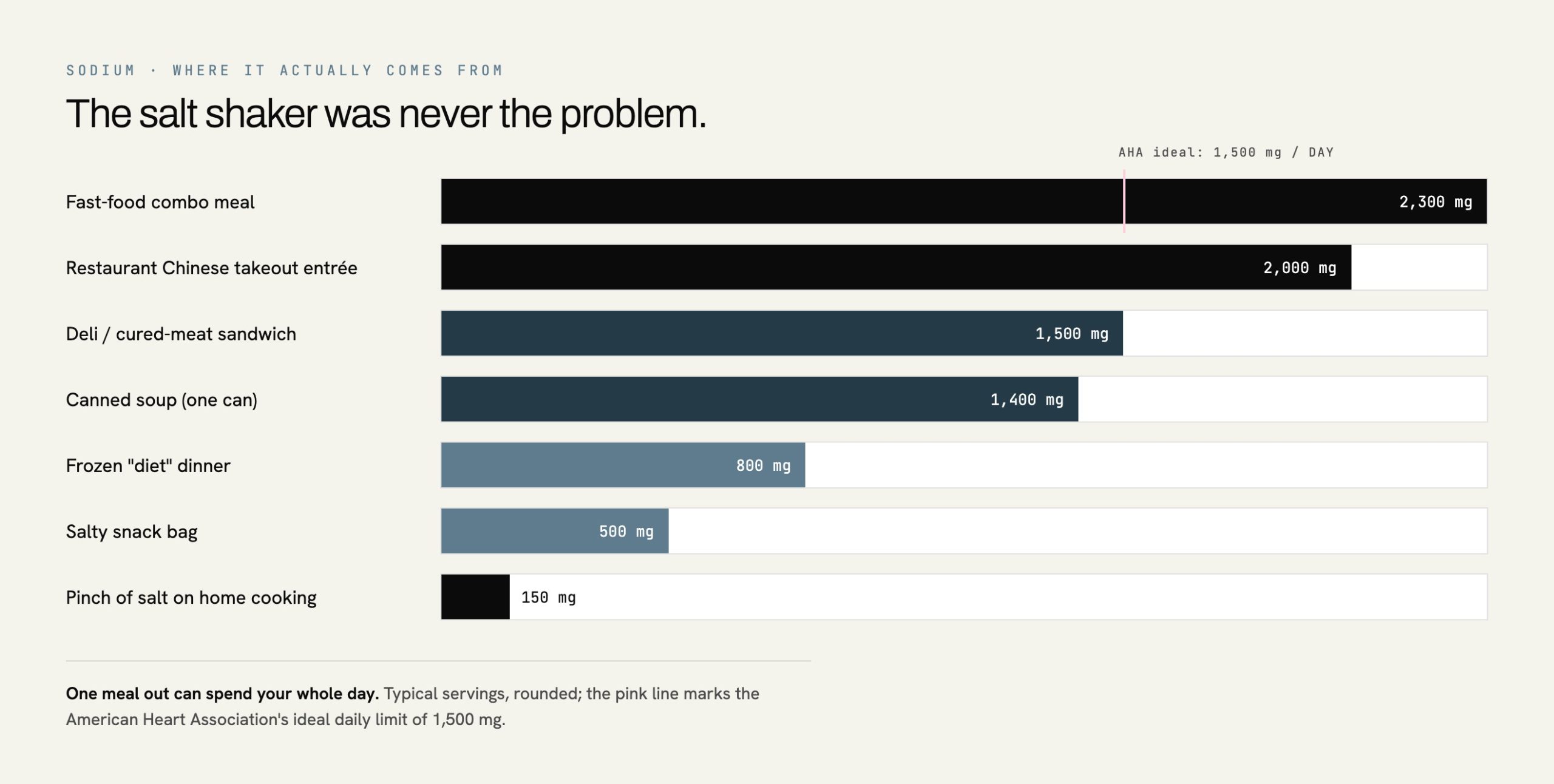
A single fast-food combo can hand you 2,000 mg or more of sodium in one sitting — past a whole day’s ideal before dinner’s even done. Salt your own cooking to taste and you’ll still land under it, easily. The shaker was never the villain. The drive-through is.
The fix isn’t a low-sodium punishment plan. It’s cooking your own food so you’re the one holding the salt, and building plates around potassium-rich stuff — greens, potatoes, fish — that helps balance the scale. A plate like my baked cod and greens is exactly the shape I’m talking about: lean protein, real vegetables, and I decide every gram of salt that touches it.
Trans fats and the deep-fryer: your cholesterol on cycle
This is the one guys underrate the most, and it’s the one your cardiologist would care about first. Anabolics are hard on your lipids on their own. A study of young men using anabolic-androgenic steroids found their HDL — the cholesterol that clears the junk out of your arteries — did its job measurably worse, and a quarter of the users already had early plaque in more than one coronary artery, in men who none of the non-users could match[5]. Your cycle is already spending your cholesterol margin.
Now bring in trans fats and heavy deep-fried food. The American Heart Association is clear that trans fats raise your bad (LDL) cholesterol and lower your good (HDL) cholesterol, and that a diet high in them raises the risk of heart disease and stroke — with some evidence artificial trans fats are worse for your heart than saturated fat[2]. That’s the same HDL your cycle is already knocking down. Two hits, same marker. That’s why the fryer comes off the menu on cycle even though it’s “just a bit of fat.”
I don’t eat zero fat — that’s its own mistake, and your hormones need dietary fat. I eat the right fats. Olive oil, whole eggs, oily fish. Sardines are one of my quiet weapons here; a plate like my grilled sardines and greens brings the omega-3s that your lipid panel actually likes, for about the price of a coffee. The oven and the air-fryer do the work the deep-fryer used to. You lose nothing but the number on the panel you didn’t want.
The added-sugar flood
Sugar itself won’t undo a cycle. A square of chocolate is a square of chocolate. What I pull back on is the flood — the litre of soda, the sweet coffee twice a day, the candy that shows up when appetite is roaring and you’re bulking anyway.
Two reasons. Added sugar in big daily volumes pushes on the same blood pressure and triglyceride numbers we’ve been protecting this whole time. And on cycle your appetite can be a liar — hungry all day, never quite full — so a sugar flood becomes a calorie flood you didn’t decide on, riding under a “dirty bulk” excuse. Real carbs around your training do everything the soda promised and none of the damage. Rice, potatoes, oats, fruit. That’s fuel with a job. The soda is just water spending your markers.
The sneaky one here is liquid sugar, because it doesn’t fill you up. A plate of rice tells your body it ate. A bottle of soda tells it almost nothing, so you drink it and eat your full dinner on top. On cycle, when you’re already primed to eat big, that’s how a couple of hundred “invisible” calories a day turn into a gut you didn’t plan for and a triglyceride number that creeps. If you want something sweet, I’d rather you have the real thing on a plate, sat down, and enjoy it — fruit, a square of good chocolate, honest dessert. It’s the mindless litre-a-day drip that costs you, not the enjoyment.
The grapefruit caveat
This one’s short and it’s a caveat, not a scare. If you take any daily medication, grapefruit is worth a second thought — and this is general information, not medical advice, so the real answer comes from your doctor and your pharmacist.
Grapefruit isn’t unhealthy. The issue is that it blocks a liver enzyme called CYP3A4 that your body uses to break down a long list of drugs. Peer-reviewed work shows grapefruit’s furanocoumarins shut that enzyme down and can push the blood level of an affected drug up — in some cases several-fold, lasting around a day[6]. If you’re on a statin, a blood pressure med, or anything your doctor put you on, that interaction is a real thing, and it has nothing to do with your cycle specifically — it’s just the kind of quiet detail that’s easy to miss. Other citrus doesn’t do this. Ask, then decide.
“Dirty bulk everything” — the mindset, not a food
The most damaging thing on this whole list isn’t a food at all. It’s a mindset: I’m on cycle, I’m anabolic, it all goes to muscle, so I can eat anything. I understand the appeal. When you’re growing and hungry and strong, it feels like the rules got suspended.
They didn’t. Your muscles might forgive the junk. Your blood pressure, your liver, and your lipids keep the receipts. That’s the difference between a cycle you look back on proud and one your fifty-year-old self has to clean up after. Eating with some care on cycle isn’t clean-eating moralism — it’s the same bloodwork math, just taken seriously because the stakes went up.
The first time I really sat with my own lipid panel after a cycle, I didn’t like what I saw. My HDL had dropped, and I couldn’t blame the compound alone — I’d been eating like the rules were off. I’d competed back in Sweden, at the B&K Classic and the Grand Prix; I knew how to be strict when a stage demanded it. But somewhere off the stage I’d let “anabolic” become an excuse for the fryer and the drive-through. That panel was the day I stopped treating my kitchen like it didn’t count. Nothing dramatic changed. I just started cooking again, salting my own food, and leaving the beer for the light weeks. The next panel thanked me.
If you want the full picture of how I actually build plates on a heavier run — not just the out-list but the in-list — I laid it all out in how I really eat on cycle, and the bigger framework for eating to grow lives on my bulking guide. This article is the fence; those two are the field inside it.
None of this is about fear, and none of it is about shame. It’s about keeping your margins wide enough that the good stuff — the strength, the size, the recovery — actually lands, and the invisible costs stay small. Cook your own food. Salt it yourself. Save the drink for the easy weeks. Build your plates around protein and real carbs and the fats your heart likes. A weeknight like my salmon, sweet potato and asparagus does more for you on cycle than any supplement in the cupboard.
And if you’d rather not think about all of it every night, I built a free eat-well plan that does the balancing for you — real macros, real food, plates that keep your markers quiet without asking you to earn a single meal. Take it. I’ve got you.
Questions men actually ask
Can you drink alcohol on cycle?
You can — nobody’s stopping you and you won’t undo a cycle with one glass. But alcohol leans on the three things your cycle is already stressing: your liver, your hormone balance, and your recovery sleep. On a heavy week I keep it off entirely and save a glass for the lighter weeks. Less is always safer than more here.
Does salt really matter on cycle?
More than it did off cycle. Sodium pulls water — that’s the puffy, smooth look in the mirror — and it pushes on blood pressure that your compounds may already be raising. The AHA ideal is around 1,500 mg a day, and one fast-food meal can blow past that alone. Cook your own food and salt it to taste and you’ll land well under, easily.
Can you eat junk food and still grow on cycle?
Your muscles might grow anyway — that’s exactly what makes the “dirty bulk everything” trap so easy to fall into. But your blood pressure, liver, and cholesterol keep the receipts even when the scale and the mirror don’t. You can grow on junk. You just pay for it on a panel you’d rather not read.
What foods help blood pressure on cycle?
The ones you cook yourself, salted by your own hand, built around potassium-rich foods — leafy greens, potatoes, fish, beans — that help balance sodium’s pull. Oily fish for the omega-3s your lipids like. And plain water instead of the soda and the beer. It’s less about magic foods and more about who’s holding the salt.
Do you need to eat clean on steroids?
Not “clean” in the shame sense — nobody earns their food in my kitchen. But you do need to eat with more care than a natural lifter, because your margins on blood pressure, liver, and cholesterol are already spent by the cycle. It’s not moralism. It’s bloodwork math with the stakes turned up.
References
- American Heart Association — How Much Sodium Should I Eat Per Day? (2024)
- American Heart Association — Trans Fat (2024)
- Cureus — Association of Alcohol Consumption on LH, FSH, and Testosterone in Men: A Systematic Review and Meta-Analysis (2024)
- Alcohol Research: Current Reviews (NIAAA) — Alcohol’s Effects on Male Reproduction
- Journal of Applied Physiology — Diminished Cholesterol Efflux Mediated by HDL and Coronary Artery Disease in Young Male Anabolic Androgenic Steroid Users (2019)
- Pharmaceuticals — Impact of Grapefruit Consumption on Plasma Concentrations of Medications Through CYP3A4 Inhibition

Magnus Olafsson
The cook behind Slim Diet Era. Former Swedish stage competitor (B&K Classic Body Show, Swedish Grand Prix), on TRT since 35, cooking high-protein food in Chicago for his husband, two kids, and you. He counts the macros so you don’t have to.
More about Magnus →Hungry for a plan, not just a post?
Start with the free plan — macros counted, grocery list written, in your inbox. You cook and eat; I’ll do the math.