What Should You Eat While on Steroids? A Full Day at My Table
Six meals, one Chicago kitchen, every macro counted — my honest on-cycle day of eating, from the 6 a.m. skillet to the last casein bowl.
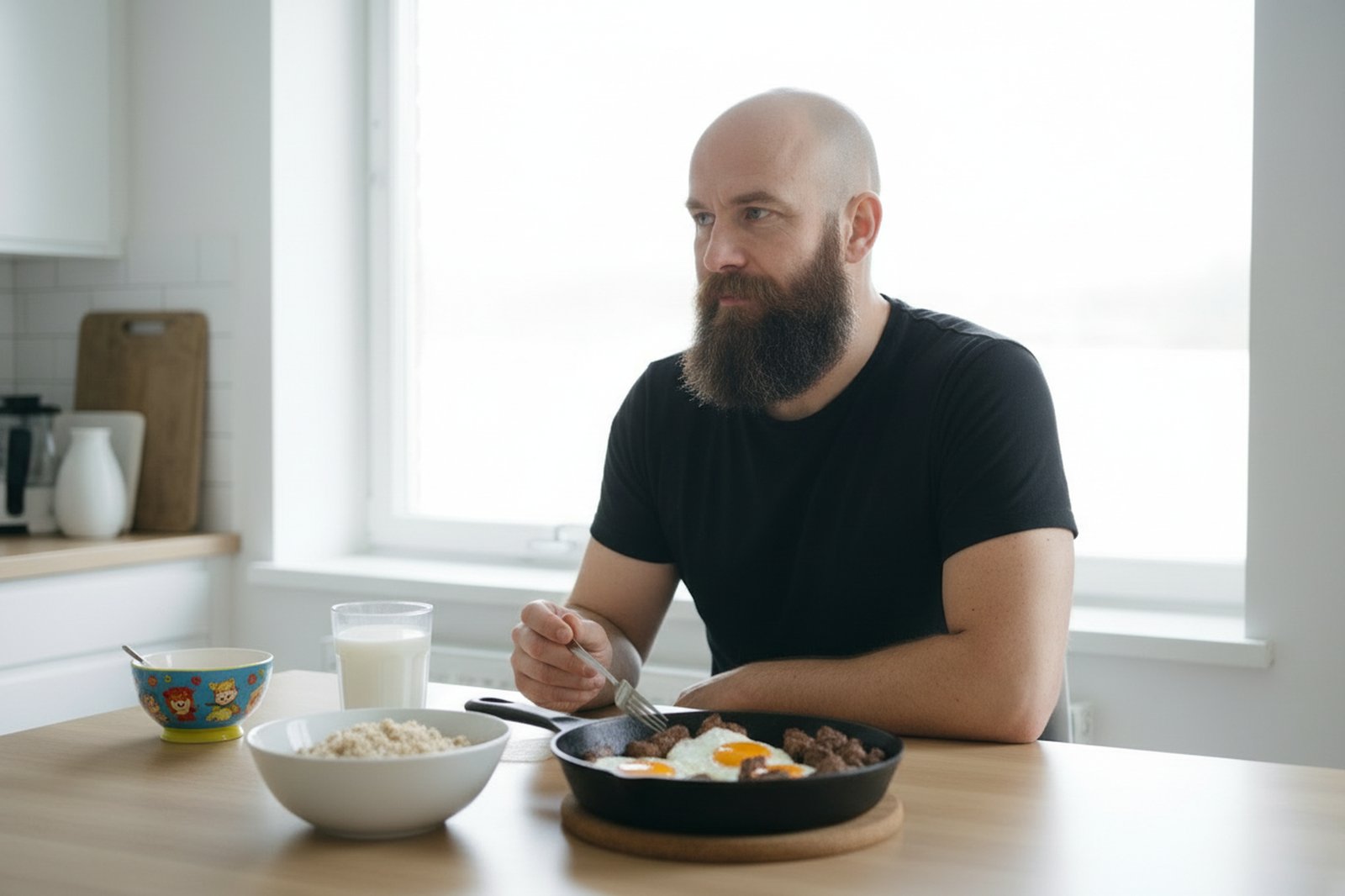
Somebody asks me this almost every week, usually in a gym hallway, shaker bottle in hand: what should I eat while on steroids? And every week I give the same answer. Come sit at my table. One honest day of food teaches more than any list of rules I could hand you.
So that’s this post. A full day at my table in Chicago, on cycle, meal by meal — from the 6 a.m. skillet with two kids arguing about waffles behind me, to the casein bowl at a quarter to ten. Real portions, real macros, and a running total the whole way down.
I already wrote the rulebook version in my steroid diet guide. That one is the principles. This one is the practice: what those principles look like with a fork in them.
One thing before the first plate. I’m 40, on TRT since 35, and I run heavier cycles from time to time now that my stage days in Sweden are behind me. Nothing here is a prescription for your body. It’s my table, honestly documented. Get your bloodwork done, talk to your doctor, and eat like you plan to be lifting in thirty years.
The short answer, before the long day
Eating on steroids is not a secret diet. You eat the way any serious bulking lifter eats, just more of it, done more carefully, since the drugs raise both what your body builds with and what it punishes you for. Six things carry my whole day:
- A protein anchor at every meal. Meat, eggs, dairy, or a shake. The plate gets built around it, never the other way.
- Enough calories to grow. A modest surplus, roughly 10–20% over maintenance, is what the off-season research supports[2]. On cycle I sit at the top of that range.
- Carbs pushed toward training. The meals before and after the barbell carry most of the rice, oats, and pasta.
- Fats late, fats moderate. Steak and olive oil live at dinner, not at 9 a.m.
- Fruit and vegetables daily. Potassium, fiber, and micros, the quiet work that keeps bloodwork readable.
- Water in liters, sodium watched. Cycles push blood pressure. Salt still goes on my food; it just stops getting a free pass.
What stays out of the kitchen on cycle matters just as much. I keep that whole list in foods to avoid while on steroids. Now let me show you the day.
6:00 a.m. — the skillet, and the school-morning chaos
My alarm goes off at 5:40. By 6:00 the pan is hot and my kids are negotiating waffle rights with my husband like two small lawyers. In the middle of that, I cook the most boring, most reliable meal I own: my beef and egg breakfast skillet. Two hundred grams of lean ground beef, three whole eggs, three hundred grams of diced potato, half an onion, whatever peppers survived the week.
Meal 1: 790 kcal · 58g protein · 52g carbs · 35g fat. Running total: 790 kcal, 58g protein.
I weigh the beef raw, straight into the pan, on a scale that has lived next to my stove since the lockdowns. That’s when cooking went from a thing I liked to the thing I do. No apps at the table, no drama. The scale takes four seconds and turns “roughly” into “actually,” and on cycle “actually” is what your bloodwork and your waistband are responding to. My daughter thinks the scale is for making the food fair. She’s not entirely wrong.
The principle this plate teaches is the anchor. Fifty-plus grams of protein before 6:30 means the day starts won, not chased. Research on drug-free lifters puts the useful per-meal dose around 0.40–0.55 g/kg, spread over the day[2], and a man my size hits that with beef and eggs before the school bus comes.
Every meal starts with the protein decision. Pick the anchor first — beef, eggs, chicken, casein — then build carbs and fat around it to fit the hour of the day. A plate with no anchor is a snack wearing a plate’s clothes.
9:30 a.m. — oats, and why calories on cycle are the whole game
By 9:30 the house is quiet and I’m hungry again. That’s not weakness — that’s testosterone doing what it does to appetite. Second breakfast is a bowl of peanut butter protein oats: 100 grams of oats cooked in water, a scoop of whey stirred in off the heat, 20 grams of peanut butter, one sliced banana.
Meal 2: 730 kcal · 43g protein · 100g carbs · 18g fat. Running total: 1,520 kcal, 101g protein.
Here’s the honest truth about calories on cycle: the drugs don’t build anything. They raise the ceiling. Food is still the bricklayer. The off-season literature lands on a surplus of roughly 10–20% over maintenance, gaining about 0.25–0.5% of bodyweight per week[2], and on cycle I ride the top of that. Undereat on a heavy cycle and you’ve rented a crane to lift groceries.
Notice the shape of this meal, too: big carbs, modest fat, protein still present. Mid-morning is climb-toward-training time. The oats will be waiting for me under the bar at 5:30.
1:00 p.m. — lunch, the repeatable middle
Lunch is the meal most men ruin by making it interesting. Mine is deliberately dull: a creamy chicken pasta I batch on Sundays: 200 grams of chicken breast, 120 grams of dry pasta, a light cream-and-parmesan sauce that tastes far richer than its macros. Three containers of it sit in my fridge right now.
Meal 3: 850 kcal · 65g protein · 90g carbs · 22g fat. Running total: 2,370 kcal, 166g protein.
The batch happens Sunday afternoon: two kilos of chicken breast seared in one pan, a pot of pasta, sauce built in the chicken pan so nothing is wasted, everything portioned by scale into containers before it cools. Forty minutes of work buys me three lunches that require zero decisions. Decisions are the expensive part of eating big, not the food and not the cooking. The men I see fall off a bulk rarely run out of chicken. They run out of patience at 1 p.m. on a Wednesday.
The principle here: an on cycle meal plan is boring on purpose. Sixteen weeks is a long time. The men who eat well for all sixteen aren’t the ones with forty recipes; they’re the ones with six meals they never have to think about. Novelty lives on the weekend. Tuesday lunch is a system.
I learned this backstage at the B&K Classic in Sweden, half my life ago. I was young, orange with bronzer, and terrified, and the older competitor next to me sat calmly eating cold rice and chicken out of a scratched container like it was a Tuesday. I asked him how he stayed so relaxed. He tapped the container and said the food was the one rep he never missed. I’ve eaten a boring, repeatable lunch nearly every training day since — that habit has outlived every cycle, every stage, and one move across the Atlantic.
4:00 to 7:15 p.m. — the meals that surround the barbell
At 4:00 I eat small and sharp: 300 grams of fat-free Greek yogurt, 20 grams of honey, a big handful of blueberries. Light on the stomach, quick carbs, 30-odd grams of protein, almost no fat to slow it down. Ninety minutes later I’m training.
Meal 4: 330 kcal · 32g protein · 42g carbs · 2g fat. Running total: 2,700 kcal, 198g protein.
Training hunger on cycle deserves a sentence of its own, since nobody warns you. It’s not the polite hunger of a Tuesday afternoon. It arrives mid-session, somewhere around the fourth set of squats, loud and specific — my body doesn’t want food in general, it wants that ribeye it knows is in the fridge. I’ve learned to treat it kindly: finish the session, drive home, and let the biggest plate of the day answer it properly instead of raiding the cabinets like a bear in a tent.
Train 5:30 to 6:45. Then home, where the biggest plate of the day is waiting to happen: my ribeye with rice and broccoli. A 250-gram ribeye, 80 grams of dry jasmine rice, a full head of broccoli with lemon and salt. My husband and I eat this one together at the table like civilized people, which on cycle takes some acting.
Meal 5: 1,070 kcal · 78g protein · 75g carbs · 57g fat. Running total: 3,770 kcal, 276g protein.
The principle these two meals demonstrate: put your carbs where the work is. The research is calmer about the “anabolic window” than the forums ever were: the muscle-building effect of training lasts a day or more, and protein on either side of the session works[3]. Practically, fueling before and feeding after is the pattern that makes hard training feel good and big eating feel easy. The window is generous. I still like to stand near it.
9:45 p.m. — the last bowl, and the quiet rules of night
Kids down, kitchen wiped, one last bowl: my casein loaded overnight oats, mixed the night before and eaten cold with a spoon in a mostly dark kitchen. A full scoop of casein, 40 grams of oats, milk. There’s real evidence behind the ritual: around 40 grams of protein before sleep measurably raises overnight muscle protein synthesis, more so on training days[4].
Meal 6: 360 kcal · 37g protein · 35g carbs · 8g fat. Day total: roughly 4,100 kcal · 313g protein · 394g carbs · 142g fat.
Night is where the fats-late principle finishes its shift. Dinner and the evening carry most of my fat for the day: 57 grams at dinner against 2 grams pre-training. Fat slows digestion, and slow is exactly what I want between 7 p.m. and morning. And night is where water and sodium get their audit: I drink 4 to 5 liters across the day, salt my food normally, and skip the salt-bomb late snacks. On cycle, blood pressure is the number I respect most. My doctor keeps score; my kitchen keeps it low.
313g of protein is about 2.5–2.7 g/kg for a man my size — above the 1.6–2.2 g/kg where growth plateaus in drug-free lifters[2], inside the 2.3–3.1 g/kg-of-lean-mass range prep coaches use[1]. Nobody has run the feeding trial on enhanced bodybuilders, so I’ll say it straight: part of that number is evidence, part is insurance, and all of it is delicious.
The whole day on one page
Here is the full day of eating, bulking, on cycle, exactly as it runs when the trains run on time. Steal the structure before you steal the portions; your maintenance calories are not mine.
| Time | Meal | kcal | Protein | Carbs | Fat | Running kcal |
|---|---|---|---|---|---|---|
| 6:00 | Beef & egg skillet with potatoes | 790 | 58g | 52g | 35g | 790 |
| 9:30 | Peanut butter protein oats + banana | 730 | 43g | 100g | 18g | 1,520 |
| 13:00 | Creamy chicken pasta (batch-cooked) | 850 | 65g | 90g | 22g | 2,370 |
| 16:00 | Greek yogurt, honey, blueberries | 330 | 32g | 42g | 2g | 2,700 |
| 17:30 | Train | — | — | — | — | — |
| 19:15 | Ribeye, jasmine rice, broccoli | 1,070 | 78g | 75g | 57g | 3,770 |
| 21:45 | Casein overnight oats, eaten cold | 360 | 37g | 35g | 8g | 4,130 |
| Total | Six meals, zero drama | ~4,100 | 313g | 394g | 142g | — |
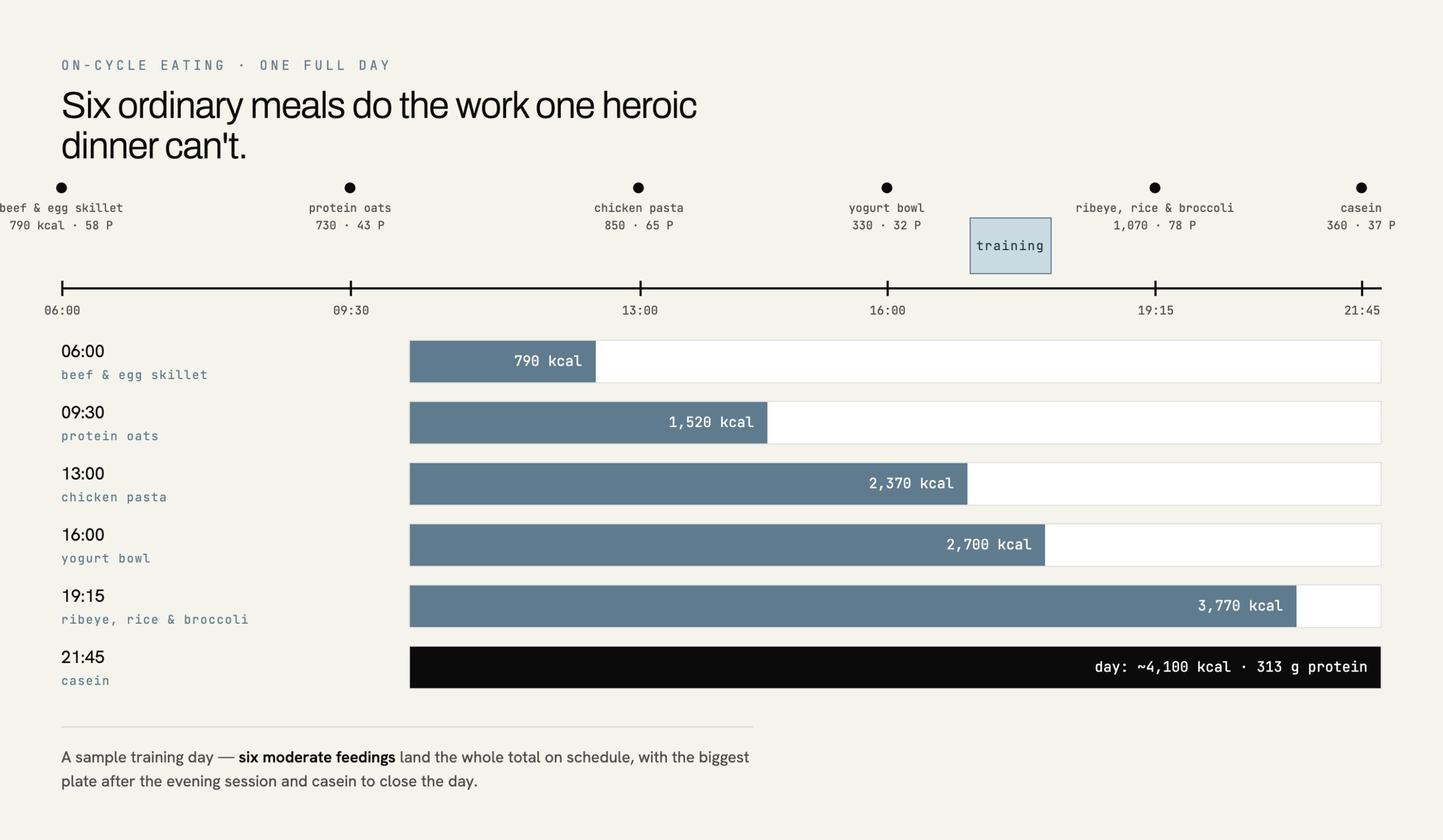
How do I know 4,100 is the right number and not a wish? The scale and the mirror, checked weekly, adjusted slowly. Gaining faster than about half a percent of bodyweight per week means too much of it is fat, cycle or no cycle[2], and I trim 200 kcal, usually the rice and the honey, never the protein. Gaining nothing for two weeks, I add 200. On rest days I keep the same six meals and just shrink the carbs at 9:30 and 16:00. The day flexes; the skeleton doesn’t.
If you want the deeper shelf, with more days like this plus the training-day and rest-day versions, everything lives in the bulking hub.
The same day, off cycle
People imagine two different men with two different diets. It’s one man, one menu, smaller numbers. Off cycle my appetite comes back down to earth, my maintenance drops, and the same six meals shrink at the edges. The structure never changes. That’s the point of having one.
| Meal | On cycle (this day) | Off cycle (same day, resized) |
|---|---|---|
| Skillet | 200g beef, 3 eggs, 300g potato | 150g beef, 2 eggs, 250g potato |
| Protein oats | 100g oats, whey, peanut butter, banana | 60g oats, whey, banana — peanut butter rests |
| Chicken pasta | 120g dry pasta | 90g dry pasta, same chicken |
| Pre-training bowl | Yogurt, honey, blueberries | Yogurt and blueberries, no honey |
| Dinner | 250g ribeye, 80g rice | 200g sirloin, 60g rice — leaner cut, same table |
| Bedtime casein | Full bowl | Full bowl — sleep is sleep |
| Day lands at | ~4,100 kcal · 313g protein | ~3,150 kcal · ~275g protein |
Two honest notes on that table. First, appetite: on testosterone, eating 4,100 is easy; the hunger shows up like a coworker. Some compounds go the other way; tren is famous for killing appetite dead, and men running it often have to eat by the clock, joylessly. Second, attention: off cycle I relax about sodium and blood pressure a little. On cycle, never. Less is safer in every part of this game. More was never the answer for me, on the plate or off it.
If this day looks like a lot of cooking, it’s really four recipes and a yogurt bowl, run on repeat. I put the whole system — portions, prep day, grocery list — into my meal plans, and there’s a free week to start with if you want to see how it fits your table before you spend a krona. Come eat.
Questions men actually ask
How many calories should you eat on cycle?
Start from your real maintenance and add 10–20%, the range the off-season research supports for muscle gain with minimal fat[2]. On cycle I sit at the top of that range, around 4,100 kcal for me. The cycle raises what you build, not the laws of energy balance: track your weight weekly and adjust when the scale moves faster than about half a percent of bodyweight per week.
Do you need more protein on cycle?
The honest answer: the trials showing 1.6–2.2 g/kg is enough were done on drug-free lifters[2], and nobody has published the enhanced version. Contest-prep reviews go to 2.3–3.1 g/kg of lean mass[1]. I eat about 2.5–2.7 g/kg on cycle: part evidence, part cheap insurance, and protein keeps me full anyway.
Can you eat eggs on steroids?
Yes. I eat about three a day, yolks included. The big pooled analyses found up to one egg per day carries no added cardiovascular risk in the general population[5]. On cycle your lipids deserve extra respect, so I balance eggs with fish, olive oil, and fiber, and I let bloodwork — not internet fear — decide if anything changes.
Should you eat before or after training on cycle?
Both, and calmly. The position-stand evidence says the anabolic effect of a session lasts at least 24 hours, and protein on either side works[3]. My pattern: a light, low-fat carb-and-protein meal about 90 minutes before, then the biggest meal of the day after. That’s comfort and logistics as much as science.
What do bodybuilders actually eat in a day?
Less exotic food than you’d hope. Beef, eggs, chicken, rice, oats, pasta, potatoes, yogurt, fruit, a mountain of vegetables, whey and casein. The table above is a genuinely typical day: five or six meals, each anchored on protein, carbs stacked around training, fats toward evening. The magic is the repetition, not the ingredients.
References
- JISSN — Helms et al., Evidence-based recommendations for natural bodybuilding contest preparation: nutrition and supplementation (2014)
- Sports (Basel) — Iraki et al., Nutrition Recommendations for Bodybuilders in the Off-Season: A Narrative Review (2019)
- JISSN — Jäger et al., International Society of Sports Nutrition Position Stand: Protein and Exercise (2017)
- Nutrients — Trommelen & van Loon, Pre-Sleep Protein Ingestion to Improve the Skeletal Muscle Adaptive Response to Exercise Training (2016)
- BMJ — Drouin-Chartier et al., Egg consumption and risk of cardiovascular disease: three large prospective US cohort studies and updated meta-analysis (2020)

Magnus Olafsson
The cook behind Slim Diet Era. Former Swedish stage competitor (B&K Classic Body Show, Swedish Grand Prix), on TRT since 35, cooking high-protein food in Chicago for his husband, two kids, and you. He counts the macros so you don’t have to.
More about Magnus →Hungry for a plan, not just a post?
Start with the free plan — macros counted, grocery list written, in your inbox. You cook and eat; I’ll do the math.