Author: Magnus Olafsson

  • The Steroid Diet: How I Actually Eat on Cycle

    The Steroid Diet: How I Actually Eat on Cycle

    BlogOn-Cycle Nutrition11 min read

    The Steroid Diet: How I Actually Eat on Cycle

    What genuinely changes on my plate when I run a heavier cycle — and what stubbornly stays the same.

    The Steroid Diet: How I Actually Eat on Cycle

    People hear “steroid diet” and picture something exotic. Some secret stack of foods that only works if you’re on. It isn’t that. When I’m running a cycle heavier than my usual TRT, my kitchen doesn’t turn into a laboratory. It turns into a bigger version of the same honest kitchen it always is: more protein on the plate, more total food, a closer eye on my blood pressure, and the same steak that would feed you just as well as it feeds me.

    I’ve been on TRT since I was thirty-five, and now that I’m off the competitive stage I run heavier from time to time. So when I talk about a steroid cycle diet, I’m not reading it off a forum. I’m telling you what actually lands on my table when I’m on, and what changes and what stubbornly refuses to.

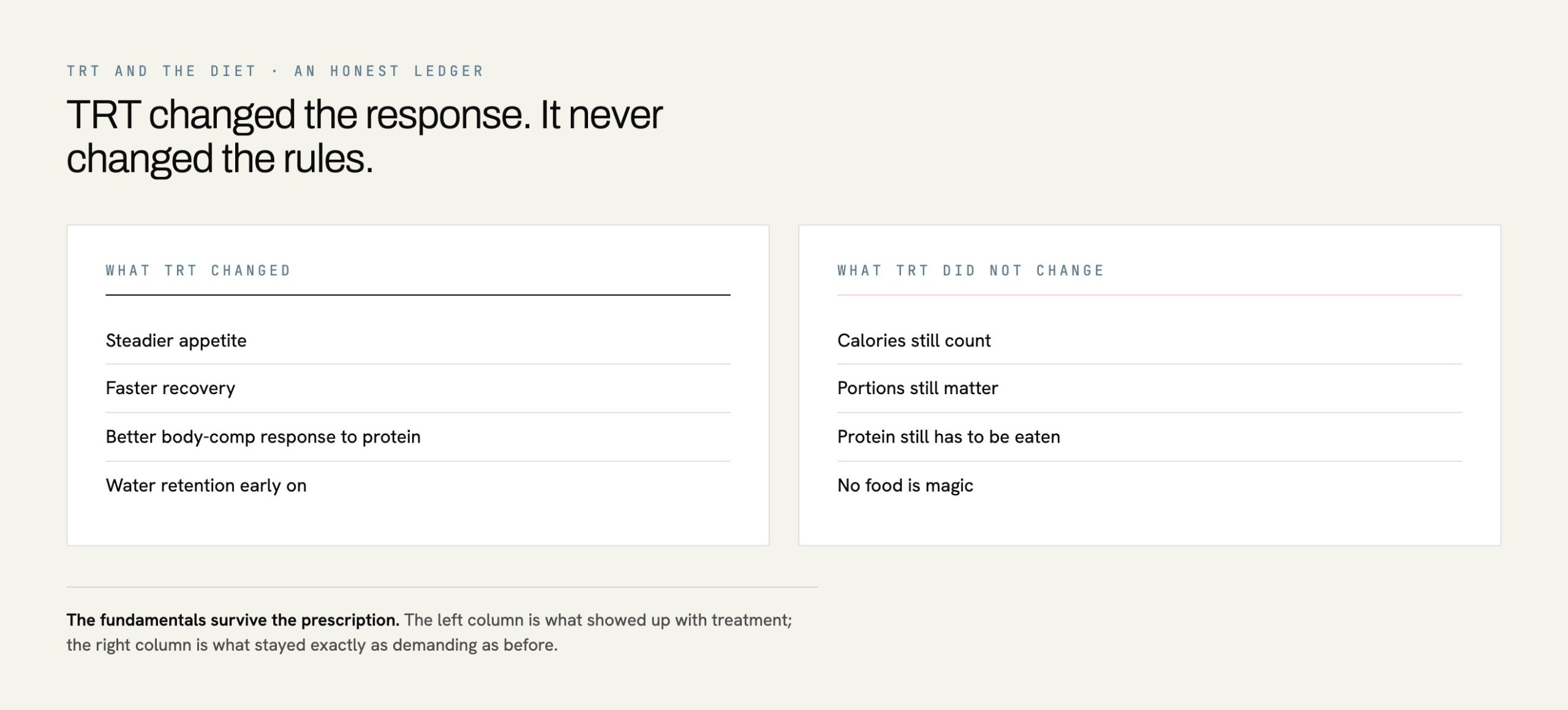
    Here’s the part nobody selling you a protocol wants to say out loud: the drugs don’t cook. They don’t shop, they don’t weigh your chicken, they don’t decide whether you eat like a man who respects his body or a man who’s hoping the vial does it all. That’s still your job. It’s still mine. Let me walk you through it.

    What a steroid diet actually is (and what it isn’t)

    A steroid diet is just good lifting nutrition, turned up to match what your body can now do with the extra food. That’s the whole trick. Enhanced or not, muscle is built out of protein, energy, and hard training. Being on cycle changes how much of the first two you can put to work and how fast you recover. It does not hand you a shortcut around eating well.

    What it is not: it’s not a licence to eat garbage and grow anyway. It’s not a magic macro ratio. And it’s for damn sure not an excuse to skip your bloodwork. If someone’s selling you a “steroid cycle diet” that’s really a dosing plan with a grocery list stapled to it, close the tab. I’m here for the food and the numbers on your plate. Where you get anything, and how much of it, is between you and a doctor who’s actually seeing your labs — not me, and not a stranger at the gym.

    Magnus’s rule

    Smaller doses and a full, honest plate beat big doses and a chaotic one. Every time. The men I’ve watched get hurt weren’t the ones who ate too much broccoli. More was never the answer for me, and food-first was.

    What changes on my plate when I’m on

    Three things move the moment a heavier cycle kicks in, and they’re worth naming plainly.

    Appetite. Hunger goes up, sometimes hard. On testosterone I can eat like the sixteen-year-old who first got off the boat in Chicago. That’s a gift and a trap. It means hitting a big protein target feels easy instead of a chore — but it also means the same appetite will happily bury you in food that does nothing for you if you let it drive. I let the hunger fuel the plates I planned, not the ones the vending machine planned.

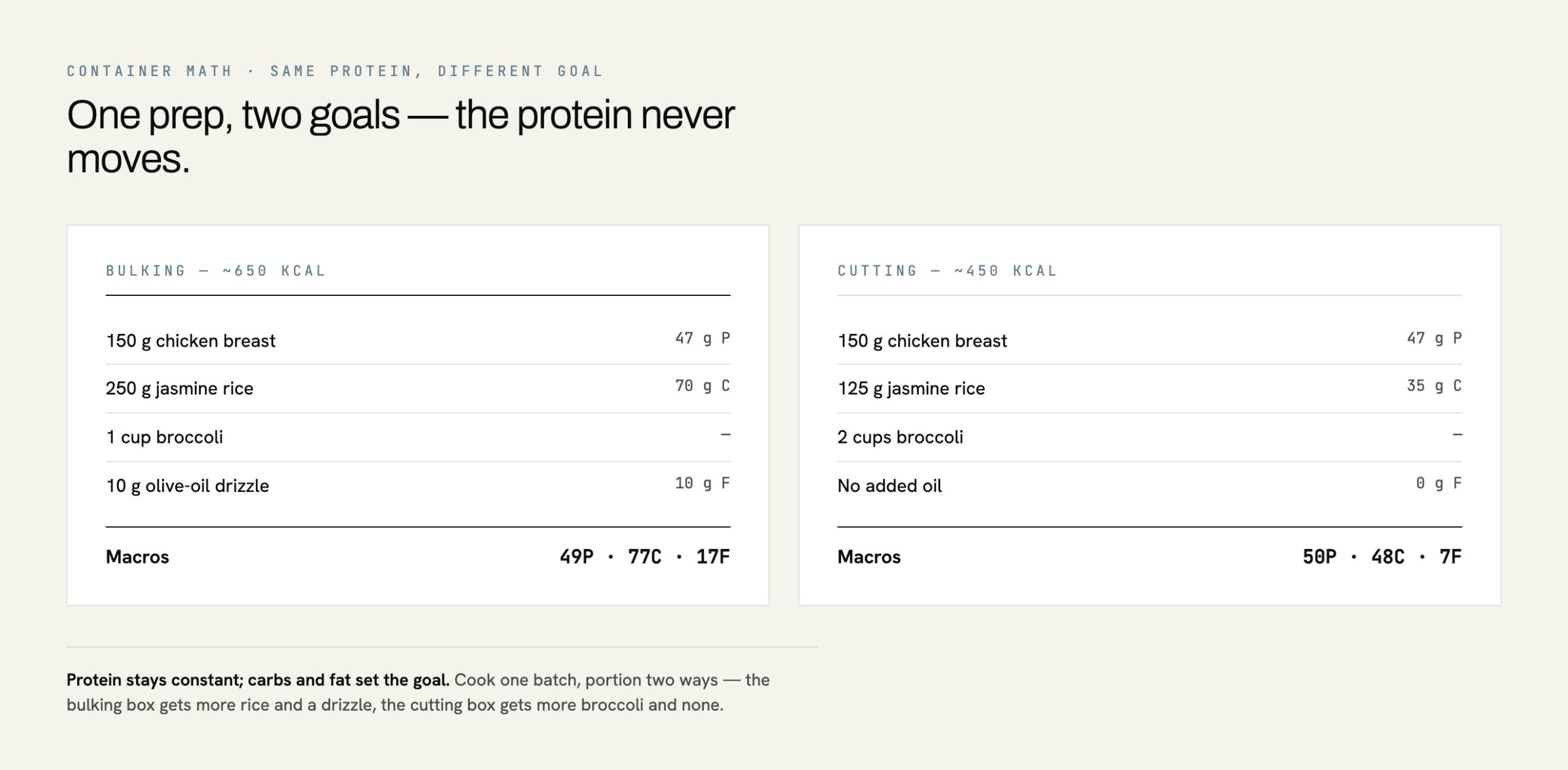
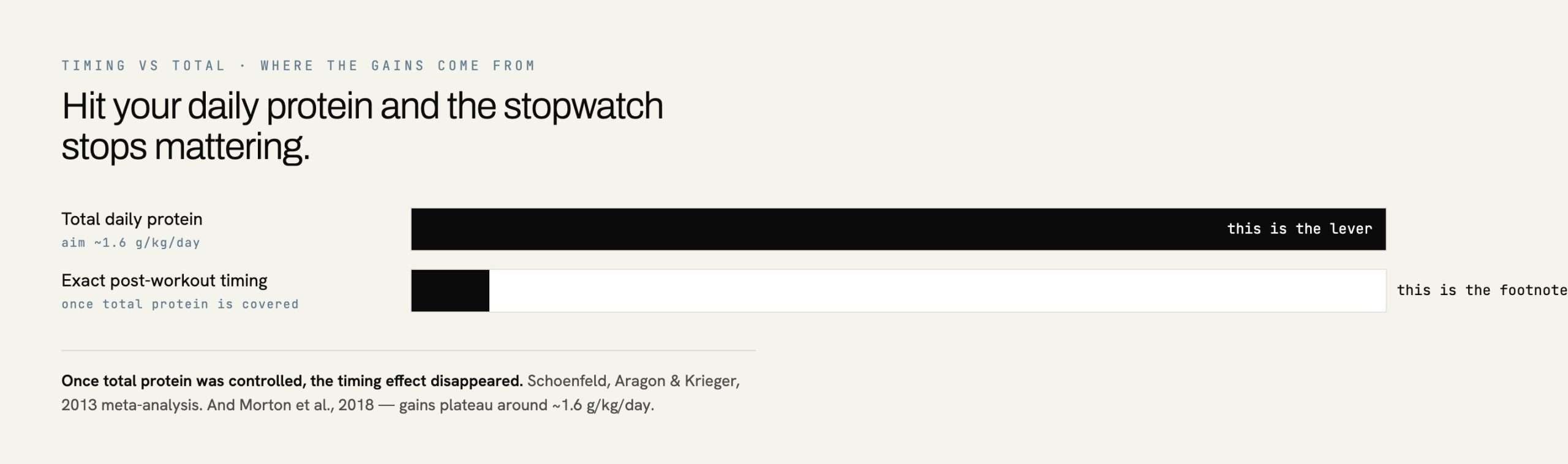
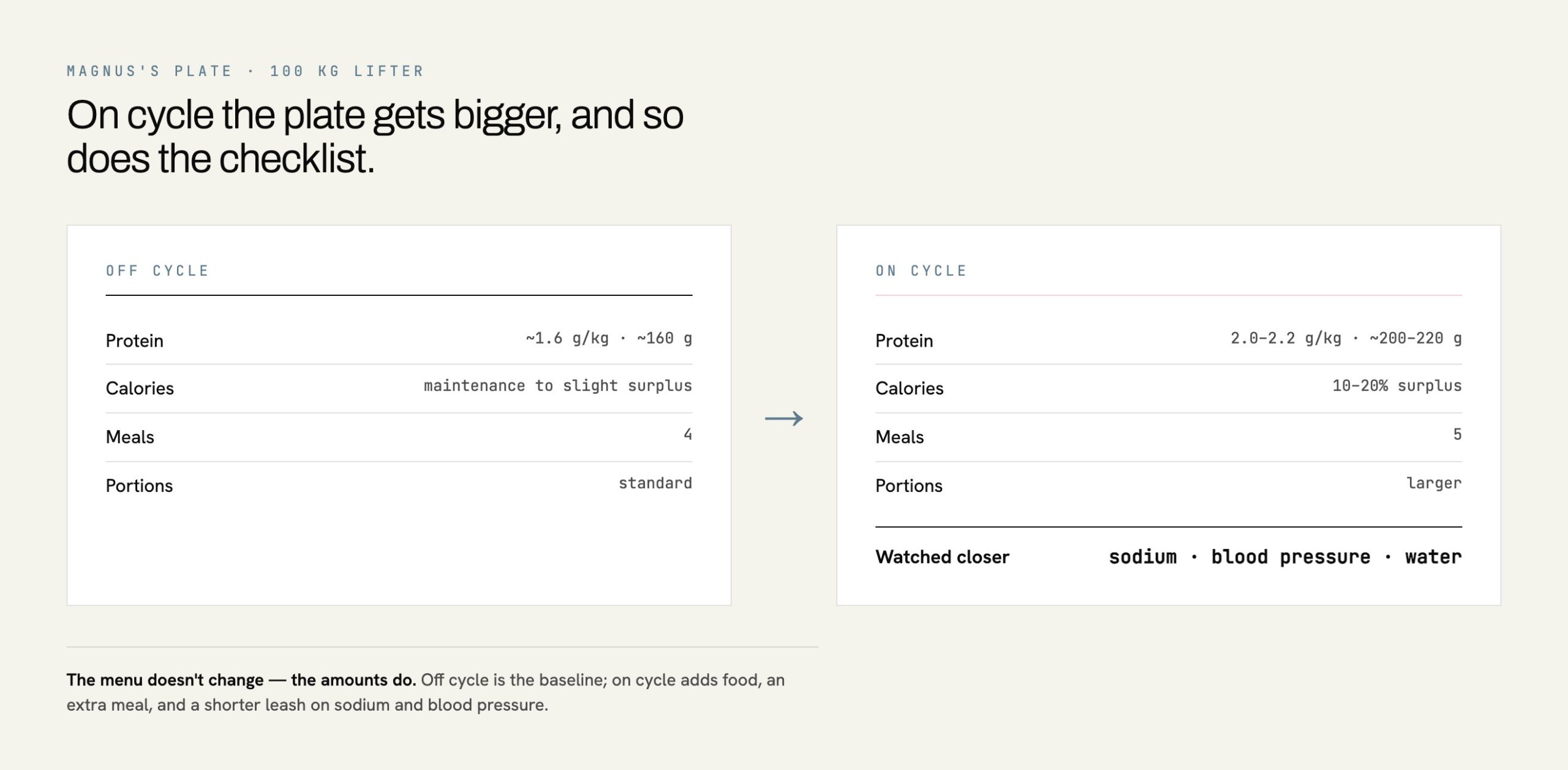
    Protein target. I eat more protein on cycle, plainly because I can build with more of it. For a natural lifter the research keeps landing around 1.6 grams of protein per kilogram of bodyweight per day as the point where extra protein stops adding muscle.[1] When I’m on, I sit at the top of the honest range — think 2.0 to 2.2 g/kg, the upper end the off-season research uses for hard-training bodybuilders[2] — because recovery is faster and there’s simply more building happening to feed. For a 100 kg man that’s roughly 200 to 220 grams a day. Not heroic. Just consistent.

    Food volume. More muscle recovering and more appetite means more total food. A modest surplus of maybe ten to twenty percent over maintenance is where lean tissue gets built without me turning into a water balloon[2] — and honestly, the exact surplus number is fuzzier in the science than the gurus pretend[3], so I watch the mirror and the scale, not a spreadsheet. Big calories that stay clean is the real skill here. That’s why my on-cycle plates lean on foods that are dense but honest, like a proper ribeye with rice and broccoli or a stack of high-volume beef and rice power bowls when I need the calories to disappear easily.

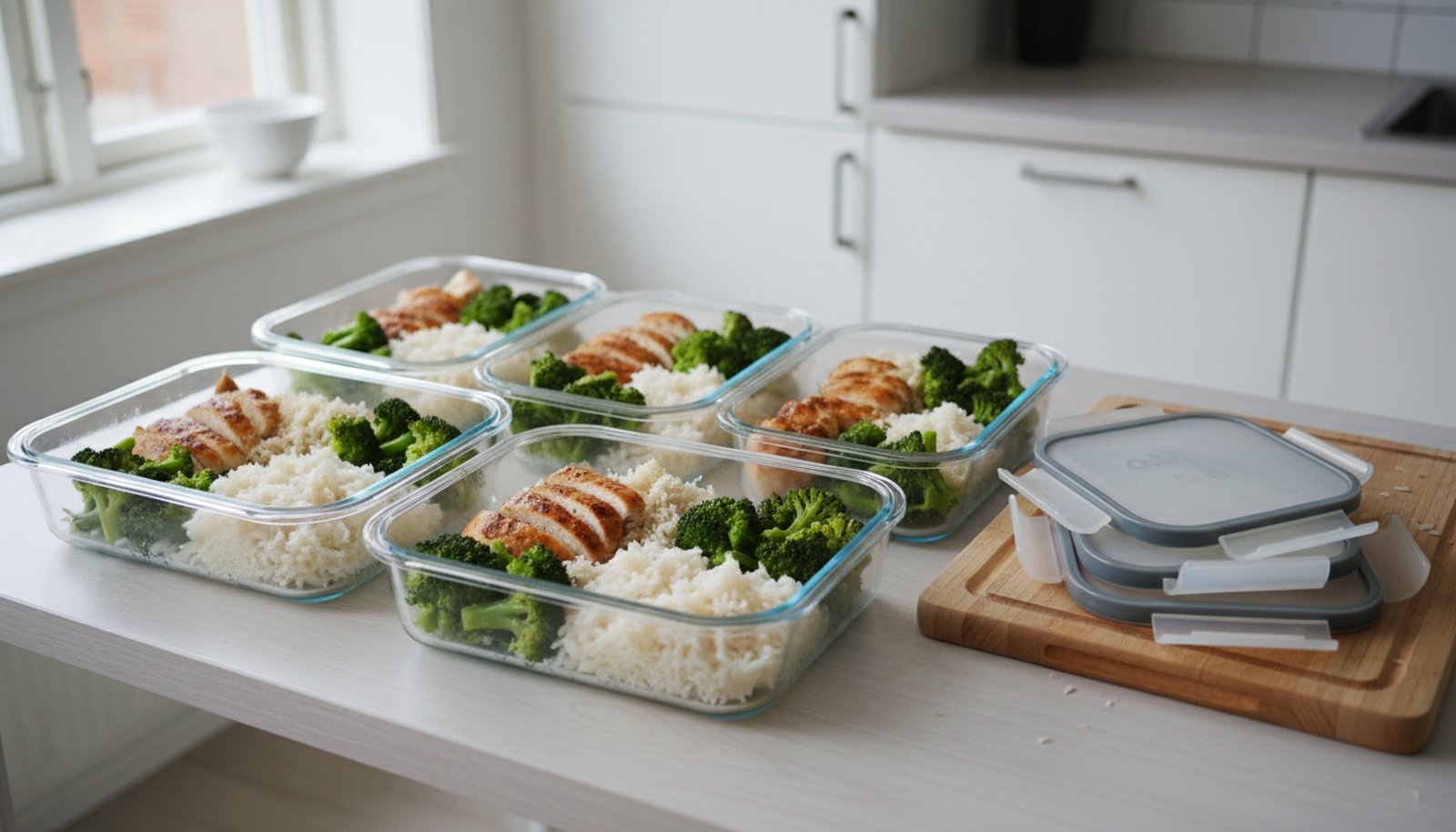
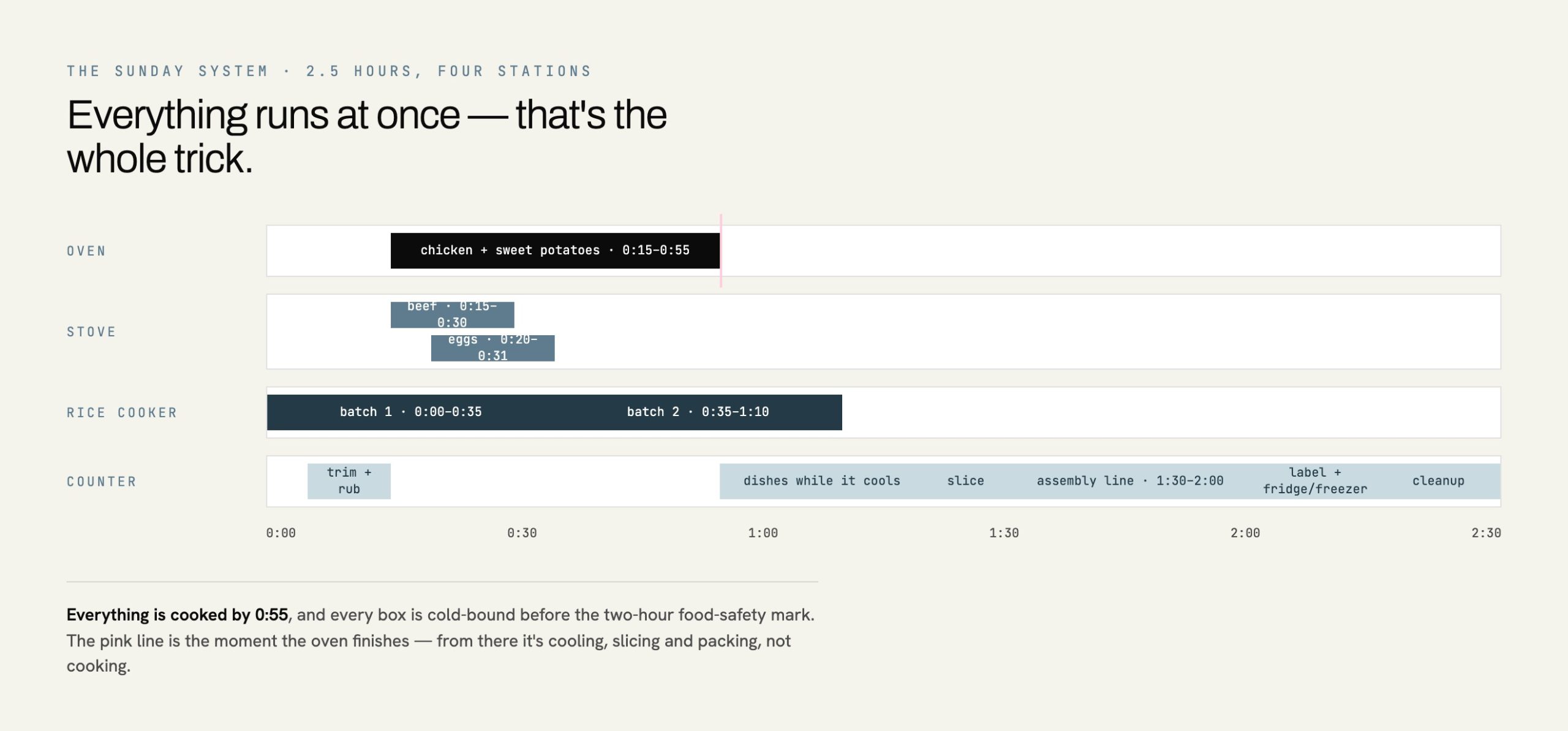
    The thing to guard against is letting the appetite decide the menu. On a heavy week I plan the day the night before — I know what’s going in every one of those five meals, and I’ve cooked most of it in advance. Prep is what keeps a big-appetite day from turning into a big-mistake day. When the hunger hits at four in the afternoon and there’s already a bowl in the fridge, you eat the food that builds you. When there’s nothing prepped, you eat whatever’s nearest, and on cycle “whatever’s nearest” adds up fast. My kitchen does more for my results than any part of my week that isn’t the gym.

    Do you need more protein on cycle?

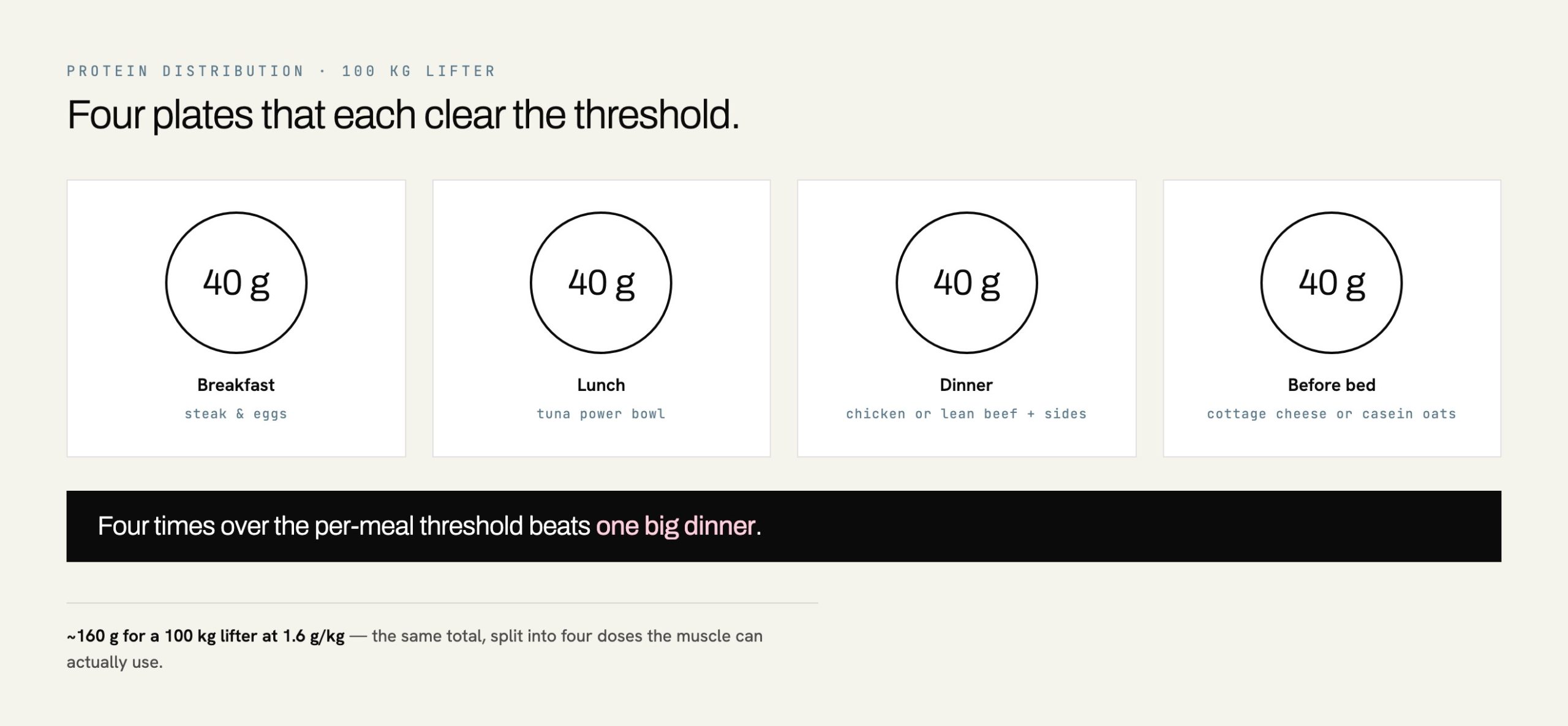
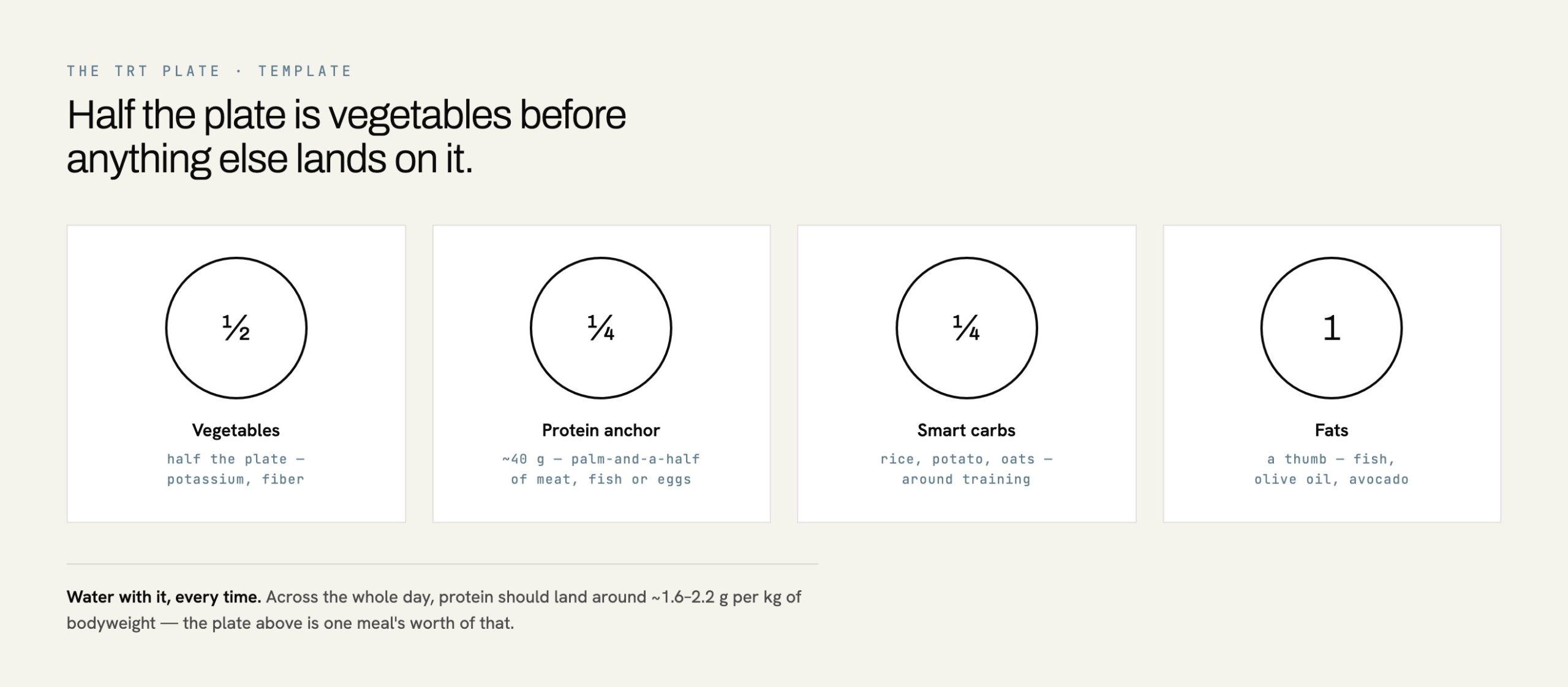
    Yes — but less than the internet screams, and here’s the honest reason. Protein is the raw material. Being on lets your body assemble that material faster and waste less of it, so more of what you eat actually becomes tissue. The distribution matters as much as the total: the sports-nutrition consensus is to spread it across the day in feeds of roughly 0.25 g/kg, or 20 to 40 grams a sitting, every three to four hours.[4] That’s four or five real meals for most of us, not one giant shake and a prayer.

    What I don’t do is treat protein as the only lever. Carbs fill me out, fuel the sessions that actually cause growth, and keep me sane. Fat keeps my hormones and my joints happy. A day built only on chicken breast and white rice will technically hit macros and quietly wreck your bloodwork and your mood. I’d rather you ate chicken thighs with rice and beans — fattier meat, real fibre, food that feeds a man — than choke down another dry, sad breast because someone online told you thighs were “dirty.” They aren’t. There’s no such thing.

    Comparison diagram of a steroid cycle diet versus off-cycle eating showing protein grams, calorie surplus, and meal frequency for a 100kg lifter
    Comparison diagram of a steroid cycle diet versus off-cycle eating showing protein grams, calorie surplus, and meal frequency for a 100kg lifter

    Sodium, water, and the puffy face

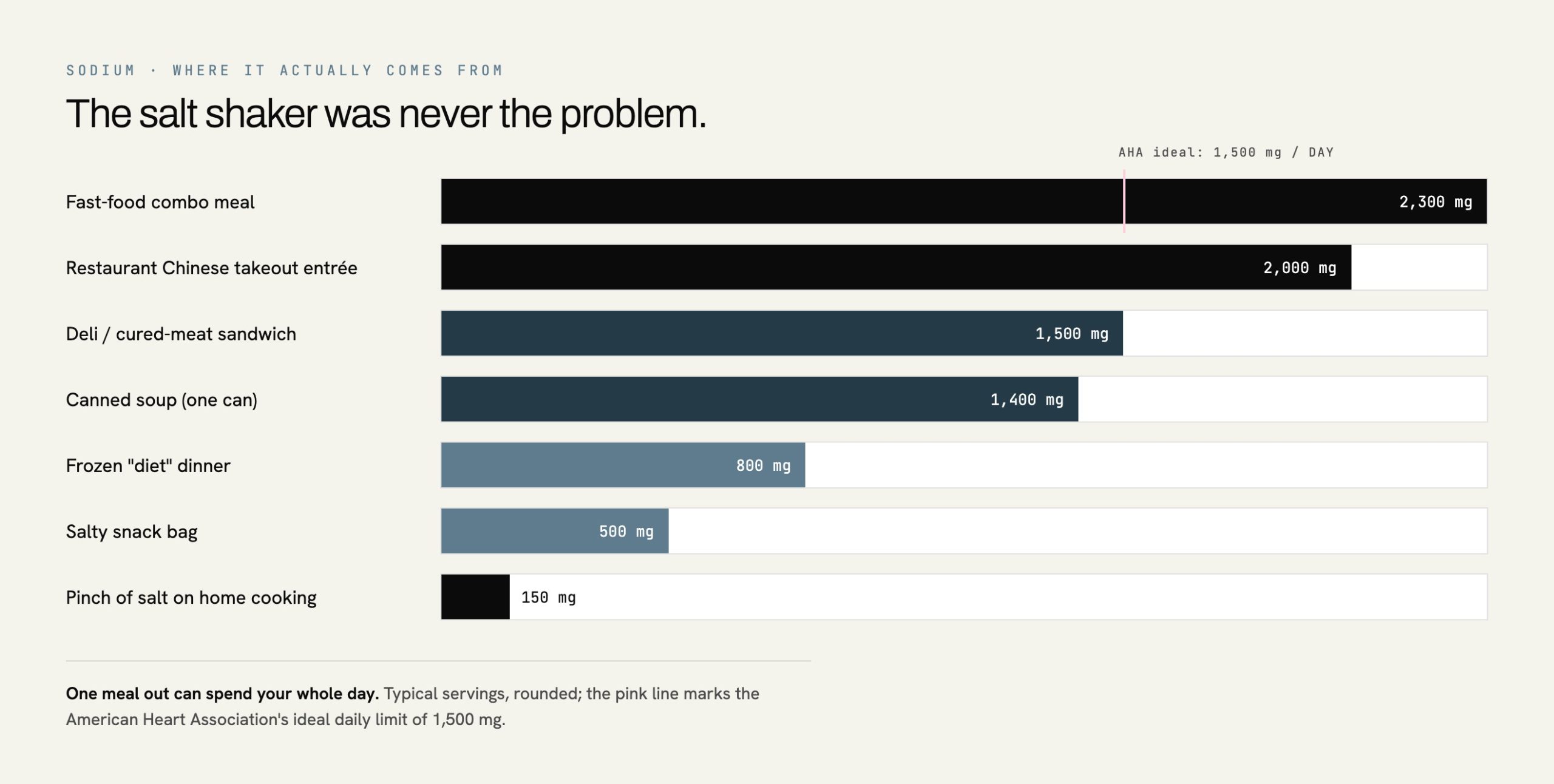
    This is the one men skip, and it’s the one I watch hardest. Many compounds hold water. Add a salty diet on top and you get the puffy face, the tight rings, the blood pressure creeping up where you can’t see it. High sodium intake pushes blood pressure up, and cutting back by even 1,000 mg a day measurably helps most people; the American Heart Association puts the ceiling at 2,300 mg and the ideal nearer 1,500 mg.[5]

    I’m not telling you to eat bland. I’m telling you where the salt actually hides — the sauces, the deli meat, the restaurant everything — and to cook enough of your own food that you’re the one holding the salt cellar. When I’m on, I keep potassium up with real potatoes, greens and fruit, drink my water honestly, and salt my own cooking to taste instead of eating whatever a factory decided. The puffy face usually isn’t the drug. It’s the drug plus a diet full of hidden sodium.

    Eating for your bloodwork

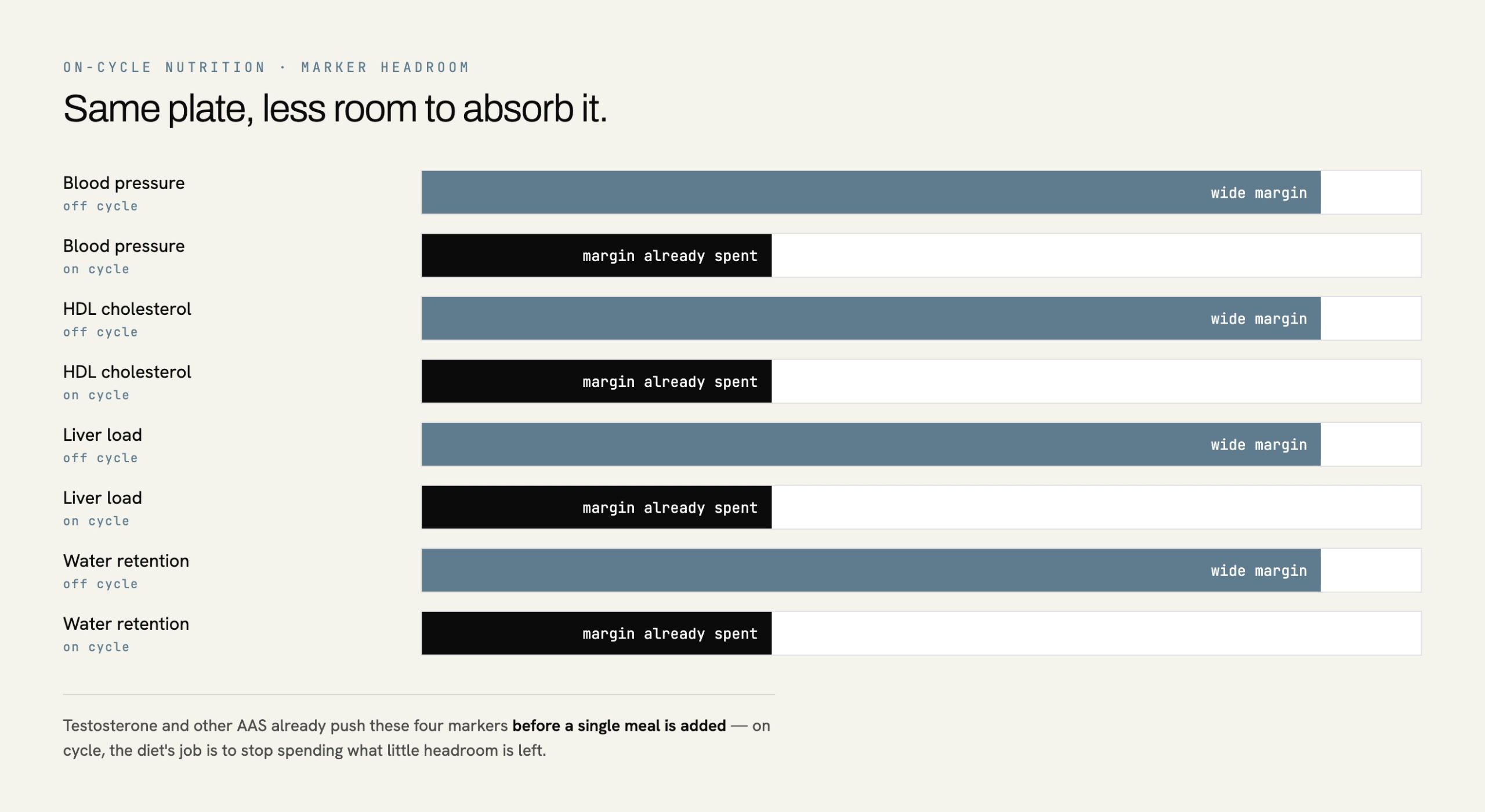
    When I’m on, my food choices answer to my labs, not the other way around. Three markers do the steering.

    • Blood pressure. The sodium story above, plus keeping bodyfat and stress in check. I take my BP at home when I’m on. If the cuff talks, the kitchen listens.
    • Lipids. Cycles can drag cholesterol around, so I lean into the foods that help — oily fish, olive oil, oats, plenty of fibre and colour — and I don’t pretend a stack of egg-white-and-bacon breakfasts is neutral. This is where fattier cuts get portioned with a bit more thought, not banned.
    • Liver. If any orals are ever in the picture, I keep the liver’s workload light: alcohol out, real food in, and nothing exotic sold as a “detox.” Whole food and water do more than any bottle of pills promising protection.

    The pattern across all three markers is the same: whole food helps, hidden ingredients hurt, and the man who cooks most of his own meals has the most control over what his labs say. I’m not eating differently on cycle because the compounds demand strange food. I’m eating the same real food more carefully, because there’s more riding on the numbers.

    None of this replaces a doctor. Get your bloodwork done before, during, and after — full stop. I cook and I count; I don’t diagnose. The plate is a tool for keeping your numbers quiet, not a substitute for reading them.

    From the stage

    Backstage in Sweden, standing there in bronzer at the B&K Classic, I learned the thing that still runs my kitchen: the man who peaks isn’t the one who found the best compound. It’s the one whose food and training were dialled for months. The rest is garnish.

    The drugs don’t cook — the research is blunt about it

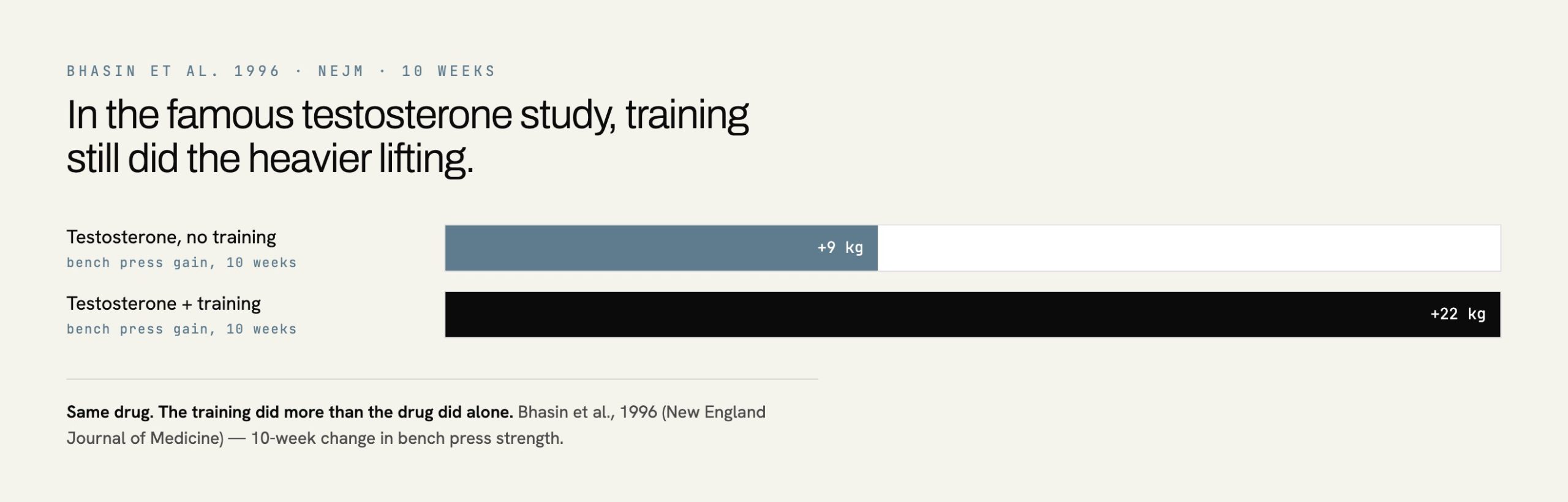
    I want to show you a number, because it’s the whole point. In the classic 1996 trial, men were given either testosterone or a placebo, with or without training, for ten weeks. The group that took testosterone without lifting gained real strength — about 9 kg on the bench. Respectable. But the group that took the same testosterone and trained gained 22 kg on the bench, and 6.1 kg of fat-free mass.[6] More than double, from the same drug, because they did the work.

    Read that again. The compound alone gave a fraction of what the compound plus training gave. And training doesn’t happen without food — you can’t recover from work you can’t fuel. That’s the honest hierarchy: the drug raises your ceiling, but your training and your plate decide how much of that ceiling you actually reach. This is exactly why the same rules I give a natural lifter over fifty in my guide to building muscle after 50 still apply to me on my heaviest week. The biology of a fork doesn’t care what’s in your bloodstream.

    The leanest, strongest I ever looked, I wasn’t running anything clever. I was cooking every meal, weighing my food, taking my blood pressure on Sunday nights at the kitchen table while the kids did homework, and training like it mattered. The years I chased it through the vial instead of the kitchen, I looked worse and felt worse. My husband will tell you: I’m a better-built man when I’m a better cook. That’s not a slogan. That’s just what the mirror keeps telling me.

    On cycle vs off cycle, at my table

    Here’s what genuinely shifts when I go from my normal TRT baseline to a heavier block, for a man around 100 kg. Note how little the foods change — it’s the volumes and the vigilance that move.

    At my tableOff / TRT baselineOn a heavier cycle
    Protein~1.6 g/kg (~160 g)~2.0–2.2 g/kg (~200–220 g)
    CaloriesMaintenance to slight surplus~10–20% surplus
    Meals a day44–5, bigger
    SodiumSensibleWatched hard; salt my own food
    Blood pressureChecked periodicallyChecked at home, weekly
    BloodworkRoutineBefore, during, after
    The actual foodsAlmost identical — steak, rice, eggs, thighs, potatoes, fish, greens
    Bar chart showing bench press strength gains from testosterone alone versus testosterone plus training, proving diet and training decide steroid diet results
    Bar chart showing bench press strength gains from testosterone alone versus testosterone plus training, proving diet and training decide steroid diet results

    If you take one thing from the table, take the bottom row. The kitchen barely changes. A smart bulking approach on cycle is the same one off it, just scaled to the appetite and watched a little closer. You already know how to cook the food that builds you. Being on just means you get to eat a bit more of it and you owe your bloodwork a bit more respect.

    Questions men actually ask

    What should I eat while on steroids?

    The same honest lifting food you should eat off them, scaled up: a high protein target spread across four or five meals, enough carbs to fuel hard training, real fats for your hormones and joints, and plenty of fruit, veg and fibre for your bloodwork. Steak, rice, eggs, chicken thighs, potatoes, oily fish, greens. Nothing exotic. The change on cycle is mostly volume and keeping a closer eye on sodium and blood pressure — not some secret food list.

    Can you eat eggs on steroids?

    Yes, absolutely. Whole eggs are one of the best foods you can eat on or off cycle — a large egg runs about 6 grams of complete protein, plus the fats and micronutrients that keep you running. The only thing worth watching is your lipid panel over time, so if your cholesterol is trending high, get your labs done and talk to your doctor about balance. That’s a bloodwork conversation, not a reason to fear the humble egg.

    Do you need more protein on cycle?

    A bit more, yes, because being on lets your body build faster and use more of it. Natural lifters do well around 1.6 g/kg a day; on a heavier cycle I sit nearer 2.0 to 2.2 g/kg, the upper end the off-season research uses. For a 100 kg man that’s roughly 200 to 220 grams, spread across the day in 20 to 40 gram feeds. More than that isn’t buying you extra muscle — it’s just expensive.

    Can you eat junk and grow anyway?

    You’ll grow something. Being on is forgiving enough that you can gain on a sloppy diet — for a while. But you’ll gain more fat, feel worse, and quietly punish your blood pressure, cholesterol and mood while you do it. The trial data is clear that the work you put in decides most of your result, and junk food undercuts the training and recovery that work depends on. You can get away with it. You just won’t like what you get.

    Does diet matter more on cycle or off?

    It matters just as much — arguably more, because the stakes on your health markers are higher. Off cycle, bad eating mostly costs you progress. On cycle, it costs you progress and stacks on top of compounds that are already asking more of your heart, lipids and liver. That’s the time to cook the most of your own food, not the least.

    So that’s the steroid diet, honestly: not a secret, just a bigger, better-watched version of eating like a man who respects his body. If you want me to do the planning for you, my free 7-day eat-well plan lays out real plates with real numbers — on cycle or off, TRT or natural, it’s the same honest food. Come eat well. I’ve got you.

    References

    1. British Journal of Sports Medicine — Morton et al., A systematic review, meta-analysis and meta-regression of the effect of protein supplementation on resistance training-induced gains in muscle mass and strength (2018)
    2. Sports (Basel) — Iraki et al., Nutrition Recommendations for Bodybuilders in the Off-Season: A Narrative Review (2019)
    3. Frontiers in Nutrition — Slater et al., Is an Energy Surplus Required to Maximize Skeletal Muscle Hypertrophy Associated With Resistance Training (2019)
    4. Journal of the International Society of Sports Nutrition — Jäger et al., ISSN Position Stand: Protein and Exercise (2017)

    5. American Heart Association — How Much Sodium Should I Eat Per Day? (2024)
    6. New England Journal of Medicine — Bhasin et al., The Effects of Supraphysiologic Doses of Testosterone on Muscle Size and Strength in Normal Men (1996)
    The honest fine print: I’m a cook and a lifter, not your doctor. Nothing here is medical advice, and nothing here tells you how to obtain or use any substance — that conversation belongs to you, your bloodwork, and a physician. Full details: Nutrition Disclaimer · Medical Disclaimer.
    Magnus Olafsson, the cook behind Slim Diet Era
    Written by

    Magnus Olafsson

    The cook behind Slim Diet Era. Former Swedish stage competitor (B&K Classic Body Show, Swedish Grand Prix), on TRT since 35, cooking high-protein food in Chicago for his husband, two kids, and you. He counts the macros so you don’t have to.

    More about Magnus →

    Hungry for a plan, not just a post?

    Start with the free plan — macros counted, grocery list written, in your inbox. You cook and eat; I’ll do the math.

  • Building Muscle After 50: The Complete Eating Guide

    Building Muscle After 50: The Complete Eating Guide

    BlogMuscle After 5011 min read

    Building Muscle After 50: The Complete Eating Guide

    A cook’s guide to the calories, protein, and per-meal plates that build muscle after 50 — with an honest word on TRT.

    Building Muscle After 50: The Complete Eating Guide

    I cook for men who train, and the ones who surprise people most are the ones past fifty. Building muscle after 50 isn’t a consolation prize or a “stay mobile” program. It’s the same job it was at thirty — put a load on the muscle, feed it enough protein, recover — done with a bit more care and a fair bit more food.

    I’m Magnus. I’m 40, I competed back in Sweden, and I’ve been on TRT since I was 35, so I’m not going to pretend I don’t know what testosterone does for a man. But I’ll tell you the same thing I tell every big man in his fifties who leans over the counter and asks me if it’s too late: it isn’t, and the fix starts on your plate, not in a vial.

    The men over 50 I lift near don’t lack effort. They lack food. They eat like they’re still trying to shrink from their forties, and then they wonder why the muscle won’t come. So let’s fix the eating. Calories, protein, how to lay out your meals, what a real week looks like, and an honest word on TRT at the end.

    Yes, you can build muscle after 50

    Let me kill the doubt first, because it’s the thing that keeps good men soft. Muscle building after 50 is not only possible, it’s well documented. In a pooled analysis of 49 resistance-training studies in adults aged 50 and older, older lifters put on an average of 1.1 kg of lean mass — real muscle, not water — and the higher-effort programs built more.[1] That’s an average across ordinary people, many of them beginners, many well past sixty.

    Your body at 55 still reads the same signals it did at 25. Lift something heavy enough to be hard, give it protein and rest, and it grows. What changes is the volume knob on how loudly your muscle hears that signal. Turn it up on purpose, and you’re back in business.

    Magnus’s rule

    Age doesn’t close the door on muscle. Under-eating does. Nearly every “I can’t build muscle anymore” I’ve heard turned out to be an “I’m not eating enough to” once we counted it.

    What actually changes: anabolic resistance

    Here’s the one piece of science worth understanding, and then we cook. As you age, your muscle gets a little deaf to protein. Researchers call it anabolic resistance: an older muscle needs a bigger dose of amino acids to kick off the same muscle-building response a younger muscle gets from a smaller one.[2]

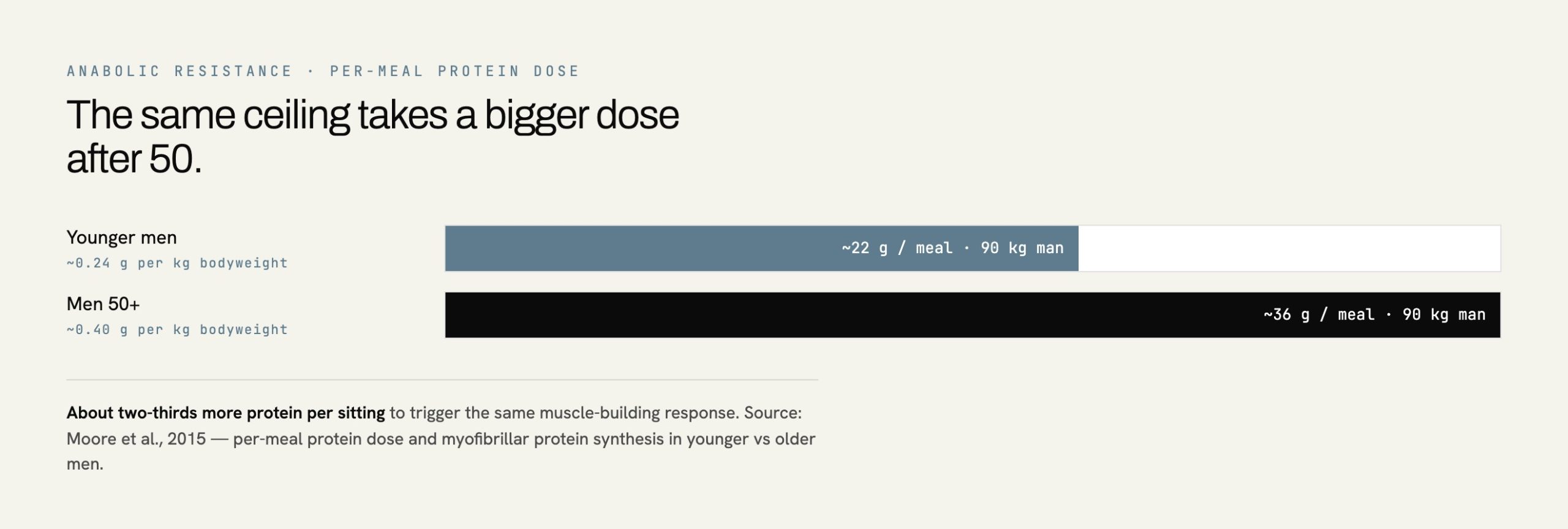
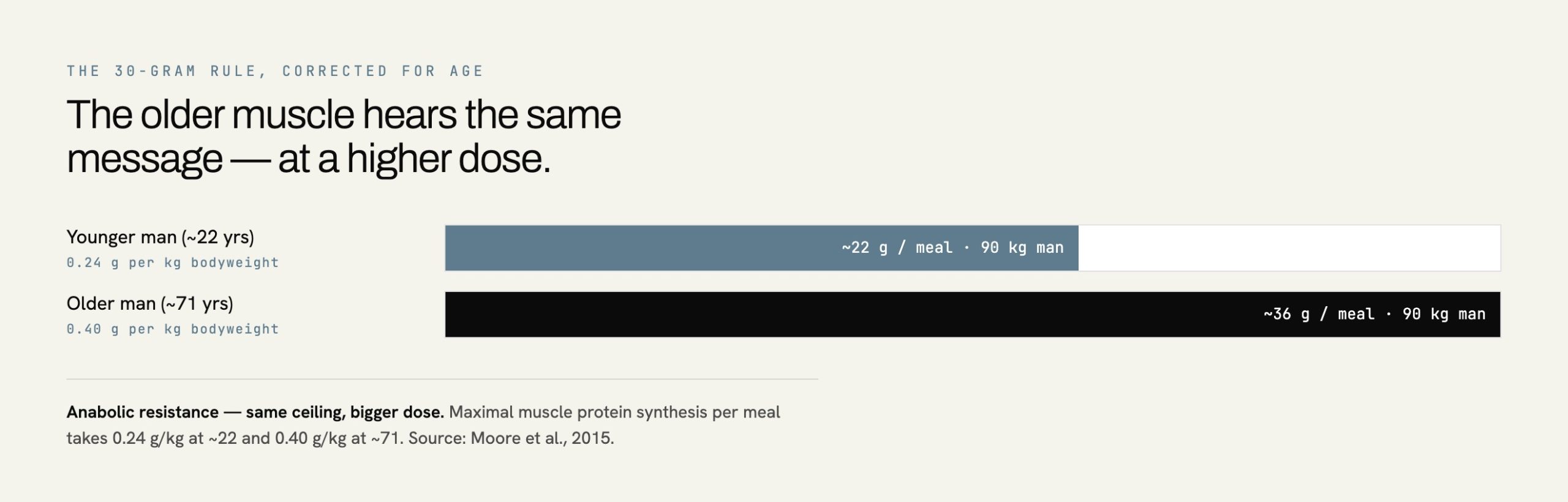
    How much bigger? In a clean comparison of younger and older men, the younger group maxed out their per-meal muscle protein synthesis at about 0.24 g of protein per kg of bodyweight. The older men needed roughly 0.40 g/kg — about two-thirds more — to hit the same ceiling.[3] Same plate, less result, unless you make the plate bigger.

    Chart comparing protein per meal needed for building muscle after 50 versus younger men, 0.40 versus 0.24 grams per kilogram
    Chart comparing protein per meal needed for building muscle after 50 versus younger men, 0.40 versus 0.24 grams per kilogram

    A big part of that dose is leucine, the amino acid that flips the muscle-building switch. Older muscle wants more of it in one sitting to get going, which is why “a bit of protein spread thin all day” fails men past fifty.[2] You want proper hits, not sprinkles. Good news: this is a kitchen problem, and kitchens are where I live.

    Two more things worth knowing, then we cook. First, a lot of what looks like aging is really inactivity stacked on top of it — a muscle that hasn’t been asked to do much in a decade gets deaf faster. Second, the same lifting that builds the muscle also sharpens its ear for protein. Train the muscle and it listens better; the anabolic resistance eases the moment you start giving it a real reason to grow.[2] Food and training aren’t two separate fixes. They’re the same fix from two sides.

    Protein needs for men over 50

    So how much? The old RDA — 0.8 g/kg/day — is a floor for a sedentary body to avoid deficiency, not a target for a man trying to grow. For older adults, an expert group (the PROT-AGE panel) put the healthy baseline at 1.0–1.2 g/kg/day, and higher for anyone who exercises.[4] For men who train hard, the sports-nutrition consensus lands at 1.4–2.0 g/kg/day.[5] The protein needs for men over 50 who lift sit at the top of that range, not the bottom.

    Let me put it in real food for a 90 kg (198 lb) man, because grams-per-kilo means nothing over a stove.

    Who you areProtein targetFor a 90 kg (198 lb) man
    Sedentary, just avoiding deficiency (RDA)0.8 g/kg/day~72 g
    Healthy older adult, not training[4]1.0–1.2 g/kg/day90–108 g
    Man over 50 who lifts[5]1.6–2.0 g/kg/day145–180 g

    If you weigh more, scale it up. If you’re carrying a lot of extra fat, base the math closer to your goal weight so you’re not chasing an unrealistic number. For most training men over fifty I’d point at roughly 1.8 g/kg and call it a day. That’s about 160 g for our 90 kg man, and it’s more than almost anyone eats by accident.

    Kitchen math

    160 g of protein sounds like a lot until you plate it: 4 eggs and a steak (~40 g), a chicken bowl (~45 g), a tub of cottage cheese or a shake (~30 g), a salmon fillet (~40 g). Four honest meals. That’s the whole trick.

    Where that protein should come from

    Not all protein hits the same. For an older muscle, the quality of each dose matters more than it did when you were young, because you’re leaning on it to punch through anabolic resistance. Animal proteins — meat, fish, eggs, dairy — carry the most leucine per gram and the fullest set of amino acids, so they do the heavy work with less on the plate. Roughly 35–40 g of a good animal protein gets you the ~2.5–3 g of leucine a meal wants.[2]

    I’m not telling you to eat meat at every meal, and plant proteins absolutely count — you just need a bit more of them and a wider mix to land the same leucine. Beans and rice, tofu, a scoop of whey stirred through oats: all fine. The point isn’t animal versus plant, it’s making each meal’s dose big enough and complete enough to matter. A slow-digesting protein at night helps too, which is why cottage cheese and casein have a place before bed for men over fifty holding onto muscle overnight.

    Calories: eat enough to actually build

    Protein is the building block. Calories are the permission slip. You cannot build much muscle in a real deficit, and the men who stay stuck are almost always eating too little across the day, not too much.

    To grow, most men over 50 do well with a small surplus — a couple hundred calories over what holds your weight steady. Not a bulk, not a free-for-all. Enough that the scale drifts up slowly over months while the mirror and the barbell tell you it’s mostly muscle. If you’re also carrying weight you’d rather lose, you can hold calories at maintenance, push protein high, and let training recomposition do slow work. It’s slower, but it’s honest.

    You don’t need a fancy calculator to find your maintenance. Take your bodyweight in pounds and multiply by about 14–15 if you’re fairly active — our 198-pound man lands somewhere near 2,800 calories to hold steady, so 3,000-ish to grow slowly. Treat that as a starting guess, not gospel. Eat it for two or three weeks, watch the scale and the mirror, and adjust by a couple hundred calories either way. Your body will correct the math faster than any app. What you don’t do is guess low and stay hungry — that’s the trap that keeps a fifty-year-old spinning his wheels.

    The plates I build for this do double duty: high in protein, full of vegetables, real carbs around training, good fats for your joints and your bloodwork. A salmon and avocado plate is the shape of the whole idea — 40-odd grams of protein, fats that love your heart, and nothing you have to apologize for.

    How to structure meals: the over-50 plate

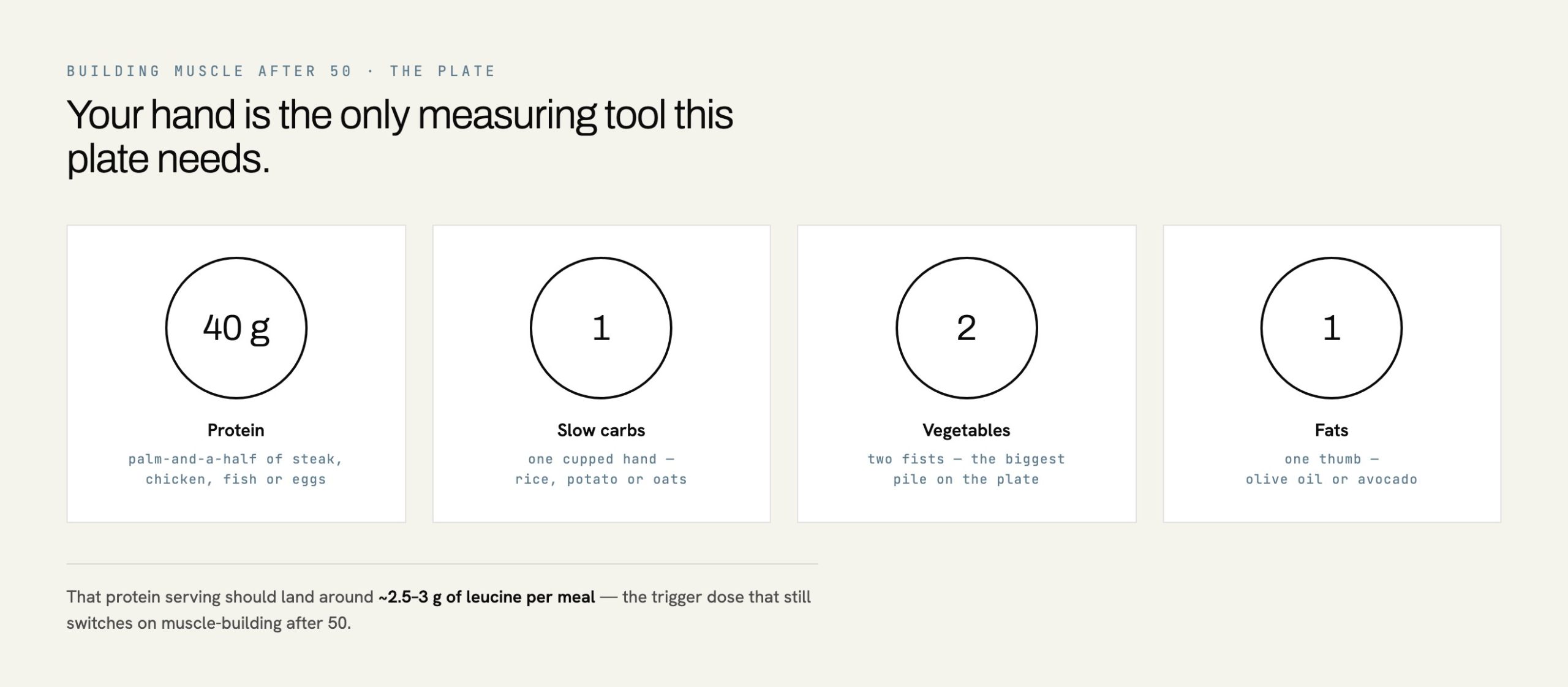
    Eating for muscle growth after 50 comes down to two habits: hit a real protein dose at each meal, and don’t leave big gaps. Because of anabolic resistance, you want a proper leucine hit per sitting — aim for 35–45 g of quality protein three or four times a day, spaced every few hours.[2][5] That single change fixes most stalled older lifters I meet.

    The over-50 plate diagram showing protein, slow carbs, vegetables and fat portions for building muscle after 50
    The over-50 plate diagram showing protein, slow carbs, vegetables and fat portions for building muscle after 50

    Build every plate in this order and you won’t have to count much:

    • Protein first. A palm-and-a-half of steak, chicken, fish, or a good stack of eggs. This is the meal; everything else is a side.
    • Slow carbs around it. A cupped hand of rice, potatoes, or oats — more on training days, especially after you lift.
    • Two fists of vegetables. Volume, fiber, color. They keep you full so the eating stays comfortable.
    • A thumb of good fat. Olive oil, avocado, oily fish. Your joints and your cholesterol panel both thank you.

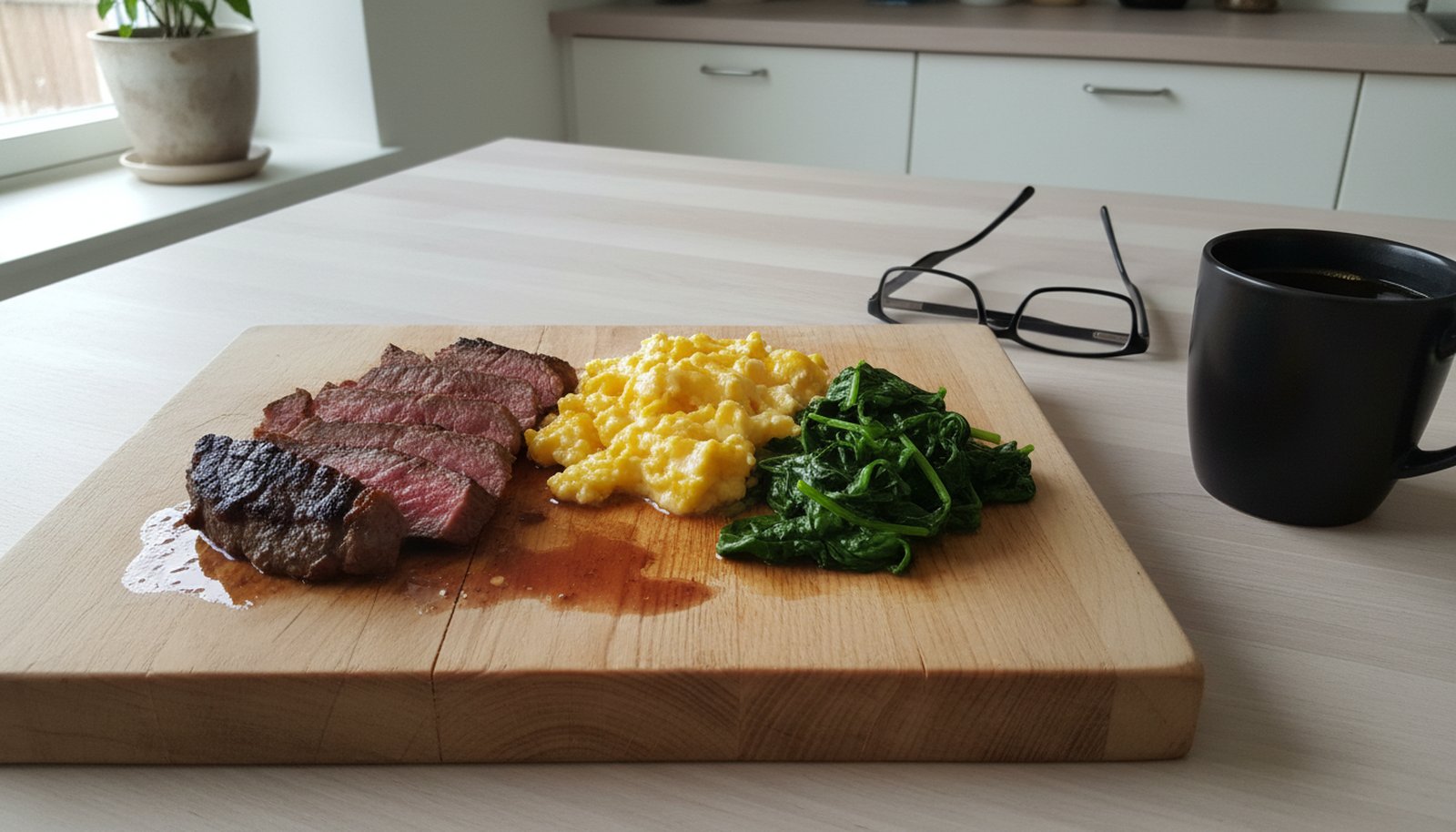
    Breakfast is where most men over fifty leave protein on the table — toast and coffee, then nothing worth counting until noon. Fix that one meal first. Steak and eggs with spinach lands 40 grams before you’ve properly woken up, and the leucine from red meat and eggs is exactly the morning hit an older muscle wants.

    What a week of eating looks like

    Here’s a plain day for our 90 kg man, the kind of thing I’d set up for building muscle after 50 for men who’d rather cook four real meals than fuss with six. Repeat the shape across the week, swap the proteins so you don’t get bored, and lean the carbs toward your training days.

    MealWhat’s on the plateProtein
    BreakfastSteak and eggs with spinach~40 g
    LunchMediterranean chicken bowl~45 g
    SnackCottage cheese, or a whey shake~30 g
    DinnerSalmon and avocado plate~40 g
    Day total~155 g

    That’s four hits, each one big enough to matter, spaced across the day. No meal is a sprinkle. If you want the whole system laid out — the recipes, the swaps, the grocery list — my recipe kitchen is built for exactly this kind of eating.

    Training is the ask; food is the answer

    I’m a cook, not your coach, so I’ll keep this short. Food builds nothing on its own — it answers a demand that lifting makes. You need to put a real, progressive load on the muscle: work hard, add a little over time, and cover the big movements. The research that shows older men building muscle is resistance-training research; the men who gained the most simply trained harder.[1]

    Recovery matters more now than it did at thirty. You’ll want a day between hitting the same muscle, sleep you actually protect, and the protein spread across the day we already talked about. Train to make the ask, then eat to answer it. That’s the whole partnership.

    The TRT question, honestly

    I said I’d be straight with you, so here it is. I’ve been on testosterone since 35. I know what it does — appetite, recovery, how much work the muscle will take before it complains. I’m not going to sit here in a pink apron and tell you hormones don’t help, because they do, and pretending otherwise is how you lose a man’s trust.

    When I first went on TRT, the thing that changed most wasn’t some overnight transformation — it was hunger, and how much better food worked. But I’d already spent years on stage in Sweden learning to eat with intent. The men I’ve watched waste that same edge were the ones who thought the prescription was the plan and let the eating go slack. It doesn’t work like that. Testosterone gives you a better engine. It doesn’t put fuel in the tank.

    So do you need it to build muscle after 50? No. Food and training come first, always, and most men have a lot of room in both before hormones are even the question. Low testosterone is real and it can flatten a man, but that’s a conversation for a doctor and a blood test, not a gym decision and not something you’ll find guidance for from me. If you’re dragging, sleeping badly, and losing your drive, get proper bloodwork and talk to someone qualified. Then come back and let’s fix the eating either way, because the plate matters whether you’re on anything or not.

    Magnus’s rule

    Fix your food and your training for a solid year before you decide your hormones are the problem. If something still feels off, that’s a doctor and a blood panel — never a shortcut, never something I’d hand you.

    You’ve got more time than the internet told you, big man. Start with the next meal — a real protein hit, sometime in the next few hours. If you want it done for you, my kitchen has the plates ready. I’ve got you.

    Questions men actually ask

    Can you really build muscle after 50?

    Yes. Studies of resistance training in adults over 50 show real lean-mass gains — around 1.1 kg on average, more with harder training. Your muscle still responds to load and protein; you just need a bigger protein dose per meal than a younger man does.

    How much protein do I need to build muscle after 50?

    More than the old RDA of 0.8 g/kg. Aim for roughly 1.6–2.0 g/kg of bodyweight per day if you’re training — about 145–180 g for a 90 kg (198 lb) man — split into 35–45 g hits across three or four meals.

    What should I eat to build muscle after 50?

    Build each plate protein-first: steak, chicken, fish, eggs, dairy. Add slow carbs around training, two fists of vegetables, and a thumb of good fat. Front-load protein at breakfast, which is where most men over fifty fall short.

    Is it too late to start lifting at 55?

    No. Plenty of the men in the research were beginners in their fifties, sixties, even older, and still gained muscle. Start lighter, learn the movements, add load slowly, and eat enough protein to back it up.

    What supplements should I take to build muscle after 50?

    Food first, always. Whey or a protein powder is useful if you struggle to hit your protein — it’s just convenient food. Creatine is well studied and cheap. Beyond that, get a blood test and let real gaps guide you rather than a shelf of pills.

    Do you need TRT to build muscle after 50?

    No. Food and training come first, and most men have plenty of room in both before hormones enter the picture. If you have real symptoms — low energy, poor sleep, no drive — that’s a reason for bloodwork and a doctor, not a gym decision.

    References

    1. Medicine & Science in Sports & Exercise — Peterson et al., Influence of resistance exercise on lean body mass in aging adults: a meta-analysis (2011)
    2. Nutrition & Metabolism — Breen & Phillips, Skeletal muscle protein metabolism in the elderly: interventions to counteract the ‘anabolic resistance’ of ageing (2011)
    3. Journals of Gerontology Series A — Moore et al., Protein ingestion to stimulate myofibrillar protein synthesis requires greater relative protein intakes in healthy older versus younger men (2015)
    4. JAMDA — Bauer et al., Evidence-based recommendations for optimal dietary protein intake in older people: a position paper from the PROT-AGE Study Group (2013)
    5. Journal of the International Society of Sports Nutrition — Jäger et al., ISSN Position Stand: protein and exercise (2017)
    The honest fine print: I’m a cook and a lifter, not your doctor. Nothing here is medical advice, and nothing here tells you how to obtain or use any substance — that conversation belongs to you, your bloodwork, and a physician. Full details: Nutrition Disclaimer · Medical Disclaimer.
    Magnus Olafsson, the cook behind Slim Diet Era
    Written by

    Magnus Olafsson

    The cook behind Slim Diet Era. Former Swedish stage competitor (B&K Classic Body Show, Swedish Grand Prix), on TRT since 35, cooking high-protein food in Chicago for his husband, two kids, and you. He counts the macros so you don’t have to.

    More about Magnus →

    Hungry for a plan, not just a post?

    Start with the free plan — macros counted, grocery list written, in your inbox. You cook and eat; I’ll do the math.