Blog

  • How Much Protein Is in a Chicken Breast? Raw vs Cooked, Weighed in My Kitchen

    How Much Protein Is in a Chicken Breast? Raw vs Cooked, Weighed in My Kitchen

    BlogAnabolic Kitchen11 min read

    How Much Protein Is in a Chicken Breast? Raw vs Cooked, Weighed in My Kitchen

    A raw breast has ~22.5g protein per 100g and a cooked one ~31g — same meat, minus the water. Here’s the real number, weighed.
    How Much Protein Is in a Chicken Breast? Raw vs Cooked, Weighed in My Kitchen

    Here is the honest answer to how much protein is in a chicken breast: a raw, skinless, boneless breast has about 22.5 grams of protein per 100 grams, and once you cook it that same meat concentrates to roughly 31 grams per 100 grams because it loses water.[1][3] Both numbers are correct. They describe the same piece of chicken at two different moments, and mixing them up is the single most common tracking mistake I see.

    A whole medium breast, the kind you buy two-to-a-pack at the store, lands somewhere around 45 grams of protein whether you weigh it raw or after it hits the grill — the meat shrinks, but the protein inside it barely moves.

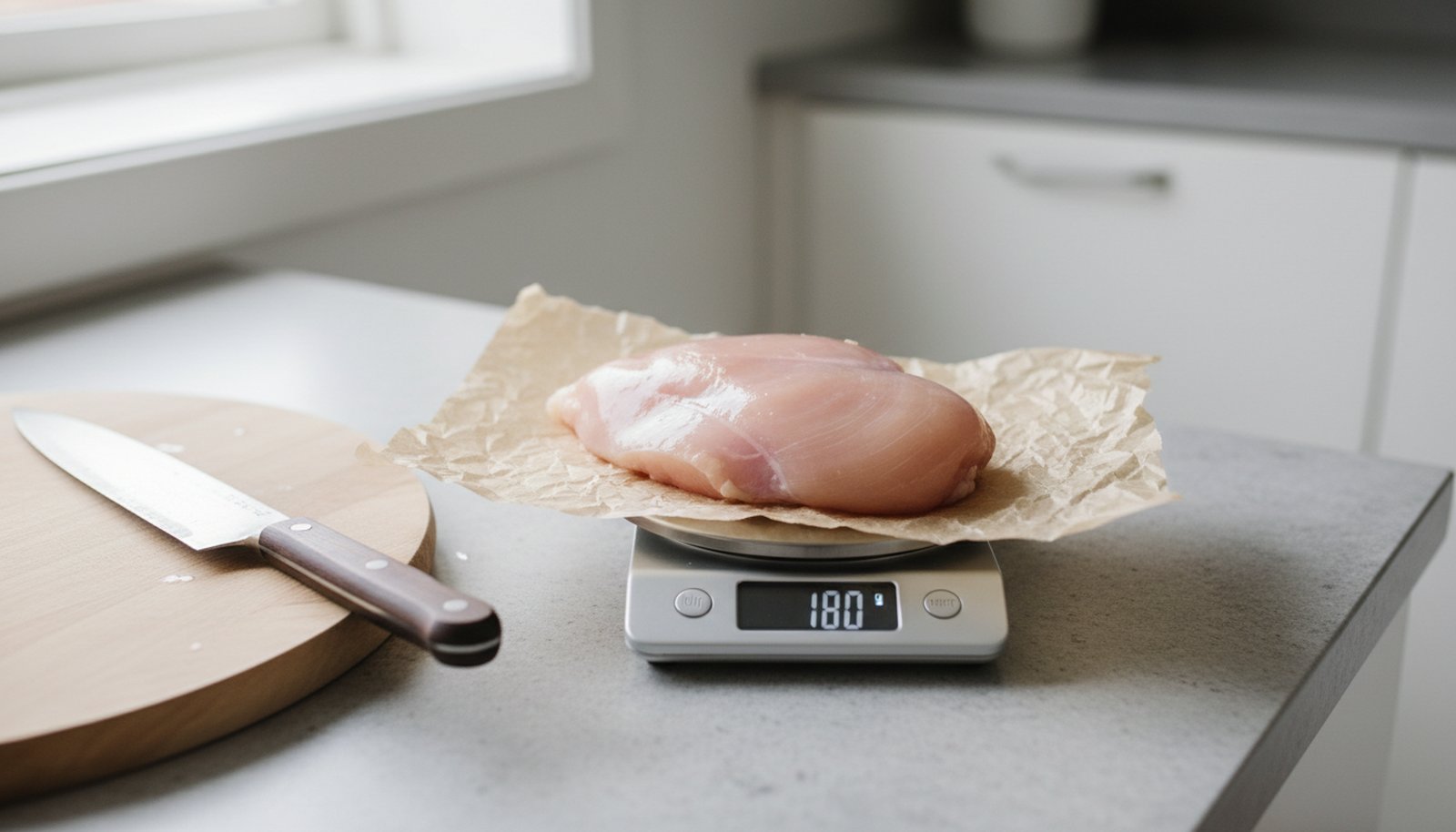
    I stood at my counter in Chicago with a scale and cooked three breasts three ways to show you exactly what happens. Raw, grilled, poached. Small, medium, large. No rounding in my favor. Let me walk you through it, big man, because once you see it you will never miscount your chicken again.

    The short answer, before anything else

    If you cook and eat one average chicken breast, you are getting roughly 40 to 55 grams of protein, depending on its size. That is the number to carry in your head. Everything below is me showing my work so you can trust it.

    Here are the USDA reference figures, per 100 grams, for skinless boneless breast meat:

    • Raw: 22.5 g protein · 120 kcal · 73.9 g water[1]
    • Roasted (dry heat): 31.0 g protein · 165 kcal · 65.3 g water[2]
    • Stewed / poached (wet heat): 29.0 g protein · 151 kcal · 68.3 g water[3]

    Look at the water column, because that column explains everything else on this page.

    Why cooked chicken has more protein per 100g than raw

    This trips up good, careful people every single day, so slow down with me here. When you read that chicken breast has “31 grams of protein per 100 grams,” that is cooked meat. When your food-tracking app shows raw breast, it says about 22.5. Same bird. So what changed?

    Water left. Raw breast is nearly three-quarters water by weight — 73.9 grams out of every 100.[1] Put it on heat and the muscle fibers tighten and squeeze that moisture out; roasted breast drops to 65.3 grams of water per 100.[2] The protein does not evaporate — water does. So the protein you started with is now packed into a smaller, lighter piece, which pushes the chicken breast protein per 100g figure up even though nothing was added.

    Researchers have measured this directly. A 2016 study on chicken cooked five different ways found that every method — boiling, steaming, grilling, microwaving — increased cooking loss and lowered the moisture left in the meat, with boiling and oven-convection giving up the most water.[6] That water loss is not a nutrition loss. It is a concentration.

    Magnus’s rule

    Cooking does not add protein and it does not destroy it. It removes water. Per 100 grams the protein goes up; per piece it stays about the same. Hold both facts at once and you are already ahead of most gym floors.

    What I weighed in my Chicago kitchen

    Numbers on a government website are one thing. I wanted to see it with my own scale, so I bought a pack of breasts, picked a small one, a medium one, and a large one, and cooked them. The medium I grilled. I poached a second medium in barely-simmering water to compare wet heat against dry. Here is what came off the scale.

    BreastRaw weightProtein rawCooked methodCooked weightProtein in the piece
    Small140 g~32 gGrilled~105 g~32 g
    Medium200 g~45 gGrilled~150 g~46 g
    Medium200 g~45 gPoached~160 g~45 g
    Large280 g~63 gGrilled~210 g~65 g

    Read across any row. The raw weight and the cooked weight are very different — grilling took roughly a quarter of the weight off as water. But the protein in the piece, the last column, barely budges. The grilled medium and the poached medium started identical and ended within a gram of each other in protein, even though the poached one held onto more water and weighed a touch more.

    The small extra gram or two on the grilled pieces is just the USDA density math playing out; it is not real new protein and I would not count on it. What matters is the shape of the story: the piece keeps its protein; only its weight and water change.
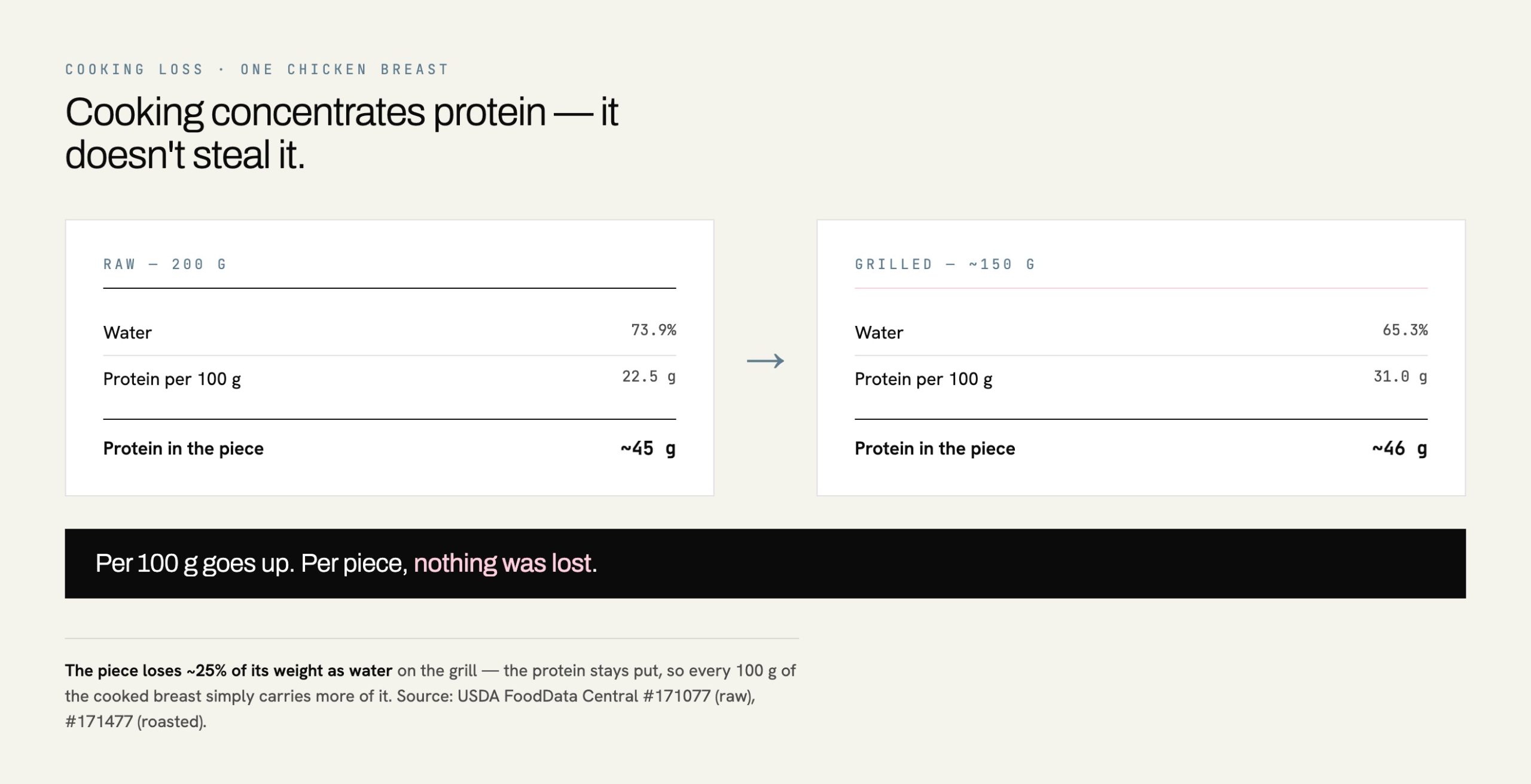
    Raw versus cooked chicken breast protein: per-100g density rises from 22.5g to 31g as water leaves, while protein per piece stays near 45g
    Raw versus cooked chicken breast protein: per-100g density rises from 22.5g to 31g as water leaves, while protein per piece stays near 45g

    How much protein is in 8 oz of chicken breast

    This is where the raw-versus-cooked mix-up costs you the most, because “8 ounces of chicken” means two very different things depending on when you weigh it. Eight ounces is 227 grams.

    • 8 oz raw breast: 227 g × 22.5 g/100 g = about 51 grams of protein.[1]
    • 8 oz cooked (roasted) breast: 227 g × 31.0 g/100 g = about 70 grams of protein.[2]

    That is a 19-gram gap on the exact same “8 oz chicken breast” — nearly a whole extra small breast’s worth — created entirely by when the scale was under it. If your plan says “eat 8 oz of chicken” and you weigh it raw, you get 51 grams. If a restaurant menu says “8 oz grilled chicken,” that plate is closer to 70. Neither is lying. They are weighing at different moments.

    Kitchen math

    The protein in 8 oz chicken breast is ~51 g if that 8 oz was on the scale raw, ~70 g if it was weighed after cooking. Decide which one your target means before you serve yourself, and stay consistent.

    A cup of diced chicken, and the grocery rotisserie

    Not everyone weighs. Sometimes you shred last night’s breast into a bowl or pull a rotisserie bird apart with your hands, and you still want a number. So here are the everyday measures I use when the scale is in the dishwasher.

    One cup of diced or shredded cooked chicken breast weighs roughly 140 grams. At the cooked density of 31 grams per 100 grams, that cup carries about 43 grams of protein.[2] Two cups of shredded chicken in a big pot of soup, split between you and someone you love, is around 43 grams each — a real meal’s worth of protein hiding in something that felt like just soup.

    The grocery-store rotisserie chicken is a slightly different animal. USDA lists rotisserie breast, meat only, at about 28 grams of protein per 100 grams — a touch lower than a plain roasted breast because these birds are injected with a saltwater solution before cooking, which holds extra water in the meat and drags the per-100-gram protein down a little.[7] It is still an excellent, cheap protein anchor. Just pull the skin, weigh what you can, and know your rotisserie breast is running a hair leaner on protein-per-gram than one you roasted yourself. The trade is that it is done, it is hot, and it cost you eight dollars and zero effort. Some nights that is the right deal.

    How much chicken do I need for 50g of protein?

    A clean, common target: 50 grams of protein in one sitting. Here is what that looks like on the scale, again splitting raw from cooked so you can weigh at whichever point suits your kitchen.

    Cut & stateProtein per 100 gWeight for 50 g proteinRough real-world size
    Breast, raw[1]22.5 g222 gOne large raw breast
    Breast, roasted[2]31.0 g161 gA bit more than one cooked medium
    Thigh, raw[4]19.7 g254 gAbout three raw thighs
    Thigh, roasted[5]24.8 g202 gAbout three cooked thighs

    So how much chicken for 50g of protein? Call it one large raw breast, or roughly 160 grams of cooked breast on the plate. If you are a thigh man, you need noticeably more — about 200 grams cooked — because thigh is lower in protein and higher in fat. More on that next.
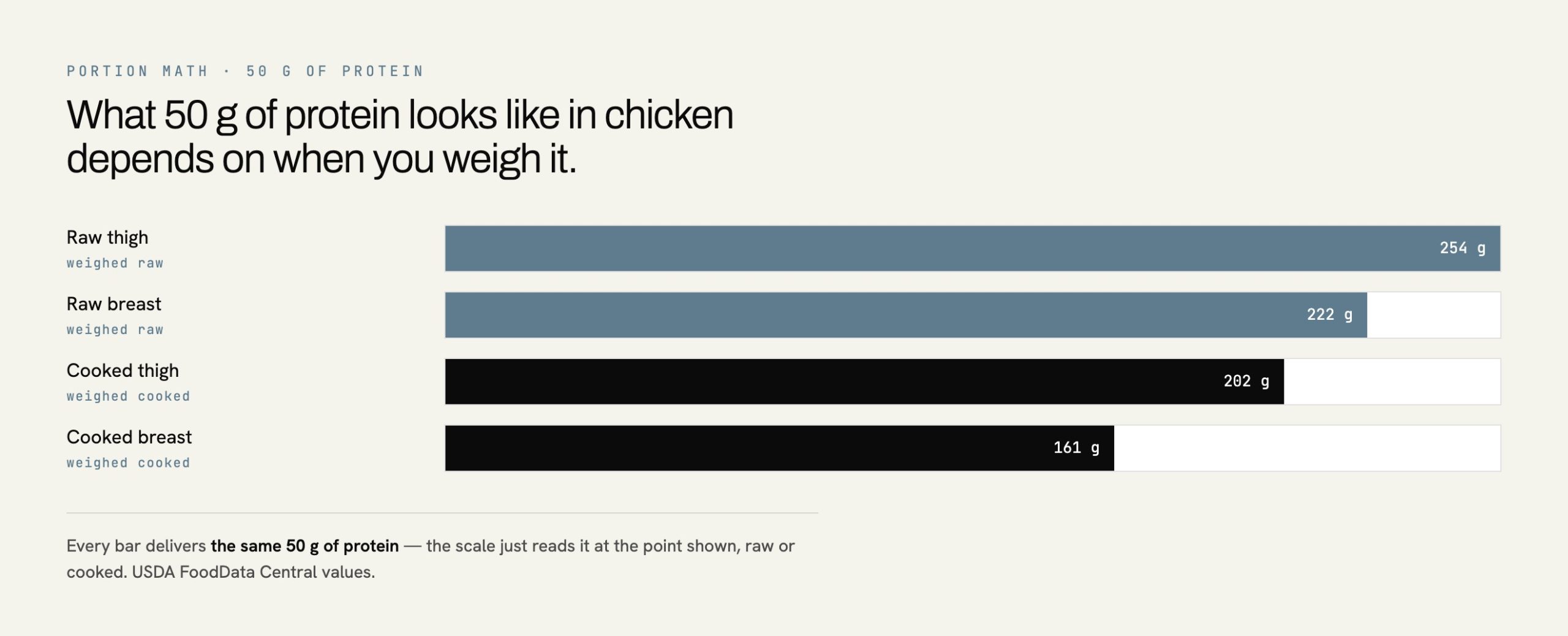
    How much chicken for 50g of protein: 222g raw breast, 161g cooked breast, 254g raw thigh, or 202g cooked thigh
    How much chicken for 50g of protein: 222g raw breast, 161g cooked breast, 254g raw thigh, or 202g cooked thigh

    Is chicken thigh protein much lower than breast?

    Lower, yes — dramatically lower, no. People treat thigh like it is a cheat, and it is not. Here is the honest side-by-side, cooked, per 100 grams.

    Cut (roasted, meat only)ProteinCaloriesFat
    Breast[2]31.0 g165 kcal3.6 g
    Thigh[5]24.8 g179 kcal8.2 g

    Cooked thigh carries about 6 grams less protein per 100 grams than breast, and a bit more than double the fat, which is why it tastes better and costs you more calories.[2][5] On a cut day I lean on breast for the leaner ratio; when I want the meal to actually satisfy and I have room for the fat, thigh earns its place. Both are real protein. If you love thigh, eat thigh and just weigh a little more of it — the table above already did the math for you. I put both to work in a batch of thighs over rice and beans when I want the plate to feel like dinner, not like a diet.

    So do you weigh chicken raw or cooked?

    Both work. What ruins your count is switching between them without telling yourself. Pick one system and hold it.

    Weigh it raw (my default)

    Weigh the breast before it touches heat, log it as “chicken breast, raw,” and let the app use the 22.5 g/100 g figure. This is the most accurate approach because raw weight does not depend on how hard you cooked it — grill it dry or poach it gentle, the raw number was already true. It is also easier when you are batch-cooking for the week: one weigh, one log, done.

    Weigh it cooked (fine, if you commit)

    If you only have the scale out at dinner, weigh the cooked meat and log it as “chicken breast, cooked/roasted” at 31 g/100 g. This is honest as long as you use the cooked entry, not the raw one. The classic blunder is weighing 200 grams of cooked chicken and logging it against the raw number — that undercounts your protein and makes you think you are falling short when you are not.

    Magnus’s rule

    Weigh raw and log raw, or weigh cooked and log cooked. Never weigh cooked and log raw, or the reverse. The number on the scale and the number in the app have to describe the chicken at the same moment.

    Back when I was prepping for the B&K Classic Body Show in Sweden, I did not own a food scale I trusted, so I eyeballed my chicken for weeks and could not understand why the mirror was not moving the way the plan promised. Turned out I was weighing my cooked breasts and pricing them against a raw protein number I had scribbled down — undercounting myself by a third and quietly panicking, eating more and more chicken to “make up” a deficit that was never there. A cheap kitchen scale and one honest afternoon of weighing fixed what months of guessing could not. That is the whole reason I am this stubborn about it with you now. You are not bad at dieting. You were probably just counting one thing while measuring another.

    Putting the number on a plate

    Once you trust your count, chicken becomes the easiest protein anchor in the kitchen. A single cooked breast does most of the heavy lifting for a meal; you build the rest of the plate around it. When I want lean and bright, I grill a breast and pile it next to volume, the way I do in a grilled breast over a genuinely big salad. When I am cutting and want the protein-to-calorie ratio as tight as it goes, I pound the meat thin and cook it fast in these lean cutting cutlets, which stay tender because thin meat cooks before it can dry out. Both of those live in my full recipe kitchen if you want more ways to spend your protein.

    And if you are wondering whether the timing of all this chicken matters as much as the total — whether you have to slam it right after training — I wrote out where the science actually lands on that in my breakdown of the anabolic window myth. Short version: hit your daily total and breathe. The total is the thing.

    Weigh it once, weigh it honestly, and let the number be the number. If you want that daily protein target laid out for you meal by meal instead of doing this math yourself every night, grab my free eating plan — it does the counting so you can just cook. I have got you, big man.

    Questions men actually ask

    How much protein is in an 8 oz chicken breast?

    About 51 grams if the 8 oz (227 g) was weighed raw, and about 70 grams if it was weighed after cooking. Raw breast runs 22.5 g of protein per 100 g and cooked roasted breast runs 31 g per 100 g, so the same “8 oz” gives very different totals depending on when it hit the scale.

    Does cooking reduce the protein in chicken?

    No. Cooking drives out water, not protein. That is why cooked chicken shows more protein per 100 grams than raw — the protein is concentrated into a lighter piece. The total protein in one breast stays about the same from raw to cooked; only its weight and water content drop.

    How much chicken do I need for 50g of protein?

    Roughly one large raw breast (about 222 g raw) or about 161 g of cooked breast on the plate. If you prefer thighs, you need more — around 254 g raw or 202 g cooked — because thigh is lower in protein than breast.

    Is chicken thigh protein much lower than breast?

    It is lower but not by a huge margin. Cooked roasted thigh has about 24.8 g of protein per 100 g versus 31 g for breast — roughly 6 grams less per 100 g — along with about double the fat and slightly more calories. Thigh is still a strong protein source; just weigh a little more of it.

    Should I weigh chicken raw or cooked?

    Either works, as long as you log it against the matching number. Weigh raw and use the raw figure (22.5 g/100 g), or weigh cooked and use the cooked figure (31 g/100 g). Weighing raw is the more reliable habit because raw weight does not change with how you cook. The only real mistake is mixing them — weighing cooked meat and logging it against the raw number, or the reverse.

    Why does my tracking app show a different number for the same chicken?

    Almost always because one entry is raw and another is cooked. Check the label on the food entry before you trust the protein figure. “Chicken breast, raw” and “chicken breast, cooked, roasted” are the same meat at two moments and their per-100-gram numbers are supposed to differ.

    References

    1. USDA FoodData Central — Chicken, broilers or fryers, breast, skinless, boneless, meat only, raw (FDC ID 171077)
    2. USDA FoodData Central — Chicken, broilers or fryers, breast, meat only, cooked, roasted (FDC ID 171477)
    3. USDA FoodData Central — Chicken, broilers or fryers, breast, meat only, cooked, stewed (FDC ID 171478)
    4. USDA FoodData Central — Chicken, broilers or fryers, dark meat, thigh, meat only, raw (FDC ID 173627)
    5. USDA FoodData Central — Chicken, broilers or fryers, thigh, meat only, cooked, roasted (FDC ID 172388)
    6. Korean Journal for Food Science of Animal Resources — Comparative Study on the Effects of Boiling, Steaming, Grilling, Microwaving and Superheated Steaming on Quality Characteristics of Marinated Chicken Steak (2016)
    7. USDA FoodData Central — Chicken, broiler, rotisserie, BBQ, breast, meat only (FDC ID 171445)

    The honest fine print: I’m a cook and a lifter, not your doctor. Nothing here is medical advice, and nothing here tells you how to obtain or use any substance — that conversation belongs to you, your bloodwork, and a physician. Full details: Nutrition Disclaimer · Medical Disclaimer.
    Magnus Olafsson, the cook behind Slim Diet Era
    Written by

    Magnus Olafsson

    The cook behind Slim Diet Era. Former Swedish stage competitor (B&K Classic Body Show, Swedish Grand Prix), on TRT since 35, cooking high-protein food in Chicago for his husband, two kids, and you. He counts the macros so you don’t have to.

    More about Magnus →

    Hungry for a plan, not just a post?

    Start with the free plan — macros counted, grocery list written, in your inbox. You cook and eat; I’ll do the math.
  • Anabolic Protein Ice Cream

    Anabolic Protein Ice Cream

    Recipe · Anabolic / Dessert / High-protein

    Anabolic Protein Ice Cream

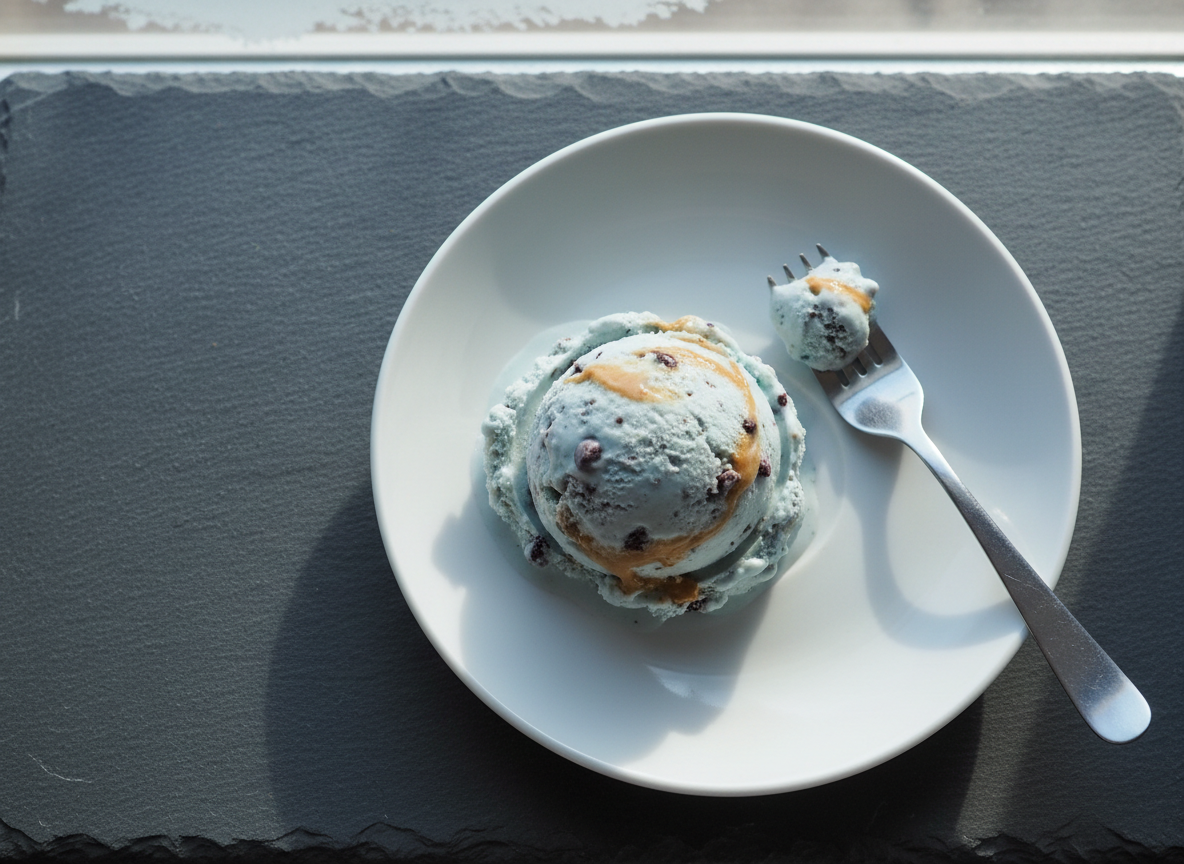
    A big, soft, scoopable bowl of frozen protein ice cream — 30 grams of protein and 300 calories in the whole serving. Casein and whey blended with frozen banana until it goes thick and creamy, no churn, no machine required. This is the dessert I eat almost every night, and I want you to have it too.

    GoalAnabolic
    Total time10 min + freeze
    Servings1 big bowl
    Protein / serving30 g
    Calories / serving300 kcal
    A thick swirl of soft protein ice cream in a chilled bowl, scooped and creamy under cold light Plate 01 / Finished

    For years I told myself a man my size didn’t get to have dessert. I’d finish a long evening session, drive home in the dark, eat my chicken and rice like a good soldier, and then sit there at the kitchen table wanting something sweet and telling myself no. It made me miserable, if I’m honest. Hungry men make bad decisions, and around week eight of a hard prep I was one bad night away from eating a whole tub of the real stuff standing up at the freezer.

    So I started building my own. I had a little frozen-then-blended machine a friend swore by, but you don’t need one — a decent blender does the same job. The trick is frozen banana for body, a scoop of casein and a scoop of whey for the protein and that thick, slow, melty texture, and a splash of milk to get it moving. You blend it cold, you scrape it down, you blend again, and what comes out is genuinely a bowl of soft-serve. Thirty grams of protein. Three hundred calories. The whole thing.

    I make a version of this most nights now, love, and I have zero shame about it. It is a smart, satisfying, high-protein bowl that happens to taste like a treat — not a treat I have to pay for later. My partner steals half of it most evenings. Make it once and I think you’ll understand why I stopped telling myself no. I’ve got you on this one.

    01Who it’s for & when to eat it

    This is an anabolic dessert — built to land your evening protein in a form you actually look forward to. The base stays the same; what you change is the milk, the toppings, and how big the banana is. Here’s how I steer it.

    On a cut

    The lean nightcap

    Use a small frozen banana and skim or unsweetened almond milk. You get a huge, slow-melting bowl for very little — high protein, low calories, and enough volume to actually feel like dessert. This is my last meal of the day before a shoot.

    On a bulk

    Easy clean calories

    Whole milk, a full banana, a spoon of peanut butter and some granola on top. Same creamy base, a lot more fuel — a painless way to add a few hundred quality calories when you’re trying to grow. See the variations below for numbers.

    On TRT

    Steady evening fuel

    A medium banana, semi-skimmed milk, a few berries on top. Moderate carbs, lean protein, easy on the gut before bed. Casein digests slowly, which makes it a kind dessert to sleep on.

    Timing: I eat this as a post-training dessert or my last bowl before bed. The casein is slow-digesting, so it sits with you for hours — a nice thing to have on board overnight when you’re trying to hold muscle.

    02Ingredients

    Makes 1 big bowl — one generous serving. Want two? Double every line and blend in batches so your machine isn’t fighting a frozen brick. The frozen banana is what gives you the soft-serve body, so don’t skip it.

    Servings 1 · adjust on the live recipe card
    • Banana, frozen sliced & frozen solid1 medium · 100 g
    • Casein protein, vanilla for the body1 scoop · 30 g
    • Whey protein, vanilla for flavour½ scoop · 15 g
    • Skimmed milk or plant milk120 ml · ½ cup
    • Plain low-fat yogurt2 tbsp · 30 g
    • Cocoa powder, unsweetened optional1 tsp · 3 g
    • Vanilla extract½ tsp
    • Pinch of saltto taste
    • Ice cubes for thickness2–3 cubes
    • Sweetener if you liketo taste

    Swaps I actually use: no banana? Use 100g of frozen cauliflower or a frozen courgette chunk for body — you won’t taste it, and it keeps the carbs and calories right down for a hard cut. All whey and no casein still works, it just melts faster, so eat it quick. A spoon of xanthan gum (just a pinch) thickens it beautifully if you’d rather skip the banana altogether. Cocoa makes it chocolate; leave it out for plain vanilla.

    03Step by step

    Freeze the banana

    Slice it and freeze it solid first

    Peel the banana, slice it into coins, and freeze it on a tray for at least two hours — overnight is better. Frozen banana is the whole secret to the thick, scoopable texture; a fresh one just gives you a milkshake.

    Magnus says: I keep a bag of frozen banana coins on hand at all times. Future you will be grateful.

    Layer the blender

    Liquid first, then everything else

    Pour the milk and yogurt into the blender first, then add the casein, whey, cocoa if you’re using it, vanilla and a pinch of salt. Putting the liquid at the bottom helps the blades catch and saves you scraping all night.

    Add the frozen bits

    Banana and ice go in last

    Drop in the frozen banana coins and the ice cubes. Keep the liquid low for now — you can always loosen it, but you can’t thicken a soup. We’re chasing soft-serve, not a smoothie.

    Magnus says: less liquid than you think. Add a splash at a time only if it won’t move.

    Blend & scrape

    Pulse, scrape down, pulse again

    Blend in short bursts, stopping to scrape the sides down with a spatula between each one. It’ll look stubborn and crumbly at first — that’s right. Keep going and it suddenly turns over into a thick, glossy swirl.

    Magnus says: patience here, love. The moment it goes creamy is worth the few extra scrapes.

    Serve or firm up

    Scoop it now, or freeze 15 minutes

    It’s ready to eat straight away as soft-serve. If you want it firmer and more scoopable, spread it into a chilled bowl and freeze for ten to fifteen minutes — no longer, or it sets hard. Top it however you like and dig in.

    04The spec sheet

    Real numbers, calculated — not guessed. The recipe makes one big bowl weighing roughly 250g. Here’s what the whole serving gives you, and the same thing levelled out to a flat 100g so you can compare it honestly to anything else in your day.

    Macros — per serving & per 100g
    NutrientPer servingPer 100g
    Energy300 kcal120 kcal
    Protein30.0 g12.0 g
    Carbohydrate28.0 g11.2 g
    — of which sugars18.0 g7.2 g
    Fat7.0 g2.8 g
    — of which saturates3.2 g1.3 g
    Fibre3.5 g1.4 g
    Sodium~0.30 g~0.12 g
    Calorie density
    120 kcal / 100g

    Low for a dessert. That’s the whole point — you get a big, cold, slow-melting bowl that feels like plenty, and the calories stay honest while you do it.

    Protein per 100 kcal
    10.0 g / 100 kcal

    A lifter’s metric. For something that eats like ice cream, getting ten grams of protein in every hundred calories is a genuinely strong ratio.

    Key micros (per serving, approx.)
    • Calcium~360 mg · 28% DV
    • Phosphorus~300 mg · 43% DV
    • Vitamin B12~1.1 µg · 46% DV
    • Riboflavin (B2)~0.5 mg · 38% DV
    • Potassium~520 mg · 11% DV
    • Magnesium~55 mg · 13% DV

    Macros are calculated from standard food-composition data and will shift a little with your exact protein powder, milk and banana size. Micronutrient figures are estimates against general adult Daily Values. Numbers are for guidance, not medical advice — see our Nutrition Disclaimer.

    05Bulk / Cut / TRT variations

    One base, three jobs. The blend stays the same — you adjust the milk, the banana, and what goes on top. Macros below are for the full bowl with the additions listed.

    Cut

    The lean default

    Swap the banana for 100g frozen cauliflower, use unsweetened almond milk, and skip the toppings. You still get a huge, creamy bowl — just far fewer calories and carbs. This is the version I lean on hardest before a show.

    200Kcal
    30G Protein
    3G Fat
    Bulk

    Build it up

    Whole milk, a full banana, a tablespoon of peanut butter blended in and a handful of granola on top. Same creamy base, a painless way to land a few hundred quality calories when you’re growing.

    560Kcal
    38G Protein
    18G Fat
    TRT

    Steady & balanced

    Semi-skimmed milk, a medium banana, and a small handful of berries on top. Moderate carbs, lean protein, gentle on digestion before bed — full and satisfied, nothing overshot.

    340Kcal
    31G Protein
    7G Fat

    06Meal prep & storage

    This one is best fresh — it’s a ten-minute job — but you can absolutely get ahead. The smart move is prepping the frozen banana and the dry mix so the bowl comes together in minutes when the craving hits.

    Fridge
    Eat fresh

    This doesn’t keep in the fridge — it’ll melt to a shake within the hour. Make it when you want it; the prep is fast enough that you can.

    Freezer
    2 weeks

    Leftovers freeze fine in a shallow tub, but they set hard. Pull it out 10–15 minutes before eating so it softens back to scoopable.

    Re-blend
    30 sec

    Frozen rock-solid? Don’t fight a spoon. Break it up, drop it back in the blender with a splash of milk, and pulse it creamy again in seconds.

    My real prep is the banana: I slice a few up every week and keep the coins bagged in the freezer, with the casein and whey pre-measured in a little jar. When I want a bowl, it’s milk in, frozen banana in, blend — done before the kettle’s even boiled.

    Free · the 7-day “Get Fed” plan

    Want a whole week built around food like this?

    Drop your email and I’ll send you my free 7-day plan — meals, macros already counted, grocery list written. No spam, no lectures.

    No spam. Unsubscribe whenever. See what’s in the plan →

    07Common questions

    Do I really need a special machine? +

    No. A frozen-dessert machine gives you the smoothest result, but a sturdy blender or even a good stick blender does the same job — you just have to stop and scrape the sides down a few times. The frozen banana and the casein are doing the real work, not the gadget.

    Why casein and not just whey? +

    Casein thickens as it sits and gives you that slow, melty, ice-cream body — whey alone goes thin and melts fast. I use mostly casein for texture with a little whey for flavour. If you only have whey, it’ll still taste great; just eat it quickly before it loosens.

    How do I make this without banana? +

    Two easy ways. Use 100g of frozen cauliflower or courgette for body — you genuinely won’t taste it under the vanilla and cocoa — or add a pinch of xanthan gum to thicken the blend. Both keep the carbs and calories lower, which is handy on a hard cut.

    It came out icy instead of creamy — what went wrong? +

    Usually too much liquid or not enough scraping, love. Start with less milk than feels right and only add a splash at a time. Keep pulsing and scraping past the crumbly stage — it turns creamy quite suddenly. The yogurt and casein are what give it that smooth finish, so don’t leave them out.

    Can I sweeten it more? +

    Of course. The banana and the flavoured protein carry most of it, but if you like things sweeter, add a little sweetener of your choice — it won’t change the macros much. A few drops of vanilla or a pinch of salt also make it taste sweeter without adding sugar.

    Is this okay to eat before bed? +

    It’s one of my favourite nighttime bowls precisely because the casein digests slowly. That said, this is just food, not a supplement protocol — eat it when it suits your day and your hunger, and don’t lose sleep over the timing.

    From my high-protein meal plans

    This bowl lives inside a full week of meals.

    This protein ice cream is the dessert in my high-protein meal plans — a full week of meals with the macros counted and the grocery list written. You pick the goal; I do the maths and feed you well.

    See the meal plans →
    A creamy bowl of protein ice cream as the dessert in a high-protein meal plan, under cold light

    08Pairs well with

    Browse all recipes →

    Magnus Olafsson in his kitchen — bald, bearded and broad, in his pink apron, under cold light
    About the author

    Magnus Olafsson

    I’m Magnus — twenty years under the iron, from a cold gym in Stockholm to the classic-physique stage, and now mostly in my kitchen in a pink apron. I’ve cut for shows, bulked through winters, and I’ve been on TRT since I was thirty-five. I know what it takes to eat for the body you’re chasing, and I know it shouldn’t come with a side of shame.

    Everything here is food I actually cook and macros I actually count. I don’t diagnose, I don’t promise, and I never make a number up. I just feed you well and tell you the truth.

    B&K Classic Body Show Swedish Grand Prix · Super Series On TRT since 35 20 years training

    Slim Diet Era shares recipes and general nutrition information. It is not medical or dietetic advice, and we do not provide guidance on obtaining or using any controlled substance. See our Medical Disclaimer and Nutrition Disclaimer.

  • The Anabolic Window: Myth or Real? What the Research Actually Says

    The Anabolic Window: Myth or Real? What the Research Actually Says

    BlogMyths & Misconceptions11 min read

    The Anabolic Window: Myth or Real? What the Research Actually Says

    The 30-minute panic was marketing in a lab coat. Here’s what the real literature says about protein timing, and when it actually matters.

    The Anabolic Window: Myth or Real? What the Research Actually Says

    The anabolic window myth is the reason a whole generation of us learned to panic. You finish your last set, and somewhere in the back of your skull a clock starts ticking. Thirty minutes. Maybe forty-five if you’re feeling brave. Miss it and the workout was wasted — that’s what we were told, backstage and in every magazine and in every gym bag that rattled with a half-mixed shaker.

    I believed it for years. I chugged in the parking lot. I’ve mixed whey in a gas-station bathroom because the drive home was thirty-five minutes and I wasn’t about to lose the growth.

    Here’s what the research actually says now, and it’s kinder than the story I grew up on: the window isn’t a window. It’s more like a garage door — hours wide, wider still if you ate before you trained. So put the shaker down for a second, big man. Nobody’s getting shamed for carrying one. Let me walk you through what changed.

    Is the anabolic window real? The short answer, then the honest one

    Short answer: yes, there’s a real thing under the myth. Your muscle is more sensitive to protein after you train it. That part isn’t made up. The question is the anabolic window real was never the interesting one — the interesting question is how long it stays open and how much the exact minute matters.

    The honest answer is that the “30 minutes or it’s wasted” version was marketing wearing a lab coat. When Alan Aragon and Brad Schoenfeld went back through the literature in 2013, they found the importance — and even the existence — of a tight post-workout window depends heavily on context, and that meeting your total daily protein matters far more than hitting a stopwatch.[1]

    So the window is real. It’s just enormous, and forgiving, and most of you are already standing inside it without knowing.

    Where the 30-minute panic actually came from

    I want to be fair to my younger self and to yours, because the panic wasn’t stupid. It came from real science that got stretched too far.

    Early studies fed people protein or carbs right after training and measured a spike in muscle protein synthesis. Real result. Then someone in a marketing meeting turned “your muscle responds after training” into “you have thirty minutes before the anabolic window slams shut,” slapped it on a tub, and sold it to a sixteen-year-old me who’d have believed anything with a Swedish flag and a big arm on the label.

    The worst I ever saw it was backstage in Sweden, at a show, in full bronzer, two of us hunched over a cooler like it was a life-support machine. My buddy had timed his shake to the minute — post-pump, pre-pump, some third shake I never understood — and he spilled half of it down his front with shaking hands and genuinely, actually, almost cried. Not because he was tired. Because he thought he’d missed the window and thrown away a week of prep. That’s what the myth does to a good man. It turns food, the one thing that’s supposed to take care of you, into a threat.

    He hadn’t missed anything. He’d eaten all day. He was fine. But nobody had ever told him the door was wider than a shot glass, so he lived every session braced for a failure that was never coming.

    That’s the part that stays with me. The myth didn’t make him train harder or eat better. It just added fear to something that should have been simple. I moved to Chicago at 16 and kept believing it there too, for years, in a different accent — the panic translated fine. It took actual research, read slowly, to un-learn it.

    How long is the anabolic window, really?

    Here’s the number people actually want. If you’re asking how long is the anabolic window, the useful answer is somewhere in the range of a few hours on either side of your session — not thirty minutes, and not a hard cliff at any point.

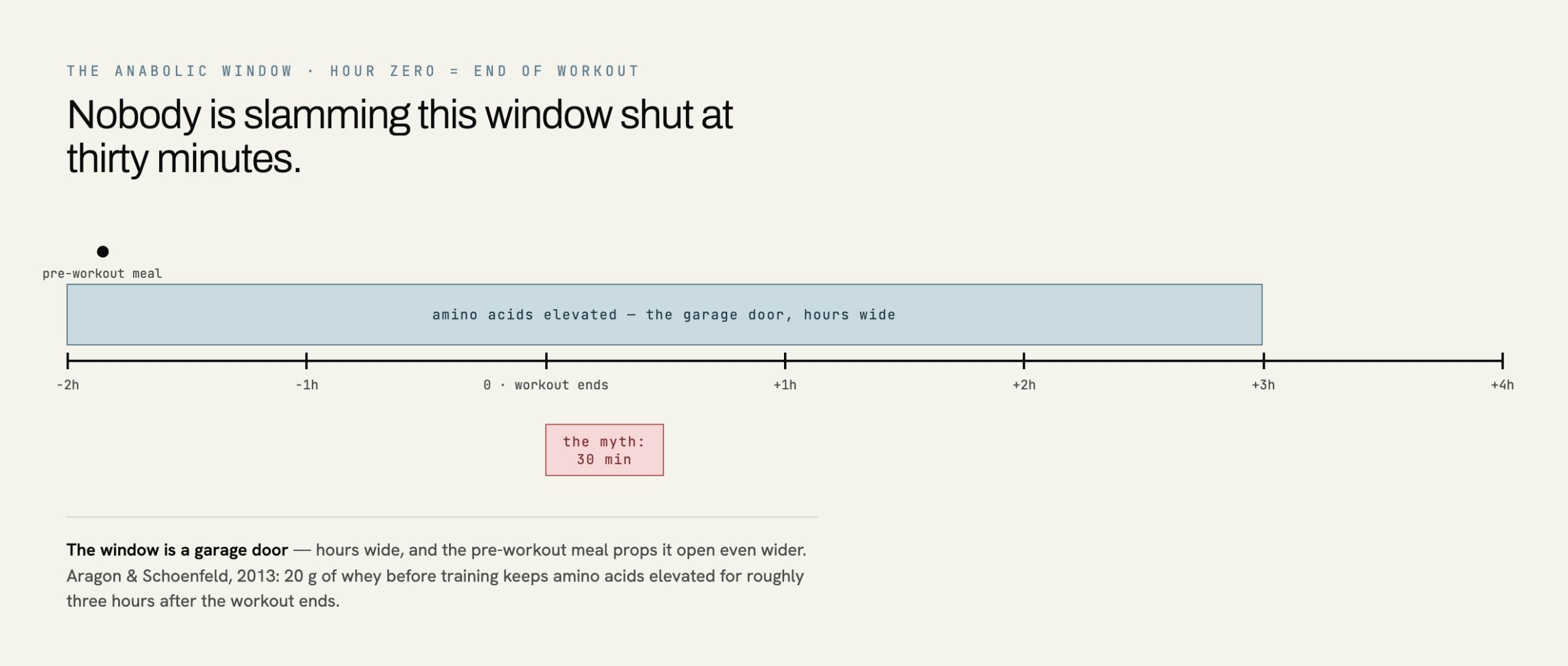
    Aragon’s own analogy is the one I use with everyone in my kitchen: it’s less like a window that snaps shut and more like a garage door that stays open for hours. And what props it open widest is the meal you ate before you trained. In the 2013 review they point to work showing that 20 g of whey taken right before exercise kept muscular amino-acid uptake elevated well into recovery — it didn’t drop back to baseline until about 3 hours after the session.[1]

    Read that again, because it’s the whole thing. If you ate a proper meal one or two hours before you lifted, those amino acids are still circulating on the drive home. The “post-workout window” and the “pre-workout meal” overlap. You could take your time, get home, shower, and eat like a human, and still be well inside it.

    Anabolic window timeline showing the real post-workout window is several hours wide, extended by a pre-workout meal, versus the 30-minute myth
    Anabolic window timeline showing the real post-workout window is several hours wide, extended by a pre-workout meal, versus the 30-minute myth
    Kitchen math

    If your pre-lift meal had 30–40 g of protein in it, your muscle is still working with those amino acids for a couple of hours after your last rep. That’s not me being generous. That’s the timeline in the paper. The stopwatch was never the point.

    What the research says: total protein beats the stopwatch

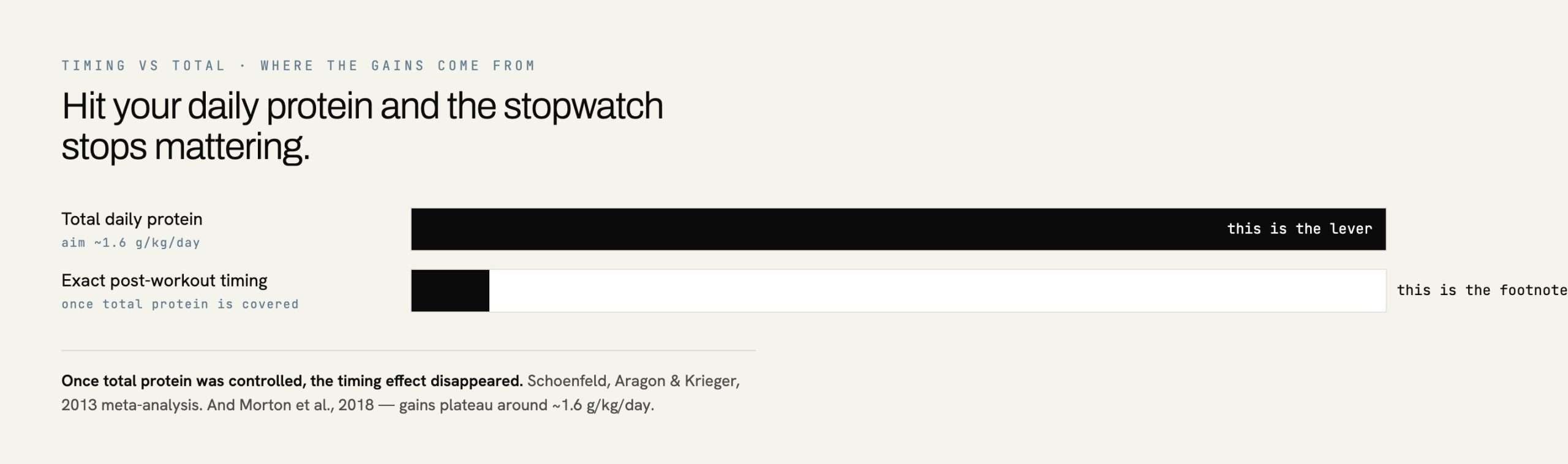
    This is where the myth really falls apart. In 2013, Schoenfeld, Aragon, and Krieger ran a meta-analysis pooling 20-plus studies on protein timing and muscle growth. On the surface, eating protein close to training looked like it helped hypertrophy a little. Then they controlled for one thing — how much total protein each group ate per day — and the timing effect all but vanished.[2]

    Plain version: the groups that “timed” their protein also happened to eat more of it overall. Once you match the total, the clock stops mattering. It was the daily amount doing the work the whole time.

    A bigger 2018 review backs this up from the other direction. Morton and colleagues pooled 49 trials — nearly 1,900 people — and found that gains in muscle and strength kept climbing with protein intake up to about 1.6 g per kg of bodyweight per day, then flattened out. Total intake mattered. Timing and protein source did not move the needle in the pooled data.[3]

    Bar comparison showing total daily protein drives muscle growth far more than exact post-workout timing
    Bar comparison showing total daily protein drives muscle growth far more than exact post-workout timing

    So here’s the hierarchy, honestly ranked, from what actually moves the needle to what barely does:

    What you’re worried aboutHow much it actually mattersWhat to do
    Total protein across the dayMost of itHit roughly 1.6–2.2 g/kg/day, every day
    Spreading it over the daySome3–5 meals, ~0.4 g/kg each
    Eating protein sometime around trainingA littleA meal within a few hours either side
    Hitting a 30-minute post-workout shakeAlmost nothing on its ownDo it if it’s convenient. Don’t panic if it isn’t.

    Notice the shake is on the list. It’s not useless. It’s just at the bottom, and it only ever mattered as a way to help you hit the thing at the top.

    When protein timing genuinely does matter

    I’m not going to pretend timing is nothing, because that’s its own kind of lie, and you’d catch me on it. There are real situations where getting protein around your session earns its keep. If any of these are you, pay a bit more attention to your post workout meal — not with panic, just with a plan.

    You trained fasted

    If you lifted first thing on an empty stomach, the garage door doesn’t have a pre-workout meal propping it open. Amino acids aren’t already circulating. Aragon and Schoenfeld are clear that in this case, eating protein reasonably soon afterward makes more sense — you’re opening the door rather than walking through one that’s already up.[1] This is the one scenario where the old advice was pointing at something true.

    You’re doing two-a-days, or training again soon

    Back when I was prepping for a show in Sweden, I’d sometimes train twice in a day. When your next session is only a handful of hours away, recovery between them matters more, and you don’t want to leave a long gap with no protein in you. Feed the first session so it’s ready for the second.

    You’re an older lifter

    This one’s personal, and it’s why I take it seriously. As we age, muscle gets a little deaf to protein — it takes more to get the same anabolic signal. I’m 40, I’ve been on TRT since I was 35, and I feel the difference in how I have to eat now versus at 22. Older muscle responds better to solid, protein-forward meals spread through the day rather than one big hit and a long fast. Timing here is really just insurance that you don’t go too long without feeding it.

    Anyone who wants the last 5%

    And there’s distribution — the quiet middle ground between “timing is everything” and “timing is nothing.” Areta and colleagues fed trained men 80 g of whey over 12 hours in three patterns: little and often, medium and steady, or big and rare. The winner was the sensible middle: 20 g every 3 hours beat both eight tiny 10 g feeds and two giant 40 g ones for keeping muscle protein synthesis high.[4]

    That’s the practical takeaway hiding under all the noise. Not “chug within 30 minutes.” Just: eat a real amount of protein every few hours, and your training will always land inside a fed window without you thinking about it.

    Schoenfeld and Aragon put a number on that middle ground in a later paper. Their recommendation is to aim for about 0.4 g of protein per kg of bodyweight per meal, across at least four meals, to comfortably clear a good daily total.[5] For a 90 kg man that’s roughly 35 g a meal, four times a day. Do that and one of those meals lands near your workout by default — no timing required, no clock, no shaker anxiety in a parking lot. You built the window into your day without trying.

    And notice what that quietly kills: the old “you can only use 30 g of protein per meal, the rest is wasted” line. Same family of myth as the window. The 2018 paper walks through why a bigger meal isn’t thrown away — slower-digesting protein eaten with other food keeps feeding you for hours.[5] Your body is smarter and more patient than the supplement ad wanted you to believe.

    What happens if you miss the anabolic window?

    Nothing dramatic. That’s the honest answer, and I wish someone had said it to my crying friend backstage.

    If you hit your total protein for the day, missing the “immediate post-workout shake” costs you next to nothing measurable. The meta-analysis found the timing effect disappeared once total intake was matched.[2] One missed shaker against a whole day of good eating is a rounding error. You did not throw away the session. You did not throw away the week.

    The only version of “missing it” that actually costs you is chronic — going most of the day eating too little protein, session after session, week after week. That’s not a timing problem. That’s a total problem, and it’s fixable at any meal, not just the one after the gym.

    Magnus’s rule

    Don’t chase the perfect post-workout minute. Chase the honest daily total. Get your protein in across the day — three, four, five real meals — and every workout you do will already be sitting comfortably inside the window. The stopwatch was a tax on people who were already doing fine.

    How I actually eat around a lift

    Since I’m telling you not to panic, let me show you what “not panicking” looks like on a plate. This is roughly how I do it, whether I’m just on my TRT dose or running something heavier.

    • A real meal one to two hours before. Protein and carbs. That’s the meal doing most of the work of “post-workout nutrition” before you’ve even started.
    • Water and maybe some carbs during, if it’s a long one. No heroics.
    • A proper meal within a couple of hours after. Not a stopwatch. A shower, a drive, then food. On a lazy day it’s a bowl of high-protein cottage cheese with fruit while I get dinner going.
    • The rest of the day’s protein spread out. Breakfast pulls its weight — peanut butter protein oats or a stack of high-protein pancakes — so I’m never scrambling to cram it all in around the gym.

    On heavy training blocks when I’m genuinely hungry and chasing calories, I lean on things that make the total easy without a fight: mass-gainer overnight oats the night before, ready in the fridge. And yes, I still keep a tub of whey. Not for the magic 30-minute window — because it’s a fast, easy 25 g when a meal isn’t practical. That was always all the shaker was for.

    If you want the whole thing planned so you never have to think about timing again, that’s exactly what our recipe kitchen is built for — protein-forward meals with honest numbers, so your total takes care of itself and the window takes care of itself right along with it.

    Questions men actually ask

    Is the anabolic window a real thing?

    There’s a real effect under it — muscle is more sensitive to protein after training. But the “30 minutes or it’s wasted” version is a myth. The window is hours wide, not minutes, and hitting your total daily protein matters far more than the exact timing.

    How long is the anabolic window?

    Roughly a few hours on either side of your session, not 30 minutes. If you ate a protein meal one to two hours before training, amino acids stay elevated into recovery — one study kept them up until about 3 hours after exercise. Think garage door, not window.

    What happens if you miss the anabolic window?

    If you hit your protein total for the day, almost nothing. When researchers matched total daily protein between groups, the timing effect essentially disappeared. One missed post-workout shake against a full day of good eating doesn’t cost you the session.

    Does the anabolic window matter more on TRT or on cycle?

    The timing rules don’t change — total daily protein still leads. What changes with age and hormones is appetite and how much protein it takes to get a response. Older and enhanced lifters do better with steady, protein-forward meals through the day. That’s about distribution, not a magic post-workout minute.

    Should I drink a protein shake right after lifting?

    You can, and it’s a fine habit — a shake is an easy 25 g of protein. Just know you’re doing it to help hit your daily total, not to beat a closing window. If you trained fasted, a shake soon after makes more sense. If you ate before you lifted, there’s no rush.

    References

    1. Journal of the International Society of Sports Nutrition — Aragon AA, Schoenfeld BJ. Nutrient timing revisited: is there a post-exercise anabolic window? (2013)
    2. Journal of the International Society of Sports Nutrition — Schoenfeld BJ, Aragon AA, Krieger JW. The effect of protein timing on muscle strength and hypertrophy: a meta-analysis (2013)
    3. British Journal of Sports Medicine — Morton RW, et al. A systematic review, meta-analysis and meta-regression of protein supplementation on resistance training-induced gains in muscle mass and strength (2018)
    4. The Journal of Physiology — Areta JL, et al. Timing and distribution of protein ingestion during prolonged recovery from resistance exercise alters myofibrillar protein synthesis (2013)
    5. Journal of the International Society of Sports Nutrition — Schoenfeld BJ, Aragon AA. How much protein can the body use in a single meal for muscle-building? Implications for daily protein distribution (2018)
    The honest fine print: I’m a cook and a lifter, not your doctor. Nothing here is medical advice, and nothing here tells you how to obtain or use any substance — that conversation belongs to you, your bloodwork, and a physician. Full details: Nutrition Disclaimer · Medical Disclaimer.
    Magnus Olafsson, the cook behind Slim Diet Era
    Written by

    Magnus Olafsson

    The cook behind Slim Diet Era. Former Swedish stage competitor (B&K Classic Body Show, Swedish Grand Prix), on TRT since 35, cooking high-protein food in Chicago for his husband, two kids, and you. He counts the macros so you don’t have to.

    More about Magnus →

    Hungry for a plan, not just a post?

    Start with the free plan — macros counted, grocery list written, in your inbox. You cook and eat; I’ll do the math.
  • High-Protein Pancakes

    High-Protein Pancakes

    Recipe · Anabolic / Breakfast / High-protein

    High-Protein Pancakes

    A proper stack of fluffy pancakes with 38 grams of protein and 480 calories — soft, golden, and built to fill you up on a morning you actually want breakfast. No chalky protein-powder taste, no sad single rubbery disc. Just a real stack that loves your macros back.

    GoalAnabolic
    Total time15 min
    Servings1 stack
    Protein / serving38 g
    Calories / serving480 kcal
    A tall stack of golden high-protein pancakes topped with berries, plated under cold light Plate 01 / Finished

    I have a memory of being maybe seven years old, standing on a chair at my mother’s elbow on a grey Sunday, watching her flip pancakes one after another while the windows steamed up. She’d slide them onto my plate the second they were done, too hot to eat, and I’d burn my mouth every single time and never learn. So you’ll understand that when I got serious about training and the bro wisdom of the day told me breakfast was now egg whites and a scoop of powder in water, something in me quietly rebelled. A man should be allowed pancakes, love. Even a man chasing a stage-lean physique.

    The problem with most “protein pancakes” is they taste like a punishment — dense, chalky, the protein powder shouting over everything. So I spent a frankly silly number of Sunday mornings working out how to get a real, fluffy, golden stack with serious protein in it. The fix turned out to be balance: oats blended into a flour for structure, cottage cheese and egg for a tender crumb and a protein hit, and just a touch of baking powder to lift the whole thing. The result is soft, it browns properly, and it doesn’t fall apart when you flip it.

    This is a stack I’m genuinely happy to put in front of anyone — 38 grams of protein, 480 sensible calories, and it eats like a Sunday treat rather than a supplement. It keeps me full till lunch, which is more than I can say for most breakfasts. Make it once on a quiet morning and I think you’ll find your weekends have a new ritual. I’ve got you on this one.

    01Who it’s for & when to eat it

    A high-protein breakfast that bends to the morning you’re having. The batter stays the same; what changes is what you stack it with. Here’s how I steer it.

    On a cut

    Keep it clean

    Use egg whites instead of the whole egg and top with fresh berries and a spoon of zero-cal syrup or plain Greek yoghurt. You keep the stack and the protein, you pull the calories down toward 360. A filling breakfast that fits a deficit.

    On a bulk

    Stack it taller

    Add an extra 30g oats and a whole banana to the batter, then top with a spoon of peanut butter and real maple syrup. Easy, clean morning calories — well over 700, still real food, still a genuine pleasure to eat.

    On TRT

    Steady start

    The recipe as written makes a balanced breakfast — good protein, moderate carbs, sensible fat. Top with berries and a few chopped nuts for a morning meal that keeps you full and level until lunch.

    Timing: these shine as a weekend or post-training breakfast — the protein and carbs land nicely after a morning session. They also batch beautifully (see meal prep), so a Sunday cook-up means a fast, real breakfast on a hectic weekday.

    02Ingredients

    Makes 1 stack of about 4 pancakes — one serving. Want a double batch for the week? Scale every line; keep the oats-to-liquid ratio steady so the batter stays pourable.

    Servings 1 · adjust on the live recipe card
    • Rolled oats blended to flour50 g · 1.8 oz
    • Cottage cheese low-fat100 g · 3.5 oz
    • Egg1 large
    • Egg white1
    • Skimmed milk50 ml · 3½ tbsp
    • Baking powder1 tsp
    • Vanilla extract½ tsp
    • Cinnamon¼ tsp
    • Sweetener or sugar optionalto taste
    • Oil or spray for the panlight coat

    Swaps I actually use: a scoop (≈25g) of vanilla whey can replace some of the oats for an even higher-protein stack — just add a splash more milk, as whey drinks up liquid. No cottage cheese? Thick Greek yoghurt works and keeps it tender. For a dairy-free version, a plant milk and a flax egg will get you there, though the stack will be a touch denser. Blend the batter for the smoothest result, or leave the oats whole for a heartier, oatier pancake.

    03Step by step

    Blend the batter

    Everything in, blitz it smooth

    Tip the oats, cottage cheese, whole egg, egg white, milk, baking powder, vanilla and cinnamon into a blender. Blitz until you’ve got a smooth, pourable batter — thick like double cream but still falling off the spoon. Add a splash more milk if it’s too stiff.

    Magnus says: blending the oats and cottage cheese is what gives you a fluffy stack instead of a dense brick.

    Rest it

    Let the batter sit 3–5 minutes

    Let the batter rest a few minutes while the pan heats. The oats soften and the baking powder wakes up, which is exactly what you want for a tender, lifted pancake. Don’t skip this — it’s a free upgrade.

    Heat the pan

    Medium-low, lightly greased

    Set a non-stick pan over a medium-low heat and wipe it with the lightest coat of oil. Protein pancakes scorch faster than flour ones because of the dairy, so resist the urge to crank the heat — patient and gentle wins here.

    Magnus says: too hot and they burn outside while staying raw in the middle. Low and steady, love.

    Pour & cook

    Small rounds, wait for the bubbles

    Pour the batter into small rounds — smaller pancakes are far easier to flip than big ones. Cook until bubbles form on top and the edges look set, about 2–3 minutes. That’s your signal they’re ready to turn.

    Flip & finish

    One confident turn, then a minute more

    Slide a thin spatula right under and flip in one clean move. Cook the second side for a minute or two until golden and cooked through. Stack them up, top with berries or whatever you fancy, and eat them warm.

    Magnus says: one confident flip beats three nervous pokes. Commit to it.

    04The spec sheet

    Real numbers, calculated — not guessed. The recipe makes one stack of about 4 pancakes, roughly 280g of finished food before toppings. Here’s what that serving and a flat 100g give you.

    Macros — per serving & per 100g
    NutrientPer servingPer 100g
    Energy480 kcal171 kcal
    Protein38.0 g13.6 g
    Carbohydrate46.0 g16.4 g
    — of which sugars6.0 g2.1 g
    Fat13.0 g4.6 g
    — of which saturates4.0 g1.4 g
    Fibre5.0 g1.8 g
    Sodium~0.62 g~0.22 g
    Calorie density
    171 kcal / 100g

    Moderate, and far gentler than a café stack swimming in butter and syrup. You get a genuinely filling breakfast with real bulk to it for the calories.

    Protein per 100 kcal
    7.9 g / 100 kcal

    Excellent for a breakfast that eats like a treat. A normal pancake stack is nearly all carbs and fat; this one carries proper protein to keep you full and support recovery.

    Key micros (per serving, approx.)
    • Calcium~190 mg · 19% DV
    • Phosphorus~340 mg · 49% DV
    • Selenium~28 µg · 51% DV
    • Vitamin B12~1.1 µg · 46% DV
    • Magnesium~70 mg · 17% DV
    • Iron~2.4 mg · 13% DV

    Macros are calculated from standard food-composition data and will shift a little with your exact ingredients, brands and toppings. Micronutrient figures are estimates against general adult Daily Values. Numbers are for guidance, not medical advice — see our Nutrition Disclaimer.

    05Bulk / Cut / TRT variations

    One batter, three breakfasts. The method stays the same — you adjust the eggs, the add-ins and the toppings. Macros below are for the full stack as described, with toppings included.

    Cut

    The lean stack

    Use 2 egg whites in place of the whole egg, skip the optional sugar, and top with fresh berries and a spoon of plain 0% Greek yoghurt. You keep the fluff and the protein and pull the calories right down. My morning pick when I’m dieting.

    360Kcal
    40G Protein
    6G Fat
    Bulk

    The mass stack

    Add 30g more oats and a whole banana to the batter, then top with a tablespoon of peanut butter and a drizzle of real maple syrup. Calorie-dense, clean, and a proper feast of a breakfast after a morning lift.

    720Kcal
    44G Protein
    22G Fat
    TRT

    The balanced stack

    The recipe as written, topped with berries and a small handful of chopped walnuts. Good protein, moderate carbs, a little healthy fat — a level, satisfying start that holds you to lunch.

    560Kcal
    40G Protein
    20G Fat

    06Meal prep & storage

    These batch beautifully, which is half of why I love them. I make a triple stack on a Sunday so a real breakfast is a 30-second reheat on a weekday morning.

    Fridge
    4 days

    Cool fully and stack in an airtight container with a square of paper between each so they don’t stick. Reheat or eat cold — they’re soft enough to enjoy straight from the fridge.

    Freezer
    2 months

    Freeze flat in a single layer first, then bag them. They thaw and reheat brilliantly — no loss of texture, which is rare for a pancake.

    Reheat
    60 sec

    Microwave for 30–60 seconds, or pop them in the toaster on a low setting for a slightly crisp edge. From frozen, give them a couple of minutes.

    If you batch them, freeze in single-serving stacks so you can grab exactly one breakfast at a time. A frozen stack and a handful of berries is a real, high-protein morning meal with almost no effort — which is the whole point on a busy week.

    Free · the 7-day “Get Fed” plan

    Want a whole week built around food like this?

    Drop your email and I’ll send you my free 7-day plan — meals, macros already counted, grocery list written. No spam, no lectures.

    No spam. Unsubscribe whenever. See what’s in the plan →

    07Common questions

    Do I have to use protein powder? +

    Not at all — the recipe as written gets its 38g of protein from cottage cheese, egg and oats, no powder needed. If you want to push the protein even higher, you can swap a scoop of whey for some of the oats, but plenty of folks find protein powder makes pancakes chalky, so don’t feel you have to.

    Why are mine falling apart when I flip them? +

    Two usual culprits: pancakes too big, or flipped too soon. Keep them small, and wait until bubbles form on top and the edges look set before you turn them. A thin, wide spatula and one confident flip does the rest. If the batter’s very loose, a touch more blended oats firms it up.

    Can I make the batter the night before? +

    You can, and it’s a great move for a weekday. Blend it, keep it covered in the fridge overnight, and give it a quick stir in the morning. It’ll thicken as the oats absorb liquid, so loosen with a splash of milk before you cook. The baking powder still gives a good lift.

    How do I turn this into a proper bulk breakfast? +

    Add carbs and a little fat: 30g more oats and a whole banana into the batter, then top with a tablespoon of peanut butter and real maple syrup. That takes the stack to around 720 calories with 44g protein — clean, calorie-dense mass-gaining fuel. See the Bulk variation above.

    Can I make these dairy-free? +

    Yes. Swap the cottage cheese for a thick dairy-free yoghurt, use a plant milk, and you can replace the whole egg with a flax egg if needed. The stack comes out a touch denser and the protein dips a little, but it’s still a real, satisfying breakfast.

    From my high-protein meal plans

    This stack lives inside a full week of meals.

    A breakfast that eats like a treat and still hits your protein is exactly what my meal plans are built on — seven days of meals with the macros counted and the grocery list written. You pick the goal; I do the maths.

    See the meal plans →
    A stack of golden high-protein pancakes under cold light

    08Pairs well with

    Browse all recipes →

    Magnus Olafsson in his kitchen — bald, bearded and broad, in his pink apron, under cold light
    About the author

    Magnus Olafsson

    I’m Magnus — twenty years under the iron, from a cold gym in Stockholm to the classic-physique stage, and now mostly in my kitchen in a pink apron. I’ve cut for shows, bulked through winters, and I’ve been on TRT since I was thirty-five. I know what it takes to eat for the body you’re chasing, and I know it shouldn’t come with a side of shame.

    Everything here is food I actually cook and macros I actually count. I don’t diagnose, I don’t promise, and I never make a number up. I just feed you well and tell you the truth.

    NPC Illinois NPC Classic Physique On TRT since 35 20 years training

    Slim Diet Era shares recipes and general nutrition information. It is not medical or dietetic advice, and we do not provide guidance on obtaining or using any controlled substance. See our Medical Disclaimer and Nutrition Disclaimer.

  • The TRT Diet: How Eating Changes When You’re On

    The TRT Diet: How Eating Changes When You’re On

    BlogEating on TRT12 min read

    The TRT Diet: How Eating Changes When You’re On

    What five years on testosterone therapy taught me about the plate — and what it never touched.

    The TRT Diet: How Eating Changes When You're On

    I’ve been on TRT since I was thirty-five. Five years now. When my doctor and I started it, I half-expected my eating to change completely — some special TRT diet with a new rulebook I hadn’t learned yet. There wasn’t one. What changed was quieter than that, and more useful.

    So this is the honest version of the testosterone diet, from a man who’s actually cooked on it: what therapy did to how I eat, what it never touched, and how I set my plate now that I’m on. No protocol talk, no numbers-per-week — that part lives between you and your doctor, and it should. Just food.

    I’m a big man who competed back home in Sweden before I ever picked up an apron. I’ve eaten for the stage, eaten for a cut, eaten for nothing but comfort. TRT sits in the middle of all of it now. Let me walk you through what it actually feels like at the table.

    What TRT actually changed at my table

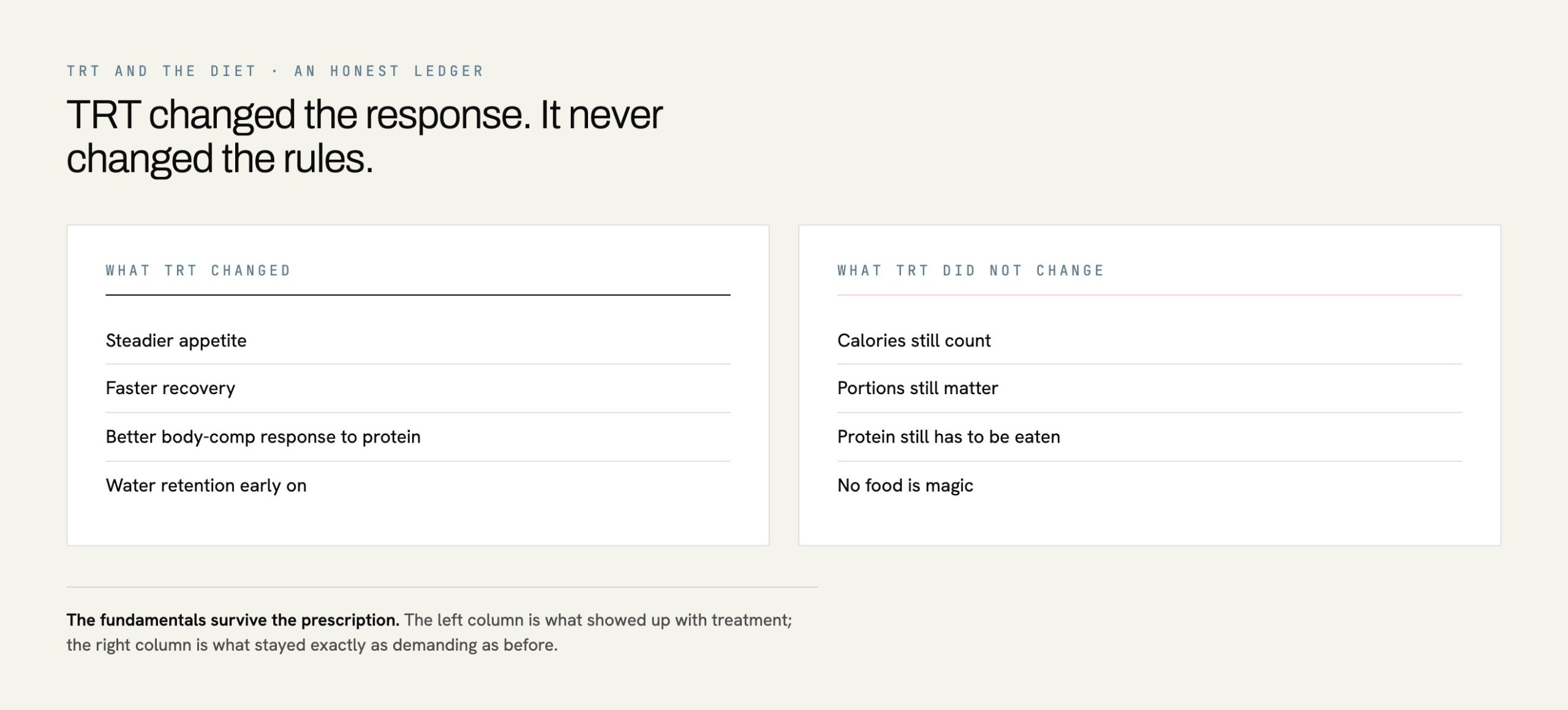
    The first thing, and the one nobody warns you about, was how steady my appetite got. Before therapy my hunger swung — ravenous one day, no interest the next. On TRT it flattened out into something reliable. I got hungry when I’d trained hard and I got full when I’d eaten enough, and both of those signals started telling the truth. That alone made eating well easier, because I wasn’t fighting my own body for information anymore.

    The second thing was recovery. I’d train, and the soreness that used to sit on me for three days packed up in one. That changes what you want to eat. When you recover faster you train more, and when you train more your body genuinely asks for more protein and more fuel. The hunger wasn’t random — it was my muscle doing repair work and sending the bill.

    Third: my body started answering the food. Feed a body with healthy testosterone the right protein and a reason to grow, and it puts on lean tissue and lets go of fat more willingly than it did before. That’s not me being poetic — it’s what the research shows. A meta-analysis of fifty-nine controlled trials found testosterone therapy reliably lowered fat mass and raised lean mass.[1] I felt that as a body that finally cooperated with good eating instead of arguing with it.

    And the fourth thing, the one that scared me before I understood it: water. The first couple of months I got puffy. Face rounder, ring tighter, the scale up. I’ll tell you what I did about that further down, because it taught me the single most important lesson of eating on TRT.

    I nearly quit in month two. I looked in the mirror one morning in Chicago and my face was soft, the scale was up four pounds in ten days, and I thought I’d done something wrong — eaten wrong, gained fat, ruined it. I called my doctor half-annoyed. We ran bloodwork. The fat calipers hadn’t moved; the water had. My body was holding fluid while it settled into a new normal, and within another month it let most of it go. Four pounds of panic that was never fat. If I’d trusted the mirror over the bloodwork I’d have crash-dieted myself into a hole for no reason.

    What TRT did not change: the calories still count

    Here’s where I get firm with you, big man, because somebody has to. Testosterone therapy is not a fat-loss drug. It is not a license to eat like the rules stopped applying to you. I’ve watched too many men start TRT, feel that first surge of appetite and recovery, and take it as permission to bury themselves in food — and then blame the therapy when the gut arrives.

    The therapy makes your body better at using what you feed it. It does not decide how much you feed it. That’s still you, at the counter, with the pan. Eat five hundred calories a day over what you burn and you will gain fat on TRT the same as you would have off it. The math didn’t leave the room when the testosterone walked in.

    What TRT buys you is a better exchange rate. The same honest eating gets you a leaner, stronger return than it used to. But you still have to do the eating. If you’re used to eyeballing your food and hoping, TRT is a good moment to actually learn what a plate weighs — the fundamentals I lay out in the free 7-day plan are the same fundamentals, therapy or not.

    Magnus’s rule

    TRT changes the exchange rate on your food. It does not do the eating for you. Protein still has to arrive on a plate, and calories still have to add up. Nobody’s testosterone ever counted a macro for them.

    Chart comparing what a TRT diet changes versus what it does not change for eating
    Chart comparing what a TRT diet changes versus what it does not change for eating

    Eating for the numbers TRT moves

    This is the part that separates eating on TRT from just eating. Therapy nudges a handful of markers on your bloodwork, and your fork has a say in most of them. None of this is medical advice — your doctor reads your labs, not me — but here’s how I set the table around the numbers we watch.

    Hematocrit — the thick-blood one

    Testosterone tells your body to make more red blood cells. For most men that’s a mild, first-year rise that plateaus; for some it climbs enough that a doctor pays attention.[4] Food doesn’t control it the way water does — so I drink through the day, every day, and I don’t skip meals or run dry before training. Hydration won’t fix a genuinely high hematocrit (that’s a bloodwork-and-doctor conversation), but staying watered is the cheapest, dumbest-simple thing you can do to not make it worse.

    Estrogen — the body-fat one

    Here’s a thing most men don’t know: your fat tissue makes estrogen. It carries an enzyme called aromatase that converts testosterone into estradiol, and the more body fat you carry, the more of that conversion happens.[2] On TRT, with more testosterone in the system, a soft midsection quietly turns more of it into estrogen. The lever you actually control isn’t a pill — it’s your body fat. Stay reasonably lean and you give the aromatase less to work with. Getting lean is an estrogen strategy, not just a mirror strategy.

    Blood pressure and lipids — the heart ones

    Water retention and thicker blood can nudge blood pressure, and testosterone can shift your cholesterol numbers around. This is bread-and-butter heart eating, nothing exotic: I keep a lid on sodium, lean hard on potassium-rich food (leafy greens, potatoes, beans), and I get most of my fat from fish, olive oil and avocado instead of the fryer. A plate like my salmon and avocado plate is built for exactly this — omega-3 fat, potassium, and no junk riding along.

    Marker TRT can moveWhich wayWhat I put on the plate
    Hematocrit (red cells)Up, mostly first year[4]Water all day; don’t train dehydrated; let bloodwork lead
    Estrogen (aromatization)Up if body fat climbs[2]Stay lean; a leaner body converts less testosterone to estrogen
    Blood pressureCan nudge upWatch sodium; potassium-rich foods; keep weight in check
    Cholesterol / lipidsCan shiftFish, olive oil, avocado, fiber; less fried food

    Notice the through-line: leaner body, more water, better fats. Three of the four markers get quieter when you simply eat well and don’t carry extra fat. That’s the whole secret. TRT doesn’t ask for a strange diet — it asks for a genuinely good one, done consistently, because now the numbers are watching.

    What to eat on TRT: building the plate

    When men ask me what to eat on TRT, they want a list of magic foods. There isn’t one. There’s a plate structure, and it’s the same sturdy plate I’d build for any lifter — just held to it a little more honestly because of the markers above.

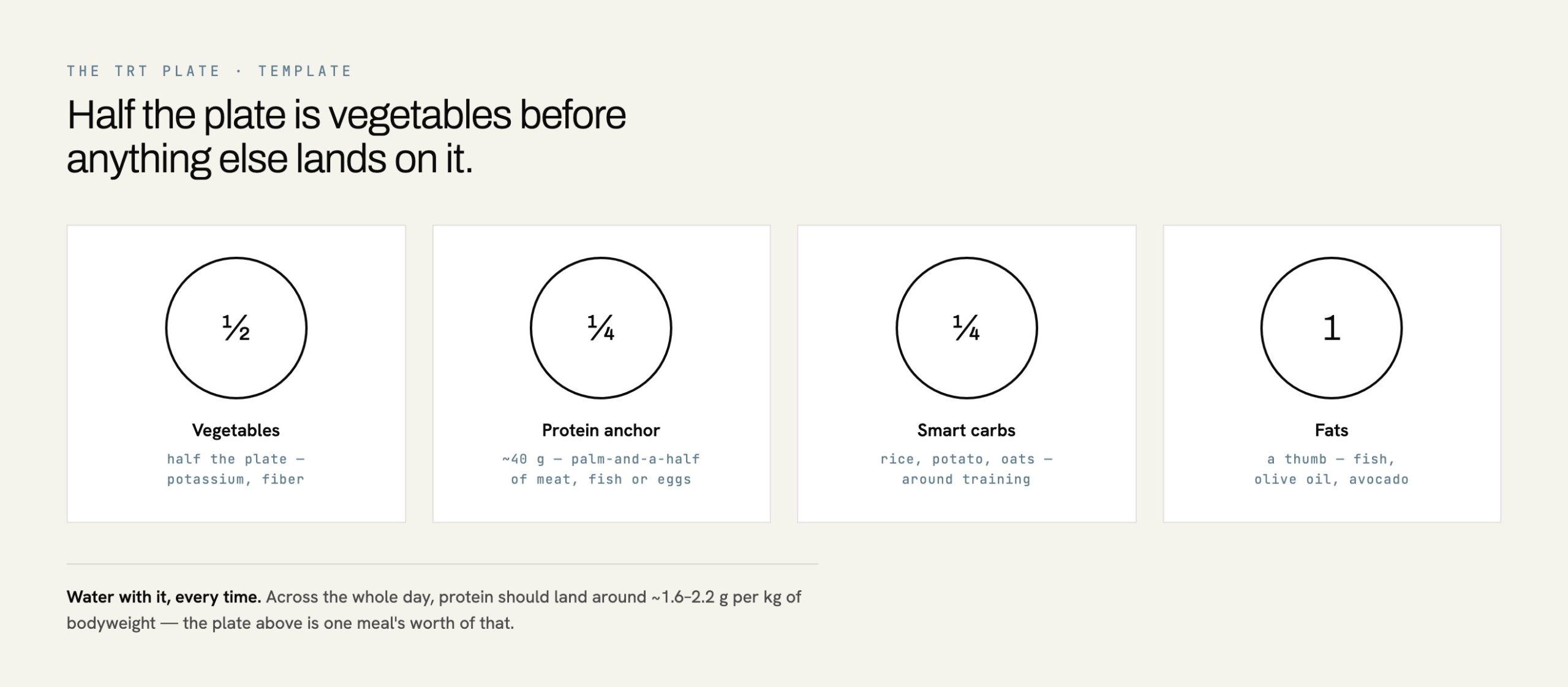
    Protein anchors every meal. This is the non-negotiable. Testosterone plus training builds muscle, but only if the raw material shows up. Aim for a real protein source at each meal — 40 grams or so, a palm-and-a-half of meat, fish or eggs. Total for the day, most lifters do well around 1.6 to 2.2 grams of protein per kilo of bodyweight; the research shows gains from added protein flatten out past roughly 1.6 g/kg, so you don’t need to drown in it.[5] My mornings are often steak and eggs with spinach — protein, iron, greens, done before the kids are up.

    Vegetables for fiber and potassium. Half the plate, most meals. This is your blood-pressure and gut insurance, and it’s where the potassium lives. Don’t overthink it — a fistful of something green or colorful next to the protein.

    Carbs to fuel the training, not to fill time. Rice, potatoes, oats, fruit — around your sessions, when your muscle actually wants them. TRT recovers you faster, so the training earns real carbs. You don’t need to fear them; you need to aim them.

    Fats, mostly the good kind. A thumb of fat per meal from fish, olive oil, nuts, avocado. This is doing double duty on TRT — it’s where you steer your lipids. When I want red meat I’ll do a ribeye with sauteed spinach, but I balance the week with oily fish so my cholesterol numbers stay boring.

    TRT plate template showing protein, vegetables, carbs and fats portions for eating on testosterone therapy
    TRT plate template showing protein, vegetables, carbs and fats portions for eating on testosterone therapy
    Kitchen math

    A 200-gram cooked steak is roughly 55–60g of protein. Three whole eggs add about 18g. That’s one breakfast doing most of a day’s minimum for a lot of men. Protein is easier than the supplement aisle makes it sound — you mostly just have to remember to put it on the plate.

    The best diet while on TRT is the one you’ll actually run

    People want me to crown a winner — is the best diet while on TRT keto, carnivore, Mediterranean, something with a trademark? I’ll be straight with you: the marker data doesn’t care about the label on your diet. It cares that you’re lean-ish, well-watered, eating enough protein, and getting decent fats. You can hit all of that a dozen different ways.

    Pick the pattern you’ll still be running in a year. If you love red meat and eggs, build around them and add fish for your lipids. If you’d rather eat like the Mediterranean, wonderful — that’s practically the TRT template already. The best TRT diet plan is the boring one you don’t quit. Consistency moves your bloodwork; novelty doesn’t.

    One honest caveat: everything here is for a replacement dose — testosterone therapy that brings a low man back to normal. If you’re running more than that, the appetite, the water and the markers all get louder, and the plate has to change with them. I wrote that up separately in how I actually eat on cycle — different animal, same kitchen.

    Alcohol, honestly

    I’m not going to pretend I’m dry. I’m a forty-year-old man with a husband and friends, and there’s wine on my table some nights. But I’ll tell you what alcohol does so you can make your own call, because the diet internet lies about this one in both directions.

    Alcohol isn’t free. Even moderate drinking lowers testosterone a little in men — a controlled study found a drop of about seven percent from a moderate daily amount.[3] On TRT your therapy is holding your level up, so a glass of wine isn’t going to sink you the way it might a natural man. But alcohol brings empty calories, wrecks your sleep, and softens your judgment right when the late-night kitchen is open. The real cost is usually the eating that comes with the drinking, not the drink.

    My rule for myself: I don’t drink on training-fuel nights, I keep it to a couple when I do, and I never let a drink turn into a meal I didn’t plan. Your doctor may have their own view given your bloodwork — worth asking. No shame in any of it. Just eyes open.

    The long game

    Five years on, here’s what TRT taught me about eating that I didn’t know at thirty-five: the therapy is a multiplier, and a multiplier does nothing to a zero. Good eating times testosterone is a strong, lean, well-recovered man. Bad eating times testosterone is just a bigger version of the mess you started with, now with bloodwork to prove it.

    So I cook. Real protein, real vegetables, water all day, fish through the week, and I keep an eye on the numbers with a doctor who knows me. It’s not a special diet. It’s an honest one, run for years instead of weeks. If you want a place to start that already has the protein and the portions built in, my free 7-day plan will feed you well for a week and show you the shape of it. Come get fed, big man. I’ve got you.

    Questions men actually ask

    Do you need to eat more on TRT?

    Sometimes, but not automatically. TRT often raises your appetite and speeds recovery, and if you’re training harder your body genuinely asks for more protein and fuel. But “more” is driven by your training and your goal, not by the therapy itself. If you’re not trying to gain and you’re already lean, you may not need extra calories at all — you need better ones. Let hunger and the mirror guide the amount, and let bloodwork keep you honest.

    What should you avoid when on TRT?

    No single food is banned, but a few things earn a closer eye. A chronic calorie surplus that adds body fat works against you twice — the fat itself, and the extra estrogen your fat tissue makes from your testosterone. Heavy sodium and lots of fried food push on the blood-pressure and cholesterol numbers TRT can already nudge. And heavy alcohol undercuts sleep, judgment and testosterone all at once. None of it is forbidden; all of it is worth moderating.

    What is the best diet for TRT?

    The one you’ll actually stick to that keeps you reasonably lean, well-hydrated, high enough in protein, and getting good fats. Whether that’s Mediterranean, higher-carb, lower-carb or carnivore-leaning matters far less than consistency. Your bloodwork responds to how you eat over months, not to the name of the plan. Pick a pattern you enjoy, build every meal around a protein anchor, and run it long enough to matter.

    How do I maximize my TRT results in the kitchen?

    Four levers do most of the work: hit your protein every day, stay lean enough to keep aromatization down, drink water consistently, and get your fats from fish and olive oil rather than the fryer. Train to give the testosterone something to build, sleep enough to recover, and review your bloodwork with your doctor so you’re aiming at real numbers instead of guessing. The food doesn’t need to be fancy — it needs to be consistent.

    Does TRT make you gain weight?

    It can, in three different ways that matter completely differently. Early on you may hold water and see the scale jump — that’s fluid, not fat, and it usually settles. If you’re training, you’ll add lean muscle, which is weight you want. And if you eat in a surplus, you’ll add fat, same as anyone. The scale alone can’t tell these apart. Watch your waist, the mirror over weeks, and your bloodwork, not the morning number.

    References

    1. European Journal of Endocrinology — Corona et al., Testosterone supplementation and body composition: results from a meta-analysis study (2016)
    2. World Journal of Men’s Health — Lee, Lee & Cho, The Role of Androgen in the Adipose Tissue of Males (2013)
    3. Alcoholism: Clinical and Experimental Research — Sierksma et al., Effect of moderate alcohol consumption on testosterone and estradiol levels in middle-aged men (2004)
    4. Endocrine Connections — Bond, Verdegaal & Smit, Testosterone therapy-induced erythrocytosis: can phlebotomy be justified? (2024)
    5. British Journal of Sports Medicine — Morton et al., Protein supplementation and resistance training-induced gains in muscle mass and strength: a meta-analysis (2018)
    The honest fine print: I’m a cook and a lifter, not your doctor. Nothing here is medical advice, and nothing here tells you how to obtain or use any substance — that conversation belongs to you, your bloodwork, and a physician. Full details: Nutrition Disclaimer · Medical Disclaimer.
    Magnus Olafsson, the cook behind Slim Diet Era
    Written by

    Magnus Olafsson

    The cook behind Slim Diet Era. Former Swedish stage competitor (B&K Classic Body Show, Swedish Grand Prix), on TRT since 35, cooking high-protein food in Chicago for his husband, two kids, and you. He counts the macros so you don’t have to.

    More about Magnus →

    Hungry for a plan, not just a post?

    Start with the free plan — macros counted, grocery list written, in your inbox. You cook and eat; I’ll do the math.
  • The Steroid Diet: How I Actually Eat on Cycle

    The Steroid Diet: How I Actually Eat on Cycle

    BlogOn-Cycle Nutrition11 min read

    The Steroid Diet: How I Actually Eat on Cycle

    What genuinely changes on my plate when I run a heavier cycle — and what stubbornly stays the same.

    The Steroid Diet: How I Actually Eat on Cycle

    People hear “steroid diet” and picture something exotic. Some secret stack of foods that only works if you’re on. It isn’t that. When I’m running a cycle heavier than my usual TRT, my kitchen doesn’t turn into a laboratory. It turns into a bigger version of the same honest kitchen it always is: more protein on the plate, more total food, a closer eye on my blood pressure, and the same steak that would feed you just as well as it feeds me.

    I’ve been on TRT since I was thirty-five, and now that I’m off the competitive stage I run heavier from time to time. So when I talk about a steroid cycle diet, I’m not reading it off a forum. I’m telling you what actually lands on my table when I’m on, and what changes and what stubbornly refuses to.

    Here’s the part nobody selling you a protocol wants to say out loud: the drugs don’t cook. They don’t shop, they don’t weigh your chicken, they don’t decide whether you eat like a man who respects his body or a man who’s hoping the vial does it all. That’s still your job. It’s still mine. Let me walk you through it.

    What a steroid diet actually is (and what it isn’t)

    A steroid diet is just good lifting nutrition, turned up to match what your body can now do with the extra food. That’s the whole trick. Enhanced or not, muscle is built out of protein, energy, and hard training. Being on cycle changes how much of the first two you can put to work and how fast you recover. It does not hand you a shortcut around eating well.

    What it is not: it’s not a licence to eat garbage and grow anyway. It’s not a magic macro ratio. And it’s for damn sure not an excuse to skip your bloodwork. If someone’s selling you a “steroid cycle diet” that’s really a dosing plan with a grocery list stapled to it, close the tab. I’m here for the food and the numbers on your plate. Where you get anything, and how much of it, is between you and a doctor who’s actually seeing your labs — not me, and not a stranger at the gym.

    Magnus’s rule

    Smaller doses and a full, honest plate beat big doses and a chaotic one. Every time. The men I’ve watched get hurt weren’t the ones who ate too much broccoli. More was never the answer for me, and food-first was.

    What changes on my plate when I’m on

    Three things move the moment a heavier cycle kicks in, and they’re worth naming plainly.

    Appetite. Hunger goes up, sometimes hard. On testosterone I can eat like the sixteen-year-old who first got off the boat in Chicago. That’s a gift and a trap. It means hitting a big protein target feels easy instead of a chore — but it also means the same appetite will happily bury you in food that does nothing for you if you let it drive. I let the hunger fuel the plates I planned, not the ones the vending machine planned.

    Protein target. I eat more protein on cycle, plainly because I can build with more of it. For a natural lifter the research keeps landing around 1.6 grams of protein per kilogram of bodyweight per day as the point where extra protein stops adding muscle.[1] When I’m on, I sit at the top of the honest range — think 2.0 to 2.2 g/kg, the upper end the off-season research uses for hard-training bodybuilders[2] — because recovery is faster and there’s simply more building happening to feed. For a 100 kg man that’s roughly 200 to 220 grams a day. Not heroic. Just consistent.

    Food volume. More muscle recovering and more appetite means more total food. A modest surplus of maybe ten to twenty percent over maintenance is where lean tissue gets built without me turning into a water balloon[2] — and honestly, the exact surplus number is fuzzier in the science than the gurus pretend[3], so I watch the mirror and the scale, not a spreadsheet. Big calories that stay clean is the real skill here. That’s why my on-cycle plates lean on foods that are dense but honest, like a proper ribeye with rice and broccoli or a stack of high-volume beef and rice power bowls when I need the calories to disappear easily.

    The thing to guard against is letting the appetite decide the menu. On a heavy week I plan the day the night before — I know what’s going in every one of those five meals, and I’ve cooked most of it in advance. Prep is what keeps a big-appetite day from turning into a big-mistake day. When the hunger hits at four in the afternoon and there’s already a bowl in the fridge, you eat the food that builds you. When there’s nothing prepped, you eat whatever’s nearest, and on cycle “whatever’s nearest” adds up fast. My kitchen does more for my results than any part of my week that isn’t the gym.

    Do you need more protein on cycle?

    Yes — but less than the internet screams, and here’s the honest reason. Protein is the raw material. Being on lets your body assemble that material faster and waste less of it, so more of what you eat actually becomes tissue. The distribution matters as much as the total: the sports-nutrition consensus is to spread it across the day in feeds of roughly 0.25 g/kg, or 20 to 40 grams a sitting, every three to four hours.[4] That’s four or five real meals for most of us, not one giant shake and a prayer.

    What I don’t do is treat protein as the only lever. Carbs fill me out, fuel the sessions that actually cause growth, and keep me sane. Fat keeps my hormones and my joints happy. A day built only on chicken breast and white rice will technically hit macros and quietly wreck your bloodwork and your mood. I’d rather you ate chicken thighs with rice and beans — fattier meat, real fibre, food that feeds a man — than choke down another dry, sad breast because someone online told you thighs were “dirty.” They aren’t. There’s no such thing.

    Comparison diagram of a steroid cycle diet versus off-cycle eating showing protein grams, calorie surplus, and meal frequency for a 100kg lifter
    Comparison diagram of a steroid cycle diet versus off-cycle eating showing protein grams, calorie surplus, and meal frequency for a 100kg lifter

    Sodium, water, and the puffy face

    This is the one men skip, and it’s the one I watch hardest. Many compounds hold water. Add a salty diet on top and you get the puffy face, the tight rings, the blood pressure creeping up where you can’t see it. High sodium intake pushes blood pressure up, and cutting back by even 1,000 mg a day measurably helps most people; the American Heart Association puts the ceiling at 2,300 mg and the ideal nearer 1,500 mg.[5]

    I’m not telling you to eat bland. I’m telling you where the salt actually hides — the sauces, the deli meat, the restaurant everything — and to cook enough of your own food that you’re the one holding the salt cellar. When I’m on, I keep potassium up with real potatoes, greens and fruit, drink my water honestly, and salt my own cooking to taste instead of eating whatever a factory decided. The puffy face usually isn’t the drug. It’s the drug plus a diet full of hidden sodium.

    Eating for your bloodwork

    When I’m on, my food choices answer to my labs, not the other way around. Three markers do the steering.

    • Blood pressure. The sodium story above, plus keeping bodyfat and stress in check. I take my BP at home when I’m on. If the cuff talks, the kitchen listens.
    • Lipids. Cycles can drag cholesterol around, so I lean into the foods that help — oily fish, olive oil, oats, plenty of fibre and colour — and I don’t pretend a stack of egg-white-and-bacon breakfasts is neutral. This is where fattier cuts get portioned with a bit more thought, not banned.
    • Liver. If any orals are ever in the picture, I keep the liver’s workload light: alcohol out, real food in, and nothing exotic sold as a “detox.” Whole food and water do more than any bottle of pills promising protection.

    The pattern across all three markers is the same: whole food helps, hidden ingredients hurt, and the man who cooks most of his own meals has the most control over what his labs say. I’m not eating differently on cycle because the compounds demand strange food. I’m eating the same real food more carefully, because there’s more riding on the numbers.

    None of this replaces a doctor. Get your bloodwork done before, during, and after — full stop. I cook and I count; I don’t diagnose. The plate is a tool for keeping your numbers quiet, not a substitute for reading them.

    From the stage

    Backstage in Sweden, standing there in bronzer at the B&K Classic, I learned the thing that still runs my kitchen: the man who peaks isn’t the one who found the best compound. It’s the one whose food and training were dialled for months. The rest is garnish.

    The drugs don’t cook — the research is blunt about it

    I want to show you a number, because it’s the whole point. In the classic 1996 trial, men were given either testosterone or a placebo, with or without training, for ten weeks. The group that took testosterone without lifting gained real strength — about 9 kg on the bench. Respectable. But the group that took the same testosterone and trained gained 22 kg on the bench, and 6.1 kg of fat-free mass.[6] More than double, from the same drug, because they did the work.

    Read that again. The compound alone gave a fraction of what the compound plus training gave. And training doesn’t happen without food — you can’t recover from work you can’t fuel. That’s the honest hierarchy: the drug raises your ceiling, but your training and your plate decide how much of that ceiling you actually reach. This is exactly why the same rules I give a natural lifter over fifty in my guide to building muscle after 50 still apply to me on my heaviest week. The biology of a fork doesn’t care what’s in your bloodstream.

    The leanest, strongest I ever looked, I wasn’t running anything clever. I was cooking every meal, weighing my food, taking my blood pressure on Sunday nights at the kitchen table while the kids did homework, and training like it mattered. The years I chased it through the vial instead of the kitchen, I looked worse and felt worse. My husband will tell you: I’m a better-built man when I’m a better cook. That’s not a slogan. That’s just what the mirror keeps telling me.

    On cycle vs off cycle, at my table

    Here’s what genuinely shifts when I go from my normal TRT baseline to a heavier block, for a man around 100 kg. Note how little the foods change — it’s the volumes and the vigilance that move.

    At my tableOff / TRT baselineOn a heavier cycle
    Protein~1.6 g/kg (~160 g)~2.0–2.2 g/kg (~200–220 g)
    CaloriesMaintenance to slight surplus~10–20% surplus
    Meals a day44–5, bigger
    SodiumSensibleWatched hard; salt my own food
    Blood pressureChecked periodicallyChecked at home, weekly
    BloodworkRoutineBefore, during, after
    The actual foodsAlmost identical — steak, rice, eggs, thighs, potatoes, fish, greens
    Bar chart showing bench press strength gains from testosterone alone versus testosterone plus training, proving diet and training decide steroid diet results
    Bar chart showing bench press strength gains from testosterone alone versus testosterone plus training, proving diet and training decide steroid diet results

    If you take one thing from the table, take the bottom row. The kitchen barely changes. A smart bulking approach on cycle is the same one off it, just scaled to the appetite and watched a little closer. You already know how to cook the food that builds you. Being on just means you get to eat a bit more of it and you owe your bloodwork a bit more respect.

    Questions men actually ask

    What should I eat while on steroids?

    The same honest lifting food you should eat off them, scaled up: a high protein target spread across four or five meals, enough carbs to fuel hard training, real fats for your hormones and joints, and plenty of fruit, veg and fibre for your bloodwork. Steak, rice, eggs, chicken thighs, potatoes, oily fish, greens. Nothing exotic. The change on cycle is mostly volume and keeping a closer eye on sodium and blood pressure — not some secret food list.

    Can you eat eggs on steroids?

    Yes, absolutely. Whole eggs are one of the best foods you can eat on or off cycle — a large egg runs about 6 grams of complete protein, plus the fats and micronutrients that keep you running. The only thing worth watching is your lipid panel over time, so if your cholesterol is trending high, get your labs done and talk to your doctor about balance. That’s a bloodwork conversation, not a reason to fear the humble egg.

    Do you need more protein on cycle?

    A bit more, yes, because being on lets your body build faster and use more of it. Natural lifters do well around 1.6 g/kg a day; on a heavier cycle I sit nearer 2.0 to 2.2 g/kg, the upper end the off-season research uses. For a 100 kg man that’s roughly 200 to 220 grams, spread across the day in 20 to 40 gram feeds. More than that isn’t buying you extra muscle — it’s just expensive.

    Can you eat junk and grow anyway?

    You’ll grow something. Being on is forgiving enough that you can gain on a sloppy diet — for a while. But you’ll gain more fat, feel worse, and quietly punish your blood pressure, cholesterol and mood while you do it. The trial data is clear that the work you put in decides most of your result, and junk food undercuts the training and recovery that work depends on. You can get away with it. You just won’t like what you get.

    Does diet matter more on cycle or off?

    It matters just as much — arguably more, because the stakes on your health markers are higher. Off cycle, bad eating mostly costs you progress. On cycle, it costs you progress and stacks on top of compounds that are already asking more of your heart, lipids and liver. That’s the time to cook the most of your own food, not the least.

    So that’s the steroid diet, honestly: not a secret, just a bigger, better-watched version of eating like a man who respects his body. If you want me to do the planning for you, my free 7-day eat-well plan lays out real plates with real numbers — on cycle or off, TRT or natural, it’s the same honest food. Come eat well. I’ve got you.

    References

    1. British Journal of Sports Medicine — Morton et al., A systematic review, meta-analysis and meta-regression of the effect of protein supplementation on resistance training-induced gains in muscle mass and strength (2018)
    2. Sports (Basel) — Iraki et al., Nutrition Recommendations for Bodybuilders in the Off-Season: A Narrative Review (2019)
    3. Frontiers in Nutrition — Slater et al., Is an Energy Surplus Required to Maximize Skeletal Muscle Hypertrophy Associated With Resistance Training (2019)
    4. Journal of the International Society of Sports Nutrition — Jäger et al., ISSN Position Stand: Protein and Exercise (2017)
    5. American Heart Association — How Much Sodium Should I Eat Per Day? (2024)
    6. New England Journal of Medicine — Bhasin et al., The Effects of Supraphysiologic Doses of Testosterone on Muscle Size and Strength in Normal Men (1996)
    The honest fine print: I’m a cook and a lifter, not your doctor. Nothing here is medical advice, and nothing here tells you how to obtain or use any substance — that conversation belongs to you, your bloodwork, and a physician. Full details: Nutrition Disclaimer · Medical Disclaimer.
    Magnus Olafsson, the cook behind Slim Diet Era
    Written by

    Magnus Olafsson

    The cook behind Slim Diet Era. Former Swedish stage competitor (B&K Classic Body Show, Swedish Grand Prix), on TRT since 35, cooking high-protein food in Chicago for his husband, two kids, and you. He counts the macros so you don’t have to.

    More about Magnus →

    Hungry for a plan, not just a post?

    Start with the free plan — macros counted, grocery list written, in your inbox. You cook and eat; I’ll do the math.

  • Anabolic Mac and Cheese

    Anabolic Mac and Cheese

    Recipe · Anabolic / Comfort / High-protein

    Anabolic Mac and Cheese

    A proper bowl of creamy, golden mac and cheese with 46 grams of protein and 560 calories — the comfort-food version that loves your macros back. Made with a cottage-cheese sauce blended smooth and a sensible amount of real cheddar, so it eats rich without running away from you.

    GoalAnabolic
    Total time25 min
    Servings1 big bowl
    Protein / serving46 g
    Calories / serving560 kcal
    A bowl of creamy golden high-protein mac and cheese with a glossy cheddar sauce, plated under cold light Plate 01 / Finished

    The first winter my partner moved in, she caught me eating plain chicken and rice at the counter, standing up, at ten at night, and she just looked at me like I’d broken her heart. “That’s your dinner?” she said. And I didn’t have a good answer, love. I’d been so deep in contest prep for so many years that I’d half-forgotten food was allowed to be a comfort as well as a fuel. So I made it my project, that whole cold January, to build a mac and cheese I could actually put in front of a person I loved — one that tasted like the bowl your gran would make, but that didn’t blow a third of my day’s calories in one sitting.

    The trick, when I finally found it, was almost stupidly simple. Cottage cheese, blended until it’s completely smooth, becomes the most velvety cheese sauce you’ve ever had — and it’s nearly all protein. You stir in a modest handful of real, sharp cheddar for the flavour that cottage cheese can’t fake, season it properly, and suddenly you’ve got a creamy bowl with 46 grams of protein in it. No protein powder, no rubbery low-fat cheese product, no apology.

    I’m not going to pretend this is a “light” dinner — it’s 560 calories and it’s meant to be a real, satisfying meal that sits you down and fills you up. But it’s a smart 560 calories, packed with protein, the kind of bowl you can build a Tuesday night around and still wake up on track. That’s the whole point of these anabolic recipes: comfort food that’s working for you, not against you. I’ve got you on this one.

    01Who it’s for & when to eat it

    This is comfort food with a backbone of protein, so it bends to almost any goal — you just shift the cheese and the pasta portion. Here’s how I steer it.

    On a cut

    Lean it down

    Swap to a high-protein or chickpea pasta, drop the cheddar to 20g, and lean hard on the blended cottage cheese for creaminess. You keep the bowl and the protein, you shave the calories down toward 420. A real dinner that still fits a deficit.

    On a bulk

    Build it up

    Go up to 90g dry pasta, add an extra 30g cheddar and a handful of shredded cooked chicken or lean mince. Now it’s a proper mass-meal — north of 800 calories and well over 60g protein, still creamy, still real food.

    On TRT

    Steady comfort

    The recipe as written is a balanced plate — good protein, moderate carbs, sensible fat. A warm, satisfying evening meal that won’t overshoot your calories or leave you raiding the cupboard an hour later.

    Timing: I love this as a post-training dinner — the carbs and protein land right when your body’s asking for them. It’s also exactly the bowl you want on a cold, tired evening when plain chicken would just make you sad. Comfort and macros, in one dish.

    02Ingredients

    Makes 1 big bowl — one generous serving. Doubling? Scale every line; the cottage-cheese-to-pasta ratio is what keeps the sauce thick, so keep it steady.

    Servings 1 · adjust on the live recipe card
    • Dry pasta macaroni or shells70 g · 2.5 oz
    • Cottage cheese low-fat, the sauce base200 g · 7 oz
    • Sharp cheddar, grated30 g · 1 oz
    • Skimmed milk40 ml · 2½ tbsp
    • Dijon mustard1 tsp
    • Garlic powder½ tsp
    • Smoked paprika¼ tsp
    • Black pepperto taste
    • Saltto taste (go light)

    Swaps I actually use: chickpea or high-protein pasta drops the calories and bumps the fibre — lovely on a cut. No cottage cheese? Blended low-fat ricotta or thick Greek yoghurt both work, though yoghurt brings a little tang. A scrape of nutritional yeast deepens the cheesy flavour without the calories of more cheddar. And if you like a bite to it, a pinch of cayenne or a dash of hot sauce stirred in at the end is never a bad idea.

    03Step by step

    Boil the pasta

    Cook it to just shy of done

    Bring a pot of lightly salted water to the boil and cook the pasta a minute under the packet time — it’ll finish in the hot sauce. Scoop out a splash of the cooking water before you drain; it’s liquid gold for loosening the sauce later.

    Magnus says: slightly underdone is the move. Mushy pasta in a creamy sauce is a sad thing.

    Blend the sauce base

    Cottage cheese, smooth as silk

    While the pasta cooks, tip the cottage cheese, milk, Dijon, garlic powder, paprika and pepper into a blender or a tall jug for a stick blender. Blend until completely smooth — no lumps, no curds. This is the step people skip, and it’s the one that makes it taste like a real cheese sauce instead of, well, blended cottage cheese.

    Magnus says: don’t stop early. You want it glossy and pourable, like custard.

    Warm the sauce

    Gentle heat, then the cheddar

    Pour the blended base into a wide pan over a low heat. Warm it through gently, stirring, then take it off the direct heat and stir in the grated cheddar until it melts into the sauce. Keep it low — blast it and the cottage cheese can split on you.

    Magnus says: low and slow. This sauce hates a roaring hob.

    Combine

    Fold the pasta through

    Drain the pasta and tip it straight into the sauce. Fold it through over the lowest heat until every piece is coated. If it’s looking tight, loosen it with a spoonful of that reserved pasta water until it’s creamy and glossy.

    Season & serve

    Taste, finish, eat it hot

    Taste and adjust — a little more pepper, the lightest pinch of salt, a dash of hot sauce if you like. Tip it into a bowl and eat it straight away while it’s hot and creamy. If you want the full diner experience, a quick blast under a hot grill gives you golden edges.

    Magnus says: it thickens as it sits, so don’t dawdle — this one’s meant to be eaten warm.

    04The spec sheet

    Real numbers, calculated — not guessed. The recipe makes one big bowl of roughly 340g of finished food. Here’s what that serving and a flat 100g actually give you.

    Macros — per serving & per 100g
    NutrientPer servingPer 100g
    Energy560 kcal165 kcal
    Protein46.0 g13.5 g
    Carbohydrate58.0 g17.1 g
    — of which sugars6.0 g1.8 g
    Fat14.0 g4.1 g
    — of which saturates7.5 g2.2 g
    Fibre3.0 g0.9 g
    Sodium~0.85 g~0.25 g
    Calorie density
    165 kcal / 100g

    Moderate for comfort food. Because the bulk of this bowl is blended cottage cheese and not butter and cream, you get a big, filling portion for the calories — far more food than a classic mac would give you.

    Protein per 100 kcal
    8.2 g / 100 kcal

    Strong for a pasta dish. Most macs are mostly carbs and fat with a token bit of protein; this one carries real protein into a meal that usually has none worth counting.

    Key micros (per serving, approx.)
    • Calcium~360 mg · 36% DV
    • Phosphorus~480 mg · 69% DV
    • Selenium~38 µg · 69% DV
    • Vitamin B12~1.3 µg · 54% DV
    • Riboflavin (B2)~0.5 mg · 38% DV
    • Zinc~3.2 mg · 29% DV

    Macros are calculated from standard food-composition data and will shift a little with your exact ingredients and brands. Micronutrient figures are estimates against general adult Daily Values. Numbers are for guidance, not medical advice — see our Nutrition Disclaimer.

    05Bulk / Cut / TRT variations

    One creamy base, three jobs. The sauce technique stays the same — you adjust the pasta, the cheese, and what protein you fold through. Macros below are for the full bowl as described.

    Cut

    The lean bowl

    Use 60g of high-protein or chickpea pasta, drop the cheddar to 20g, and keep the full 200g cottage cheese. Maximum creaminess, leaner numbers, more fibre to keep you full. My pick when calories are tight but I want comfort.

    420Kcal
    45G Protein
    9G Fat
    Bulk

    The mass bowl

    Bump to 90g dry pasta, add 30g more cheddar and 80g shredded cooked chicken breast folded through at the end. Calorie-dense, easy to eat, and over 60 grams of protein in one warm bowl.

    820Kcal
    64G Protein
    22G Fat
    TRT

    The balanced bowl

    The recipe as written, served with a side of steamed broccoli or a handful of leaves. Good protein, moderate carbs, sensible fat — a full, satisfying plate that keeps the calories honest.

    560Kcal
    46G Protein
    14G Fat

    06Meal prep & storage

    Mac and cheese is best fresh, but this version holds up better than most because the sauce is protein-based rather than a fragile butter roux. Here’s how I keep it for the week.

    Fridge
    3 days

    Cool fully and store in an airtight container. The sauce firms up cold; that’s normal — it loosens again with a splash of milk when you reheat.

    Freezer
    2 months

    Freezes okay in single portions, though the texture softens a touch on thawing. Thaw overnight in the fridge before reheating gently.

    Reheat
    3 min

    Add a splash of milk, then warm gently in the microwave or a low pan, stirring. Low heat only — too hot and the cottage-cheese sauce can split.

    For a prep-ahead trick, blend a big batch of the sauce base on a Sunday and keep it in the fridge for three days. Then it’s a two-minute job to boil pasta and stir up a fresh, creamy bowl on a weeknight — far nicer than reheating the whole thing.

    Free · the 7-day “Get Fed” plan

    Want a whole week built around food like this?

    Drop your email and I’ll send you my free 7-day plan — meals, macros already counted, grocery list written. No spam, no lectures.

    No spam. Unsubscribe whenever. See what’s in the plan →

    07Common questions

    Does it actually taste like cottage cheese? +

    No — and that surprises everyone. Once it’s blended completely smooth and warmed with cheddar, mustard and seasoning, the cottage-cheese tang disappears and you’re left with a proper savoury cheese sauce. The blending is what does it; if you can still taste curds, you didn’t blend it long enough.

    Can I make it without a blender? +

    You can, but it won’t be as silky. If you’re set on it, buy a smooth-style cottage cheese and whisk it hard with the milk, or push it through a fine sieve first. Honestly though, a cheap stick blender is the single best tool for these high-protein sauces — worth the few quid.

    My sauce went grainy — what happened? +

    The heat was too high, love. Cottage-cheese-based sauces split if you boil them. Keep the pan on the lowest heat, stir in the cheddar off the direct flame, and never let it bubble. If it does split, a quick blast back in the blender can sometimes pull it back together.

    How do I turn this into a proper bulk meal? +

    Three moves: more pasta (90g dry), more cheddar (an extra 30g), and a protein boost — fold through 80g of shredded cooked chicken or some lean cooked mince. That takes one bowl up to around 820 calories and 64g protein. See the Bulk variation above for the full numbers.

    Can I bake it for a crispy top? +

    Absolutely. Tip the finished mac into an oven dish, scatter a little extra cheddar or some panko on top, and grill or bake hot for a few minutes until golden. Factor the extra cheese into your macros, but a proper crispy top is a beautiful thing.

    From my high-protein meal plans

    This bowl lives inside a full week of meals.

    Comfort food with the macros counted is the whole idea behind my meal plans — seven days of high-protein meals you’ll actually want to eat, with the grocery list written for you. You pick the goal; I do the maths.

    See the meal plans →
    A bowl of creamy high-protein mac and cheese under cold light

    08Pairs well with

    Browse all recipes →

    Magnus Olafsson in his kitchen — bald, bearded and broad, in his pink apron, under cold light
    About the author

    Magnus Olafsson

    I’m Magnus — twenty years under the iron, from a cold gym in Stockholm to the classic-physique stage, and now mostly in my kitchen in a pink apron. I’ve cut for shows, bulked through winters, and I’ve been on TRT since I was thirty-five. I know what it takes to eat for the body you’re chasing, and I know it shouldn’t come with a side of shame.

    Everything here is food I actually cook and macros I actually count. I don’t diagnose, I don’t promise, and I never make a number up. I just feed you well and tell you the truth.

    NPC Illinois NPC Classic Physique On TRT since 35 20 years training

    Slim Diet Era shares recipes and general nutrition information. It is not medical or dietetic advice, and we do not provide guidance on obtaining or using any controlled substance. See our Medical Disclaimer and Nutrition Disclaimer.

  • Beef and Egg Breakfast Skillet

    Beef and Egg Breakfast Skillet

    Recipe · TRT / Beef & Eggs / High-protein

    Beef and Egg Breakfast Skillet

    Lean mince browned with peppers and onion, eggs cracked in to finish, all cooked in one pan — a plate that lands around 540 calories with 44 grams of protein. Whole-food, steady-burning breakfast for the days you want one good skillet to set you up and keep you level.

    GoalTRT
    Total time20 min
    Servings1 skillet
    Protein / serving44 g
    Calories / serving540 kcal
    A cast-iron skillet of browned beef mince with peppers and eggs cooked on top under cold light Plate 01 / Finished

    There’s a particular kind of breakfast a person wants when the morning is theirs — no rush, the coffee on, time to actually cook. For me, that’s this skillet. One heavy pan, beef and peppers browning while the kitchen fills with that good savoury smell, eggs cracked in at the end to finish it off. It’s the breakfast I make on a slow Sunday, or on any morning I want one solid plate to carry me clean through to the afternoon.

    I came to eating this way after years of fussier dieting. When you’ve weighed every gram of rice for a stage, there’s real comfort in going back to honest, whole-food cooking — mince, eggs, a few vegetables, all in one pan you can put straight on the table. Nothing processed, nothing pretending. Just protein and a bit of colour from the peppers, cooked properly.

    What I like most is how it sits. Protein and a little fat together, no sugar spike to send you crashing an hour later — eating steady plates like this tends to keep me full and even through the day, and that suits how I live now. I won’t promise it’ll do anything magic for you; I’ll just say it’s good, honest food that’s easy to love. Make it once on a quiet morning and you’ll see. I’ve got you.

    01Who it’s for & when to eat it

    A beef and egg skillet is a brilliant whole-food base — high protein, plenty of veg, nothing processed. What you add around it sets the calories and the job. Here’s how I steer it.

    On a cut

    Trim it back

    Extra-lean mince, two eggs instead of three, and double the peppers and onion for volume. Keeps the protein high and the skillet generous while the calories drop. Numbers in the variations below.

    On a bulk

    Build it up

    A bigger portion of mince, an extra egg, and some potatoes or a tortilla folded in. Easy clean calories from whole food — proper fuel to start a heavy training day.

    On TRT

    Steady fuel

    The default skillet — lean mince, peppers, onion, eggs cracked in to finish. Whole-food protein and a little fat that keep you full and level for hours. My go-to slow-morning plate.

    Timing: this is a substantial, slow-burning breakfast, so it’s brilliant as a late, leisurely morning meal — one solid plate that keeps hunger quiet well into the afternoon. It also makes a fine quick dinner if you fancy breakfast at night.

    02Ingredients

    Makes 1 skillet — one generous serving. Doubling for two? Use a bigger pan and brown the mince in two goes so it caramelises properly rather than stewing in its own liquid.

    Servings 1 · adjust on the live recipe card
    • Lean beef mince, 5% fat150 g · 5.3 oz
    • Eggs, large3
    • Red pepper, diced100 g · 3.5 oz
    • Onion, diced60 g · 2 oz
    • Garlic, minced2 cloves
    • Olive oil1 tsp · 5 ml
    • Smoked paprika1 tsp
    • Fresh parsley or chives, chopped1 tbsp
    • Black pepperto taste
    • Saltto taste

    Swaps I actually use: turkey or chicken mince swaps straight in for a leaner skillet. No red pepper? Mushrooms, courgette, spinach or leftover roast veg all work — this is a great pan for using up the fridge. Want a little heat? A pinch of chilli flakes with the paprika. No fresh herbs? A scatter of spring onion at the end does the same brightening job.

    03Step by step

    Soften the veg

    Onion and pepper first

    Heat the olive oil in an ovenproof or heavy skillet over medium. Add the onion and pepper and cook for about 5 minutes until softened and just starting to colour, then stir in the garlic for the last minute. Soft, sweet veg is the base of the whole pan.

    Diced onion and red pepper softening in a skillet
    Brown the mince

    Real heat, real colour

    Turn the heat up, add the mince and the smoked paprika, and break it up as it cooks. Let it actually brown — 6 to 7 minutes — so you get those caramelised bits rather than grey, stewed meat. Season with salt and pepper.

    Magnus says: let the mince sit and colour before you stir. Browning is flavour; stirring too soon just steams it.

    Beef mince browning with paprika in the skillet
    Make wells

    Spaces for the eggs

    Spread the beef and veg into an even layer, then use the back of a spoon to make three little wells in the mixture. This gives each egg somewhere to settle so the whites set neatly instead of running everywhere.

    Wells made in the beef mixture ready for eggs
    Cook the eggs

    Crack in, lid on

    Crack an egg into each well, season with a little pepper, and pop a lid on the pan (or slide it under a grill). Cook for 4 to 5 minutes until the whites are set but the yolks are still soft and runny — that’s the sauce.

    Magnus says: lid on is the trick. It cooks the tops of the eggs gently without overdoing the yolks.

    Eggs cooking in wells in the beef skillet with the whites setting
    Finish and serve

    Herbs on, pan to table

    Scatter over the parsley or chives, grind on a little more pepper, and bring the whole skillet to the table. Eat it straight from the pan with the soft yolks broken over the top. No plating, no fuss.

    The finished beef and egg skillet scattered with herbs

    04The spec sheet

    Real numbers, calculated — not guessed. This makes one generous skillet, about 460g of food. Here’s what the whole serving and a flat 100g actually give you.

    Macros — per serving & per 100g
    NutrientPer servingPer 100g
    Energy540 kcal117 kcal
    Protein44.0 g9.6 g
    Carbohydrate12.0 g2.6 g
    — of which sugars7.0 g1.5 g
    Fat34.0 g7.4 g
    — of which saturates11.0 g2.4 g
    Fibre3.0 g0.7 g
    Sodium~0.60 g~0.13 g
    Calorie density
    117 kcal / 100g

    Moderate. The peppers and onion bring water and bulk, so even with three eggs you get a big, filling skillet — a substantial breakfast built to keep you full and steady, not to chase the lowest number.

    Protein per 100 kcal
    8.1 g / 100 kcal

    A lifter’s metric. Strong protein for a whole-food breakfast — a serious dose to start the day, alongside the fats that keep you satisfied.

    Key micros (per serving, approx.)
    • Vitamin B12~3.5 µg · 146% DV
    • Vitamin C~80 mg · 89% DV
    • Zinc~8 mg · 73% DV
    • Choline~400 mg · 73% DV
    • Iron~4.0 mg · 22% DV
    • Selenium~50 µg · 91% DV

    Macros are calculated from standard food-composition data and will shift a little with your exact ingredients and brands — the fat content of your mince makes the biggest difference. Micronutrient figures are estimates against general adult Daily Values. Numbers are for guidance, not medical advice — see our Nutrition Disclaimer.

    05Bulk / Cut / TRT variations

    One base, three jobs. The beef and eggs stay the same — you adjust the fat and carbs around them. Macros below are for a full serving.

    Cut

    Trim it back

    Extra-lean mince, two eggs instead of three, and double the peppers and onion for volume. Keeps the protein high and the skillet generous while the calories come right down — a big plate that still eats like a treat.

    390Kcal
    40G Protein
    20G Fat
    Bulk

    Build it up

    200g mince, four eggs, and some roast potatoes or a tortilla folded in to mop it up. Easy clean calories from whole food — proper fuel to open a heavy training day.

    780Kcal
    56G Protein
    42G Fat
    TRT

    Steady & balanced

    The default skillet — lean mince, peppers, onion, three eggs to finish. Whole-food protein and a little fat that keep you full and level for hours. This is how I make it most mornings.

    540Kcal
    44G Protein
    34G Fat

    06Meal prep & storage

    The beef-and-veg base of this skillet is a meal-prep dream — make a big batch ahead, then it’s just cracking fresh eggs into a portion each morning. The eggs are always best cooked to order.

    Fridge
    4 days

    The cooked beef-and-pepper base keeps for up to four days in an airtight container. Reheat a portion in a pan and crack the eggs in fresh.

    Freezer
    3 months

    The beef base freezes well — portion it before the eggs go in. Thaw overnight, reheat in a pan, then add fresh eggs. Don’t freeze it once the eggs are cooked.

    Reheat
    3 min

    Warm the beef base through in a hot pan, make the wells, and crack in fresh eggs to finish. Three minutes and a proper breakfast is on the table.

    If you’re prepping for the week, make a triple batch of the beef-and-pepper base and portion it into tubs. Each morning it’s two minutes to reheat and a couple more to cook fresh eggs — a hot, whole-food breakfast with almost none of the weekday effort.

    Free · the 7-day “Get Fed” plan

    Want a whole week built around food like this?

    Drop your email and I’ll send you my free 7-day plan — meals, macros already counted, grocery list written. No spam, no lectures.

    No spam. Unsubscribe whenever. See what’s in the plan →

    07Common questions

    Why is this in the “TRT” section? +

    It’s just my label for the whole-food, protein-and-fat plates I lean on for steady energy — the way I like to eat now. It isn’t medical advice and it doesn’t treat or replace anything. It’s a good breakfast, nothing more. Anything about your own health is a conversation for your doctor, not a recipe page.

    Can I make it in the oven? +

    Yes, and it’s lovely that way. Brown the beef and veg on the hob in an ovenproof skillet, make the wells, crack in the eggs, then slide the whole pan into a 190°C oven for about 6 to 8 minutes until the whites set. The oven cooks the eggs evenly without you having to watch a lid.

    What mince should I use? +

    5% lean beef mince is my everyday choice — good flavour without swimming in grease. If you want it leaner still, go for extra-lean or swap in turkey mince. Fattier mince tastes great but will push the calories up noticeably, so drain off the excess fat after browning if you’re watching the numbers.

    How do I make it lower in calories? +

    Use extra-lean mince, drop to two eggs, and double up the peppers and onion for volume. That brings it from around 540 to roughly 390 calories while keeping the protein high — a big, satisfying skillet that still feels like a proper breakfast. See the Cut variation above for the full numbers.

    Can I add cheese? +

    Of course — a little grated cheese melted over the top just before serving is delicious. Just know it adds calories and fat fast, so go with a modest scatter rather than a blanket if you’re keeping an eye on the numbers. A sharp cheese gives you plenty of flavour for less.

    From my 7-day TRT plan

    This skillet lives inside a full week of meals.

    This beef and egg skillet is one breakfast in my 7-day steady-energy plan — seven days of whole-food, high-protein meals with the macros counted and the grocery list written. You pick the goal; I do the maths.

    See the TRT meal plan →
    Beef and egg breakfast skillet portioned as part of a meal plan under cold light

    08Pairs well with

    Browse all recipes →

    Magnus Olafsson in his kitchen — bald, bearded and broad, in his pink apron, under cold light
    About the author

    Magnus Olafsson

    I’m Magnus — twenty years under the iron, from a cold gym in Stockholm to the classic-physique stage, and now mostly in my kitchen in a pink apron. I’ve cut for shows, bulked through winters, and I’ve been on TRT since I was thirty-five. I know what it takes to eat for the body you’re chasing, and I know it shouldn’t come with a side of shame.

    Everything here is food I actually cook and macros I actually count. I don’t diagnose, I don’t promise, and I never make a number up. I just feed you well and tell you the truth.

    NPC Illinois NPC Classic Physique On TRT since 35 20 years training

    Slim Diet Era shares recipes and general nutrition information. It is not medical or dietetic advice, and we do not provide guidance on obtaining or using any controlled substance. See our Medical Disclaimer and Nutrition Disclaimer.

  • Garlic Butter Steak Bites and Eggs

    Garlic Butter Steak Bites and Eggs

    Recipe · TRT / Beef & Eggs / High-protein

    Garlic Butter Steak Bites and Eggs

    Seared cubes of steak tossed in garlic butter, two eggs cooked soft alongside, and a plate that lands around 580 calories with 48 grams of protein. Whole-food, steady-burning fuel for the days you want to eat like a grown man and feel level for hours after.

    GoalTRT
    Total time15 min
    Servings1 big plate
    Protein / serving48 g
    Calories / serving580 kcal
    Seared steak bites glistening in garlic butter beside two soft eggs on a plate under cold light Plate 01 / Finished

    Steak and eggs is an old, honest plate. Lifters have eaten it for a hundred years, and not because it’s clever — because it’s whole food that works. When I came off the years of competition dieting and settled into eating for the long haul, this is the kind of meal I came back to. No powders, no tricks. Beef, eggs, butter, garlic. Food my grandfather would recognise.

    Cutting the steak into bites is the small change that makes it. You get more seared surface, the garlic butter coats every piece, and it cooks in a couple of minutes flat over real heat. The eggs go in the same pan after, soaking up what the beef left behind. It’s the meal I make on a slow morning or a quiet evening when I want something that sits well and keeps me steady — not a spike of energy and a crash an hour later, just a long, level burn.

    I won’t sell you magic. This is simply how I like to eat now: real protein, real fats, cooked properly, nothing pretending to be something it isn’t. Eating steady, whole-food meals like this tends to keep me satisfied and even through the day, and that’s worth a great deal. If that suits how you’re living too, good — pull up a chair. I’ve got you.

    01Who it’s for & when to eat it

    Steak and eggs is a brilliant whole-food base — high protein, healthy fats, nothing processed. What you add around it sets the calories and the job it does. Here’s how I steer it.

    On a cut

    Trim it back

    Leaner steak, one egg instead of two, half the butter and a pile of greens for volume. Keeps the protein high and the plate satisfying while the calories come right down. Numbers in the variations below.

    On a bulk

    Build it up

    Bigger steak, three eggs, and a hunk of sourdough or some potatoes to mop the garlic butter. Easy clean calories from whole food — proper fuel for a heavy training day.

    On TRT

    Steady fuel

    The default plate as written — steak, two eggs, garlic butter, a handful of greens or tomatoes on the side. Whole-food protein and fats that keep you full and level for hours. My go-to.

    Timing: this is a substantial, slow-burning plate, so it’s lovely as a late breakfast or an early dinner when you want one solid meal to carry you. The protein and fat together keep hunger quiet for a good long while.

    02Ingredients

    Makes 1 big plate — one generous serving. Doubling for two? Sear the steak in two batches so the pan stays screaming hot and the bites caramelise rather than steam.

    Servings 1 · adjust on the live recipe card
    • Sirloin or rump steak, cubed180 g · 6.3 oz
    • Eggs, large2
    • Butter15 g · 1 tbsp
    • Garlic, finely sliced3 cloves
    • Olive oil for searing1 tsp · 5 ml
    • Fresh parsley, chopped1 tbsp
    • Cherry tomatoes or greens to serve100 g · 3.5 oz
    • Black pepperto taste
    • Saltto taste

    Swaps I actually use: any tender cut works — sirloin, rump, ribeye, even good steak tips. Cheaper cut? Cube it smaller and don’t overcook it. No butter? A flavoured olive oil does the job, though you lose a little richness. Swap the parsley for chives, and the side of greens for sautéed spinach, mushrooms or peppers depending on what’s in the fridge.

    03Step by step

    Prep the steak

    Cube it, dry it, season it

    Cut the steak into even, bite-sized cubes and pat them properly dry with paper towel. Season with salt and pepper. Dry meat sears; wet meat steams — and steamed steak is grey and sad. Get the surface bone dry.

    Magnus says: dry the beef like you mean it. The crust is the whole reward.

    Cubed steak being patted dry and seasoned
    Sear the bites

    Hot pan, single layer

    Heat the olive oil in a pan over high until it shimmers. Add the steak cubes in a single layer — don’t crowd them — and sear for about a minute a side until deeply browned but still pink within. Take them out and rest them on a warm plate.

    Magnus says: don’t crowd the pan. Cubes touching means steam, and steam means no crust.

    Steak cubes searing deeply browned in a hot pan
    Make the garlic butter

    Melt, bloom, toss

    Drop the heat to medium and add the butter and sliced garlic to the same pan. Let it foam and turn fragrant for about a minute — don’t let the garlic brown hard. Tip the steak back in, toss to coat every cube, then pull it all out.

    Steak bites tossed in foaming garlic butter
    Cook the eggs

    Same pan, soft whites

    Crack the eggs straight into the buttery pan and cook to your liking — I go for set whites and a soft, runny yolk that becomes a sauce. Two minutes over medium does it. Season with a little pepper.

    Magnus says: cook the eggs in the steak pan. All that garlic butter is flavour you’ve already paid for.

    Two eggs frying in the garlicky buttered pan
    Plate it up

    Beef, eggs, greens

    Pile the steak bites onto the plate, slide the eggs alongside, and add the tomatoes or greens. Scatter over the parsley and spoon any garlic butter left in the pan over the top. Eat it straight away while everything’s hot.

    The finished plate of steak bites, eggs and greens

    04The spec sheet

    Real numbers, calculated — not guessed. This makes one big plate, about 420g of food. Here’s what the whole serving and a flat 100g actually give you.

    Macros — per serving & per 100g
    NutrientPer servingPer 100g
    Energy580 kcal138 kcal
    Protein48.0 g11.4 g
    Carbohydrate6.0 g1.4 g
    — of which sugars4.0 g1.0 g
    Fat41.0 g9.8 g
    — of which saturates17.0 g4.0 g
    Fibre2.0 g0.5 g
    Sodium~0.65 g~0.15 g
    Calorie density
    138 kcal / 100g

    Moderate. The butter and egg yolks bring the calories up, but it’s all whole-food fat and protein — this is a satisfying, substantial plate built to keep you full and steady, not to chase low numbers.

    Protein per 100 kcal
    8.3 g / 100 kcal

    A lifter’s metric. Strong protein for a higher-fat plate — you’re getting a serious dose of whole-food protein alongside the fats that make it taste this good.

    Key micros (per serving, approx.)
    • Vitamin B12~4.0 µg · 167% DV
    • Zinc~9 mg · 82% DV
    • Iron~4.5 mg · 25% DV
    • Selenium~45 µg · 82% DV
    • Choline~280 mg · 51% DV
    • Vitamin A~250 µg · 28% DV

    Macros are calculated from standard food-composition data and will shift a little with your exact ingredients and brands — fattier cuts will push the calories up. Micronutrient figures are estimates against general adult Daily Values. Numbers are for guidance, not medical advice — see our Nutrition Disclaimer.

    05Bulk / Cut / TRT variations

    One base, three jobs. The steak and eggs stay the same — you adjust the fat and carbs around them. Macros below are for a full serving.

    Cut

    Trim it back

    Leaner steak, one egg, half the butter and a big pile of greens for volume. Keeps the protein high and the plate satisfying while the calories drop — proof a cut meal can still feel like real food.

    390Kcal
    42G Protein
    22G Fat
    Bulk

    Build it up

    Bigger steak, three eggs, and a thick slice of sourdough or some roast potatoes to mop the garlic butter. Easy clean calories from whole food — proper fuel for a heavy training day.

    820Kcal
    58G Protein
    48G Fat
    TRT

    Steady & balanced

    The default plate — steak, two eggs, garlic butter, greens on the side. Whole-food protein and healthy fats that keep you full and level for hours. This is how I eat it most days.

    580Kcal
    48G Protein
    41G Fat

    06Meal prep & storage

    Steak bites are best straight from the pan, but the components prep fine if you’re sensible. I’ll cube and season the steak ahead so it’s ready to hit a hot pan, and cook the eggs fresh — they take two minutes.

    Fridge
    3 days

    Cooked steak bites keep for up to three days in an airtight container. Cook the eggs fresh each time — reheated fried eggs are never as good.

    Freezer
    Not ideal

    I don’t freeze cooked steak bites — they dry out and toughen on thawing. Keep raw cubed steak portioned in the freezer instead and sear fresh.

    Reheat
    60 sec

    Gently, just to warm through — a quick toss in a hot pan keeps them tender. Push the reheat and good steak turns to leather.

    If you’re prepping for the week, cube and season the steak ahead and keep it in the fridge ready to go. Searing the bites and frying two eggs is a five-minute job — barely more effort than reheating, and it tastes far better fresh.

    Free · the 7-day “Get Fed” plan

    Want a whole week built around food like this?

    Drop your email and I’ll send you my free 7-day plan — meals, macros already counted, grocery list written. No spam, no lectures.

    No spam. Unsubscribe whenever. See what’s in the plan →

    07Common questions

    Why “TRT” — is this a medical recipe? +

    No. It’s just how I label the whole-food, protein-and-fat plates I lean on for steady energy through the day — the way I like to eat now. I’m not a doctor, this isn’t medical advice, and nothing here treats or replaces anything. It’s food. If you have questions about your own health, that’s a conversation for your GP, not a recipe blog.

    What’s the best cut for steak bites? +

    Anything tender that takes a fast, hot sear. Sirloin and rump are my everyday picks — good flavour, sensible price. Ribeye is richer if you want a treat. Steak tips work beautifully too. If you’re using a cheaper cut, cube it a little smaller and keep it pink in the middle so it stays tender.

    How do I keep the steak tender? +

    Two rules: sear it hard and fast on real heat, and don’t overcook it. A minute a side on a screaming-hot pan gets you a crust while the inside stays pink and juicy. Then rest it on a warm plate while you cook the eggs. Overcooked beef goes tough no matter how good the cut.

    Can I make this lower in calories? +

    Easily. Use a leaner cut, drop to one egg, halve the butter and pile on a big side of greens for volume. That brings it from around 580 to roughly 390 calories while keeping the protein high — a genuinely satisfying plate that still eats like real food. See the Cut variation above for the numbers.

    Is steak and eggs every day a good idea? +

    I’d rotate it. It’s a fine, nutritious plate, but variety is your friend — mix in fish, poultry and plenty of veg across the week so you’re not leaning on red meat every single day. General healthy-eating guidance from bodies like the NHS suggests keeping red and processed meat moderate. Enjoy it often, not exclusively.

    From my 7-day TRT plan

    This plate lives inside a full week of meals.

    These steak bites are one meal in my 7-day steady-energy plan — seven days of whole-food, high-protein meals with the macros counted and the grocery list written. You pick the goal; I do the maths.

    See the TRT meal plan →
    Garlic butter steak bites and eggs portioned as part of a meal plan under cold light

    08Pairs well with

    Browse all recipes →

    Magnus Olafsson in his kitchen — bald, bearded and broad, in his pink apron, under cold light
    About the author

    Magnus Olafsson

    I’m Magnus — twenty years under the iron, from a cold gym in Stockholm to the classic-physique stage, and now mostly in my kitchen in a pink apron. I’ve cut for shows, bulked through winters, and I’ve been on TRT since I was thirty-five. I know what it takes to eat for the body you’re chasing, and I know it shouldn’t come with a side of shame.

    Everything here is food I actually cook and macros I actually count. I don’t diagnose, I don’t promise, and I never make a number up. I just feed you well and tell you the truth.

    NPC Illinois NPC Classic Physique On TRT since 35 20 years training

    Slim Diet Era shares recipes and general nutrition information. It is not medical or dietetic advice, and we do not provide guidance on obtaining or using any controlled substance. See our Medical Disclaimer and Nutrition Disclaimer.

  • Brazil-Nut and Berry Skyr Bowl

    Brazil-Nut and Berry Skyr Bowl

    Recipe · TRT / Breakfast / High-protein

    Brazil-Nut and Berry Skyr Bowl

    Thick, cold skyr under a tumble of mixed berries, two chopped brazil nuts and a thread of honey — about 380 calories and 30 grams of protein, and not a single thing to switch on. This is the bowl I build on the mornings I want something quick, steady and whole-food, and it’s ready in five minutes flat. No cooking, no fuss, just real breakfast.

    GoalTRT
    Total time5 min
    Servings1 bowl
    Protein / serving30 g
    Calories / serving380 kcal
    A bowl of thick skyr topped with mixed berries, chopped brazil nuts and a drizzle of honey under cold light Bowl 01 / Finished

    I found skyr the way most people do — looking for something thicker than yogurt that wouldn’t disappear in two spoonfuls. It’s an old Icelandic thing, strained until it’s dense and almost cheese-like, and it carries a serious amount of protein for what it is. The first morning I had it I remember thinking, well, that’s the search over. It’s been a fixture in my fridge ever since, and this bowl is the five-minute breakfast I build on it most often.

    There’s nothing clever going on here, and that’s the point. Skyr brings the protein. The berries bring colour, a little sweetness and the antioxidants that come bundled into real fruit. The brazil nuts go on for crunch and good whole-food fat, and they happen to be one of the better food sources of selenium going. I’m not dressing any of that up as medicine, love — it’s just a bowl of dairy, fruit and nuts, the kind of breakfast that keeps me full and steady for hours instead of leaving me hunting for a second one by ten o’clock.

    One honest word on those brazil nuts before we go further: they’re so high in selenium that a couple is genuinely plenty. You don’t need a handful. I keep it to two chopped nuts on a bowl and I’d gently steer you to do the same — it still tastes great, and a little goes a long way. More on that in the questions below.

    01Who it’s for & when to eat it

    A no-cook, protein-forward bowl that flexes to your goal. The skyr stays the base; you steer the calories with the nuts, the honey and how much granola you scatter on top.

    On TRT

    Steady morning fuel

    The bowl as written. High-protein skyr, whole-food fat from the nuts and antioxidants from the berries give you 30g of protein in a breakfast that’s calm on the gut and easy to make half-awake.

    On a cut

    Pull the calories back

    Skip the granola and the honey, lean on the berries for sweetness, and you’ve still got a thick, satisfying bowl with the protein fully intact and the calories right down.

    On a bulk

    Build it up

    Stir in a scoop of whey, pile on the granola and add a spoon of nut butter. Easy clean calories on top of the same protein base — the numbers are in the variations below.

    Timing: this is a brilliant breakfast — cold, quick and protein-heavy to start the day steady. It works just as well as an afternoon snack when you want something real instead of reaching for biscuits, and it travels fine in a jar.

    02Ingredients

    Makes 1 bowl. Building a few jars for the week? Multiply it straight up — just keep the nuts and granola separate until you eat, or they’ll go soft.

    Servings 1 · adjust on the live recipe card
    • Skyr, plain or thick Greek yogurt200 g · 7 oz
    • Mixed berries fresh or frozen80 g · 2.8 oz
    • Brazil nuts, chopped2 nuts · ~8 g
    • Honey optional1 tsp · 7 g
    • Ground cinnamona pinch
    • Granola optional, for crunch15 g · 0.5 oz

    Swaps I actually use: no skyr? Thick Greek yogurt works the same way, just a touch less protein per spoon. Want more protein still, on a bulk or a hard training day? Stir a scoop of whey or a whey-boosted high-protein yogurt through the skyr — it pushes you well past 40g without changing the bowl. Frozen berries are honestly fine and often cheaper; let them sit two minutes and they soften and bleed their juice into the skyr beautifully. Out of brazil nuts? A few chopped almonds or walnuts give you the crunch — you just lose the selenium, which is no disaster.

    03Step by step

    The base

    Spoon the skyr in cold

    Spoon the skyr straight from the fridge into your bowl and level it off with the back of the spoon. Stir the pinch of cinnamon through it now if you like — it warms the whole thing up flavour-wise without a single thing heating up.

    Magnus says: cold and thick is the whole appeal. Don’t water it down with anything.

    The berries

    Tumble them over the top

    Scatter the mixed berries across the skyr. If you’re using frozen, give them two minutes to soften and they’ll start to bleed their juice into the white — that’s the prettiest part of the bowl and the tastiest.

    Magnus says: a few halved strawberries on top and it looks like you tried much harder than five minutes.

    The nuts

    Chop just the two

    Roughly chop two brazil nuts on the board and scatter them over. Two is the number, love — they’re rich in selenium and a couple genuinely does the job, both for crunch and for the good of you. No need for a handful.

    The finish

    Drizzle, scatter, done

    Thread the honey over the top if you’re having it, and scatter on the granola last so it stays crunchy. That’s the bowl — cold, thick, bright and ready. Eat it straight away while everything’s still got its texture.

    04The spec sheet

    Real numbers, calculated — not guessed. The bowl as written is one serving, about 320g of food. Here’s what that serving and a flat 100g actually give you.

    Macros — per serving & per 100g
    NutrientPer servingPer 100g
    Energy380 kcal119 kcal
    Protein30.0 g9.4 g
    Carbohydrate34.0 g10.6 g
    — of which sugars24.0 g7.5 g
    Fat13.0 g4.1 g
    — of which saturates3.5 g1.1 g
    Fibre4.5 g1.4 g
    Sodium~0.10 g~0.03 g
    Calorie density
    119 kcal / 100g

    Low. Skyr is mostly protein and water, so the bowl is big and filling for its calories — the fats from the nuts and the natural sugars in the fruit do the rest of the work.

    Protein per 100 kcal
    7.9 g / 100 kcal

    A lifter’s metric, and a strong one for a breakfast. Skyr is a genuinely protein-dense base, which is exactly why it’s worth keeping in the fridge over thinner yogurts.

    Key micros (per serving, approx.)
    • Selenium brazil nuts~190 µg · 345% DV
    • Calcium skyr~280 mg · 28% DV
    • Vitamin C berries~22 mg · 24% DV
    • Phosphorus~250 mg · 36% DV
    • Vitamin B12~1.2 µg · 50% DV
    • Magnesium~55 mg · 13% DV

    Macros are calculated from standard food-composition data and will shift a little with your exact skyr, berries and brands. Micronutrient figures are estimates against general adult Daily Values. A quick honest note on that selenium number: brazil nuts are exceptionally high in it, so even two nuts push well over 100% — that’s why I keep it to a couple and don’t pile them on. Skyr is a recognised whole-food source of protein and calcium and berries of vitamin C — those are statements about food, not medical claims. Numbers are for guidance, not medical advice — see our Nutrition Disclaimer.

    05Bulk / Cut / TRT variations

    One bowl, three jobs. The skyr base never changes — you adjust the toppings around it. Macros below are for a full serving.

    TRT

    Steady & whole-food

    The bowl as written: skyr, berries, two brazil nuts, a thread of honey and a little granola. High protein, whole-food fat and antioxidants in a calm, no-cook breakfast.

    380Kcal
    30G Protein
    13G Fat
    Cut

    Lean it out

    Drop the granola and the honey, keep the two nuts and lean on the berries for sweetness. You hold all the protein and the selenium while pulling the calories right back.

    270Kcal
    27G Protein
    10G Fat
    Bulk

    Build it up

    Stir a scoop of whey through the skyr, double the granola and add a spoon of nut butter. Easy, clean calories that turn this into a serious morning bowl.

    610Kcal
    52G Protein
    22G Fat

    06Meal prep & storage

    This one is a dream to prep ahead — you can build the bowls in jars the night before and grab one on your way out. The only rule is keep the crunchy bits separate until you eat.

    Jars, made ahead
    3 days

    Layer skyr and berries in a jar the night before and seal it. The berries soften and their juice runs into the skyr overnight — honestly it’s better for the wait.

    Nuts & granola
    keep dry

    Store the chopped nuts and granola in a separate little pot or bag and scatter them on only when you sit down. Mix them in early and they go soft and sad by morning.

    Frozen berries
    months

    Keep a bag of frozen mixed berries in the freezer and you’re never out. Spoon them straight onto the skyr the night before and they thaw perfectly in the jar.

    For a TRT breakfast that needs a pan but is just as steady, try my Avocado Toast and Poached Egg — this bowl is the one for the mornings you can’t face the stove at all.

    Free · the 7-day “Get Fed” plan

    Want a whole week built around food like this?

    Drop your email and I’ll send you my free 7-day plan — meals, macros already counted, grocery list written. No spam, no lectures.

    No spam. Unsubscribe whenever. See what’s in the plan →

    07Common questions

    Is this a good breakfast for men on TRT? +

    It’s a great whole-food breakfast for anyone — skyr gives you 30g of protein to start the day steady, the berries bring vitamin C and antioxidants, and the nuts add good fat. I eat it often myself. But food supports how you feel and recover; it isn’t treatment, and I won’t pretend a bowl of skyr does what your protocol does. Have it because it’s genuinely good food that keeps you full and even all morning.

    Why only two brazil nuts — can I have more? +

    You can, but I’d gently keep it to a couple. Brazil nuts are exceptionally high in selenium — more than almost any other food — so two already give you plenty, and the selenium adds up if you’re eating a handful every day. This isn’t medical dosing advice, love, just friendly common sense: a couple tastes great and does the crunchy job, and there’s no prize for piling them on.

    What’s the difference between skyr and Greek yogurt? +

    Both are strained, but skyr is technically a fresh soft cheese, strained even further, so it’s thicker and usually a touch higher in protein for the same spoonful. Thick Greek yogurt works exactly the same way in this bowl and tastes lovely — you just lose a gram or two of protein. Use whichever you can get easily.

    Can I use frozen berries instead of fresh? +

    Absolutely, and I often do. Frozen mixed berries are picked ripe, they’re cheaper, and they last for months. Let them sit on the skyr for a couple of minutes and they soften and bleed their juice into it — genuinely one of the best things about this bowl. No need to cook or thaw them first.

    How do I turn this into a bulk breakfast? +

    Stir a scoop of whey through the skyr, double the granola and add a spoon of nut butter. That takes it from around 380 to roughly 610 calories with 52g of protein. See the Bulk variation above for the full numbers — clean carbs and protein, and still no cooking.

    From my 7-day TRT plan

    This bowl lives inside a full week of meals.

    The brazil-nut and berry skyr bowl is one breakfast in my 7-day TRT plan — a week of whole-food, protein-forward meals with the macros counted and the grocery list written. You pick the goal; I do the maths.

    See the TRT meal plan →
    The 7-day TRT meal plan laid out as portioned whole-food meals under cold light

    08Pairs well with

    Browse all recipes →

    Magnus Olafsson in the gym — bald, bearded and broad, in his pink apron
    About the author

    Magnus Olafsson

    I’m Magnus — twenty years under the iron, from a cold gym in Stockholm to the classic-physique stage, and now mostly in my kitchen in a pink apron. I’ve cut for shows, bulked through winters, and I’ve been on TRT since I was thirty-five. I know what it takes to eat for the body you’re chasing, and I know it shouldn’t come with a side of shame.

    Everything here is food I actually cook and macros I actually count. I don’t diagnose, I don’t promise, and I never make a number up. I just feed you well and tell you the truth.

    NPC Illinois NPC Classic Physique On TRT since 35 20 years training

    Slim Diet Era shares recipes and general nutrition information. It is not medical or dietetic advice, and we do not provide guidance on obtaining or using any controlled substance. See our Medical Disclaimer and Nutrition Disclaimer.