Blood Pressure on Cycle: The Kitchen Rules That Keep Mine Quiet
The food that takes pressure off your heart on a run — and why it supports your doctor, never replaces her.
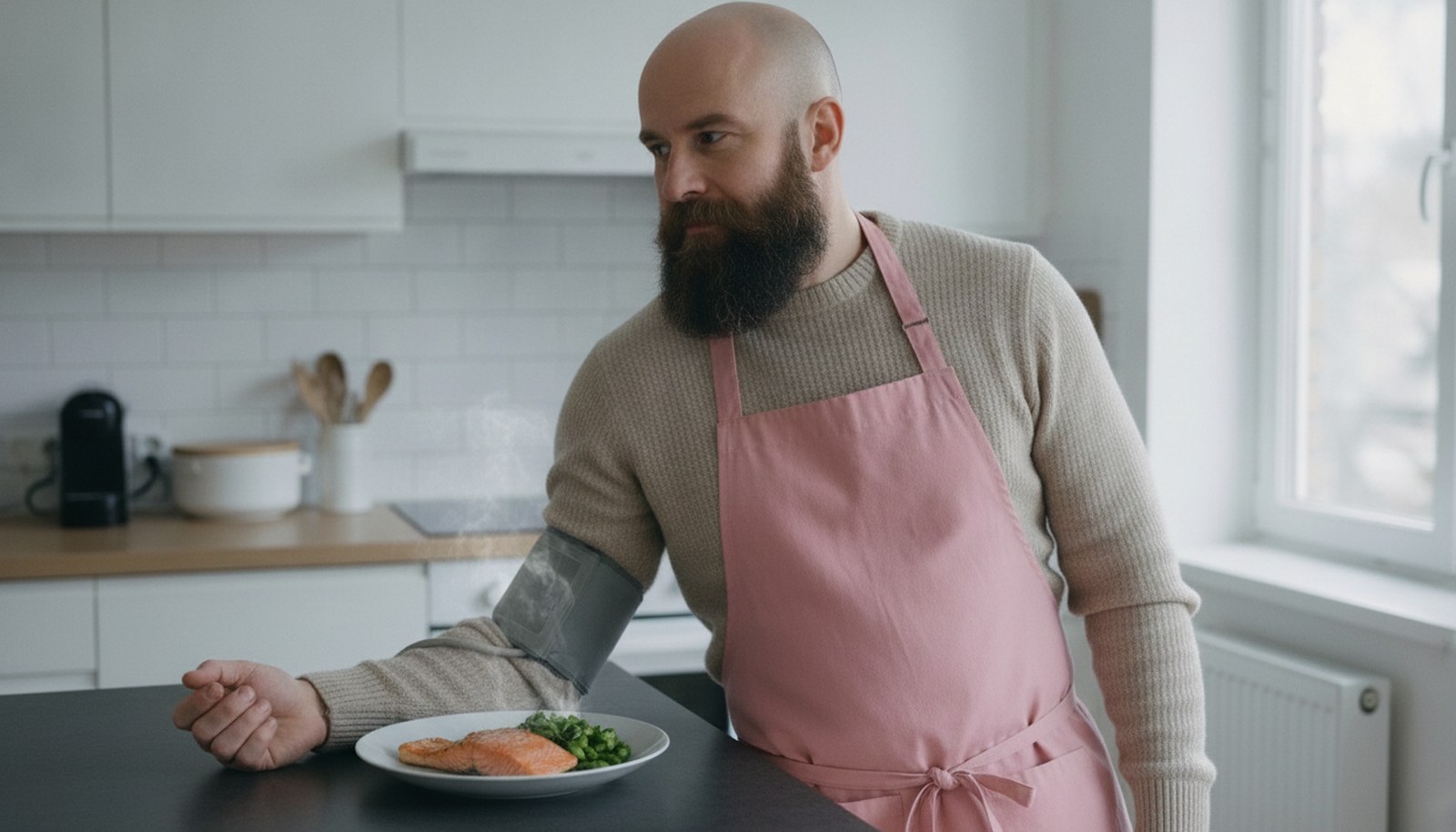
Nobody warns you about it before your first heavier run, so I will: blood pressure on cycle is the number that quietly decides whether the whole thing was worth it. You can chase the pump and the scale all you want. If your heart is working against a garden hose that’s been kinked half-shut, none of the rest matters much.
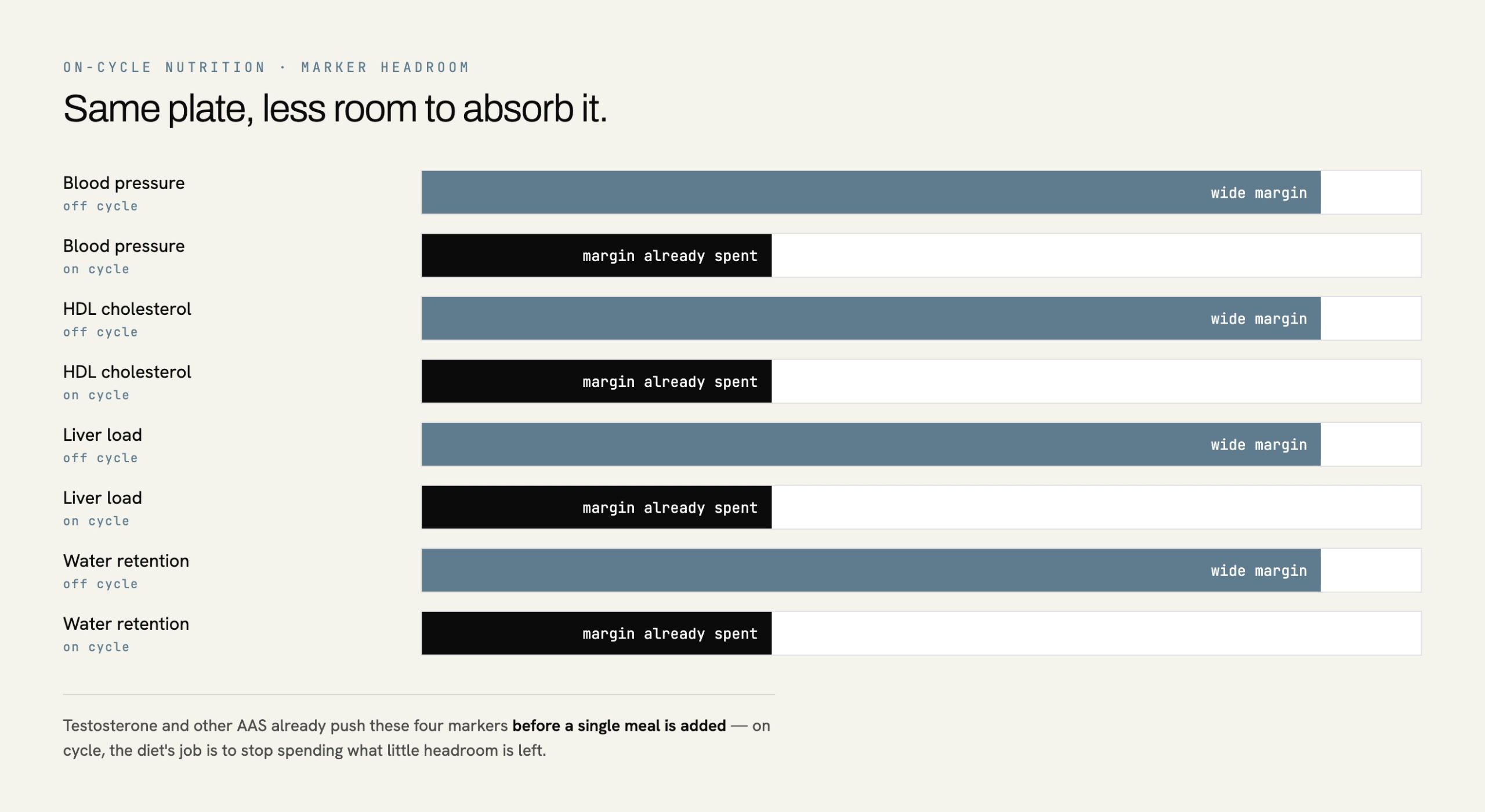
I’ve been on TRT since I was thirty-five, and a few times a year I run something heavier than a replacement dose. Every time I do, my blood pressure wants to climb. Water comes on, the blood gets thicker, the scale jumps, and the little cuff on my kitchen counter starts reading numbers I don’t love. So I’ve learned the kitchen levers that keep mine quiet, and that’s the whole of what I’m going to give you here.
One thing straight up, big man: this is a cook talking, not a doctor. Nothing below is medical advice, nothing below is a dose. It’s how I set my plate to take pressure off my own heart while a doctor watches my labs. Your numbers are yours. Read this, then go buy a cuff and book the bloodwork.
Why blood pressure climbs when you’re on
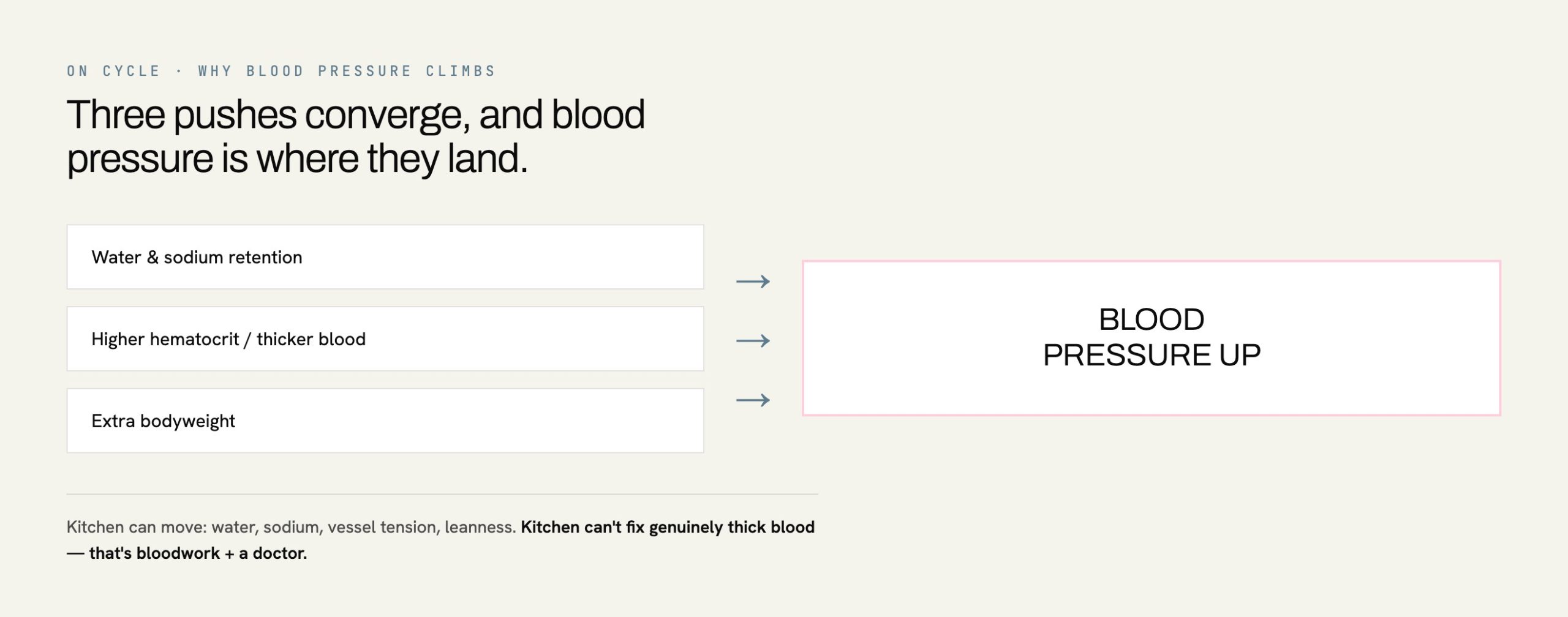
Three things happen at once, and they all push the same direction.
First, water. Anabolics tell your body to hold sodium and fluid, and more fluid in the pipes means more pressure against the walls. That’s the puffy, full look a lot of men chase — but the same fluid that rounds out your delts is sitting in your arteries too.
Second, thicker blood. Testosterone tells your marrow to make more red blood cells, and on a heavier run that signal gets loud. One review of the therapy data put the risk of erythrocytosis — genuinely high red-cell count — at nearly four times placebo, and it’s blunt about why that matters: hematocrit drives blood viscosity, and thicker blood is harder to push.[1] Your heart feels that as extra work.
Third, the weight itself. You’re carrying more muscle, more water, more everything, and a bigger body asks more of the pump. Put those three together and you get the thing every honest lifter eventually meets: a good run, a great mirror, and a cuff reading that says the engine is straining.
Food doesn’t touch all of that. It can’t thin genuinely thick blood — that’s a bloodwork-and-doctor conversation, sometimes a phlebotomy conversation. But the water, the vessel tension, and the general strain? Your kitchen has real say there. The point of lowering blood pressure as a bodybuilder isn’t a magic food. It’s four or five boring levers pulled every day.
Before any of this: buy a cuff and book the bloodwork
I’m going to keep saying this because it’s the only part that’s non-negotiable. You cannot manage a number you don’t measure. A home blood-pressure cuff costs less than a tub of protein, and it turns a vague worry into a fact you can actually work on.
Take it at the same time most days, sitting, arm at heart height, after a few quiet minutes. Watch the trend across a week, not one nervous reading. And get real bloodwork with your doctor while you’re on — hematocrit, lipids, the lot — because the cuff tells you the pressure but not why. If your reading is high and staying high, that’s not a nutrition problem for you and me to solve over a recipe. That’s a doctor’s office, today, before the next meal.
The plate supports the doctor; it never replaces her. If your cuff is reading high week after week, no amount of spinach fixes that on its own. Food is how you make the good numbers easier to hold — it is not a treatment for high blood pressure. Get seen.
Sodium on cycle: aware, not afraid
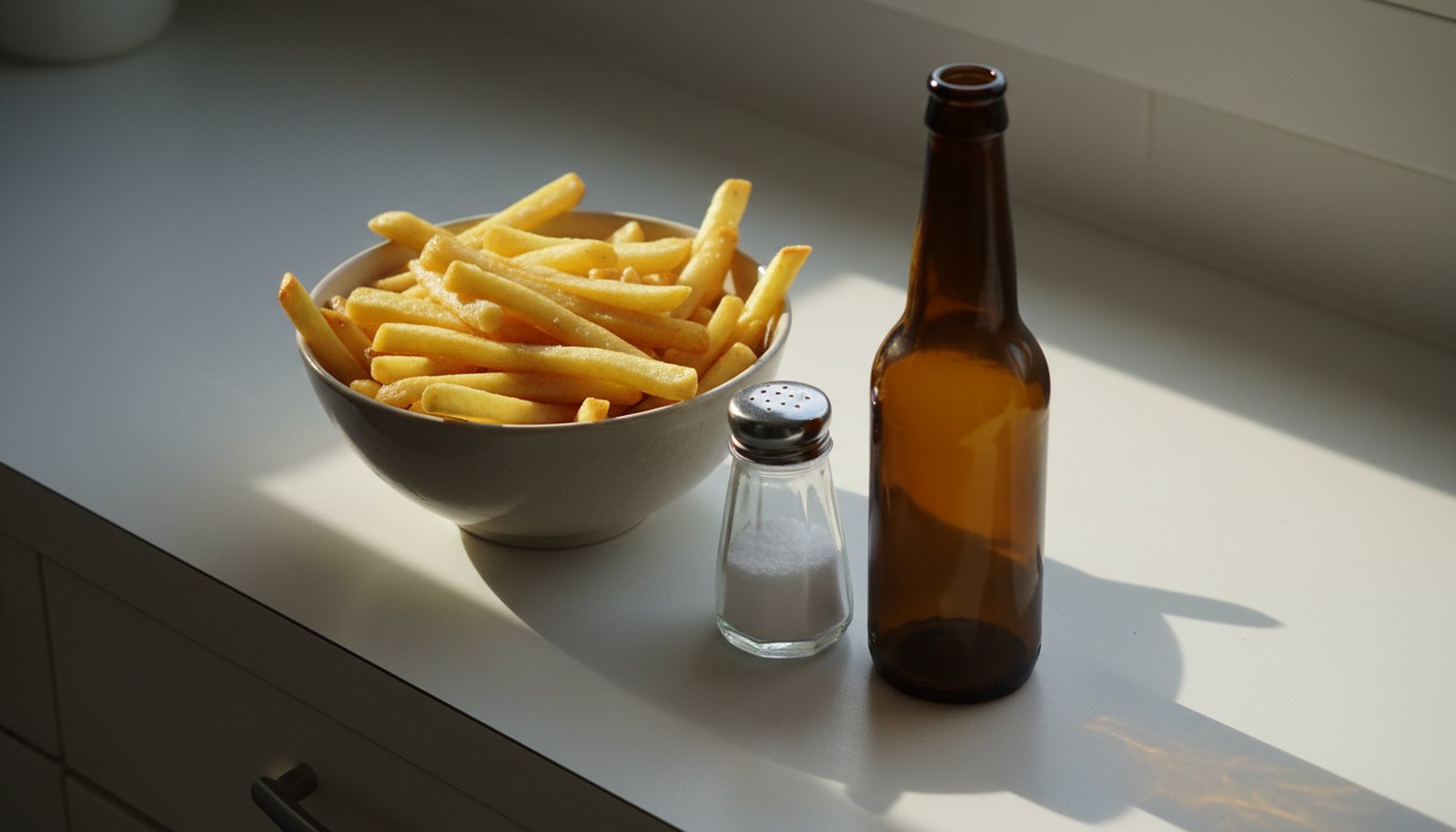
Here’s where the internet loses its mind and starts telling men to eat zero salt. Don’t. Sodium isn’t poison, you need some, and pulling it to nothing while you train hard just leaves you flat and cramping. The move with sodium on cycle isn’t zero. It’s awareness.
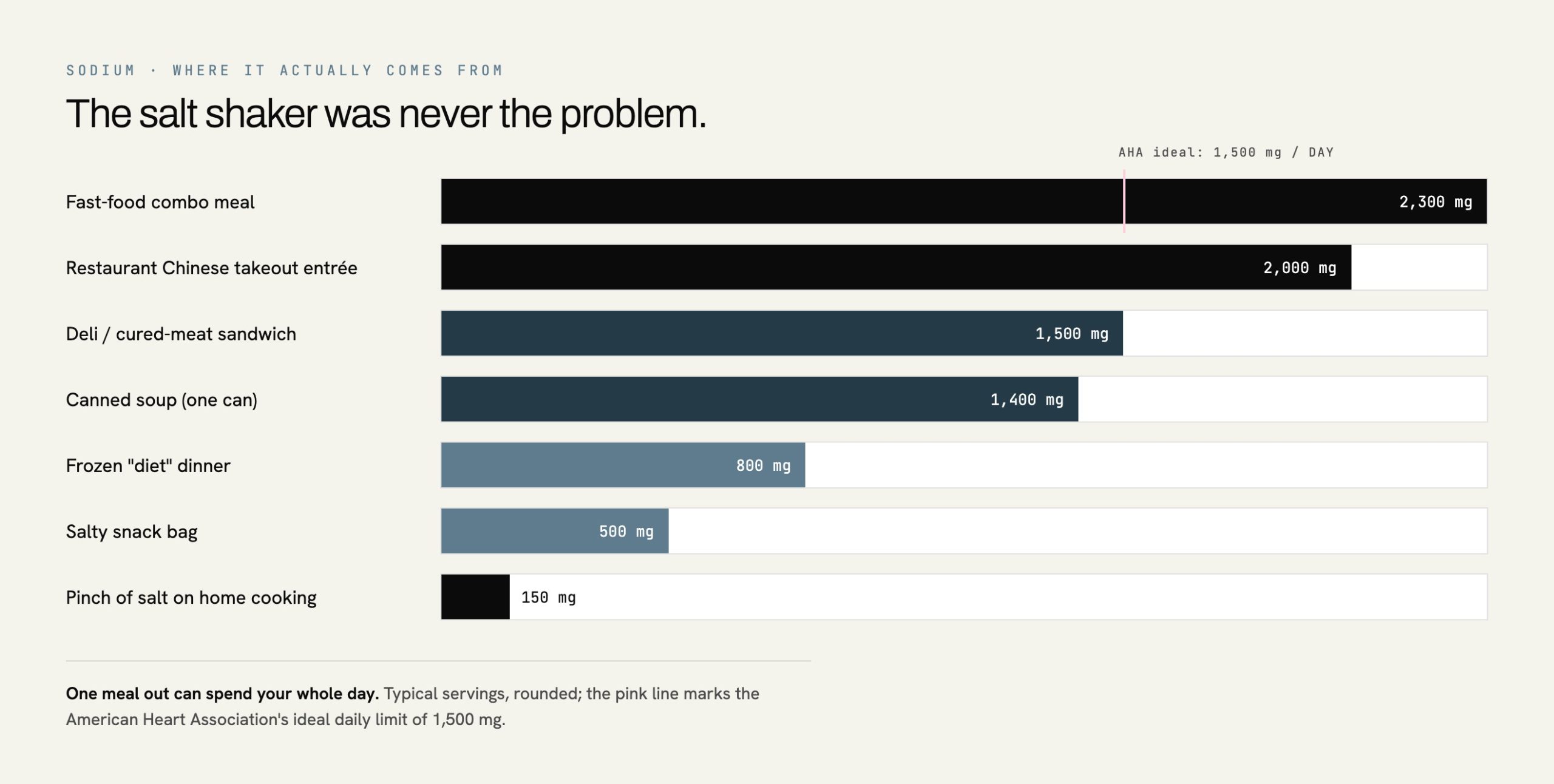
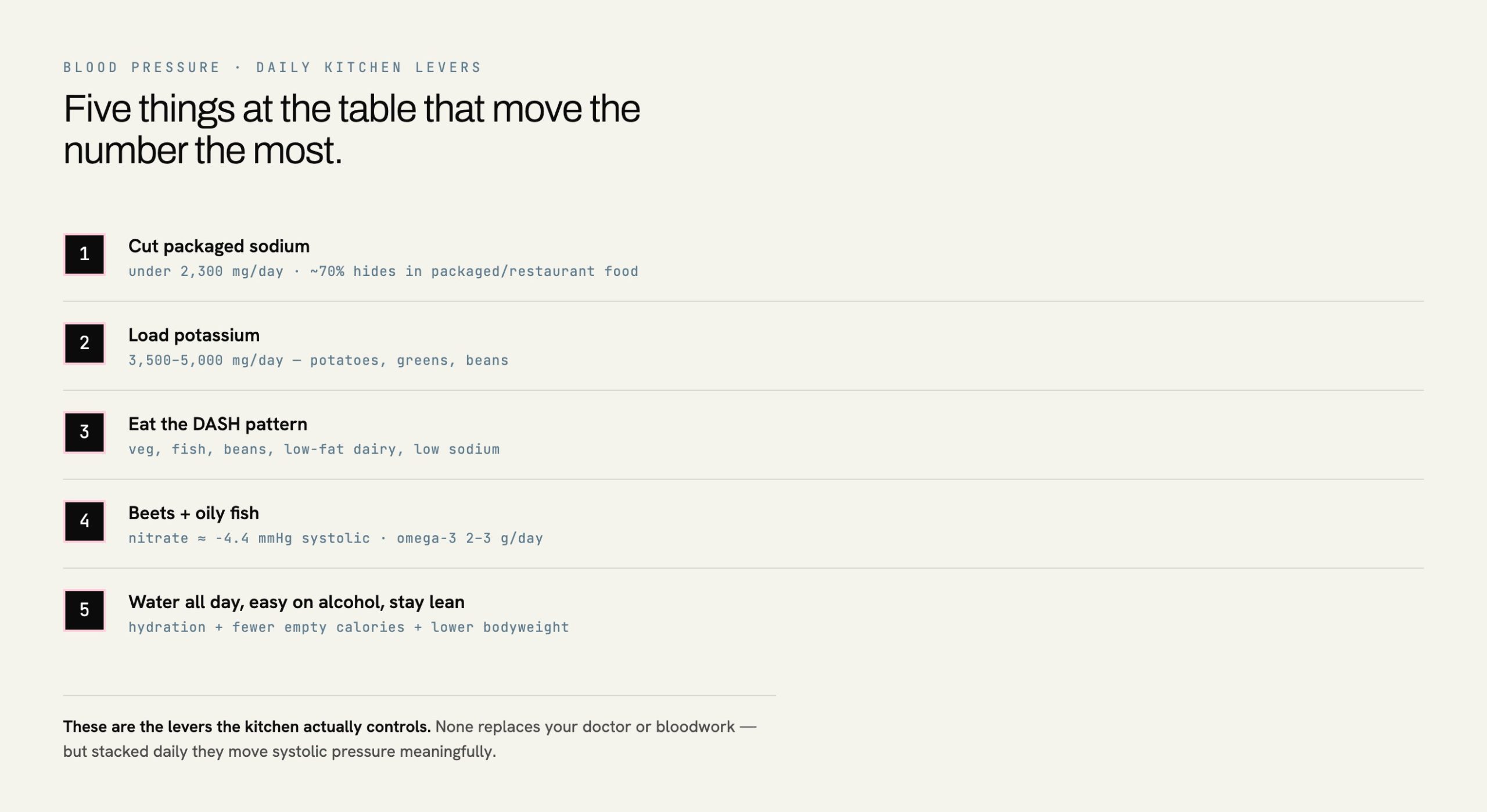
The numbers give you a target to aim near. The American Heart Association puts the ceiling at 2,300 mg a day and the ideal closer to 1,500 mg for most adults, while the average man is eating over 3,100 mg without trying.[2] That gap is the whole game. And the same source points at where it hides: more than seventy percent of the sodium people eat comes from packaged, prepared and restaurant food — not the shaker in your hand.[2]
So the fix isn’t a sad, unsalted chicken breast. It’s cooking your own food, where you control the salt, instead of eating out of packages that were salted for you. When I’m on and watching my pressure, I salt my cooking to taste and spend my sodium budget there, because the deli meat, the sauces, the frozen dinners and the takeout are where it really piles up. A plate of my baked cod and greens that I salted myself has a fraction of the sodium of the same calories from a drive-through, and it tastes like more.
Potassium: the lever most men ignore
If sodium is the pedal, potassium is the brake, and almost nobody eats enough of it. Potassium does two useful things for your pressure: the more you eat, the more sodium your body sheds in urine, and it eases the tension in your blood-vessel walls directly.[3] The AHA leans on it hard, recommending 3,500 to 5,000 mg a day from food for anyone trying to get their pressure down.[3]
One honest caution before you go loading up: if you have kidney trouble, potassium is a different conversation, and too much can build up when the kidneys can’t clear it.[3] That’s another reason the bloodwork matters. Assuming your kidneys are healthy and your doctor’s fine with it, the answer is beautifully simple — it’s just food. Leafy greens, potatoes, beans, a banana. Here’s roughly what the everyday stuff carries.
| Food | Everyday serving | Potassium (approx.) |
|---|---|---|
| White beans, cooked | 1 cup | ~1,000 mg |
| Baked potato, with skin | 1 medium | ~925 mg |
| Spinach, cooked | 1 cup | ~840 mg |
| Sweet potato, baked | 1 medium | ~540 mg |
| Beets, cooked | 1 cup | ~520 mg |
| Avocado | half | ~485 mg |
| Banana | 1 medium | ~420 mg |
| Salmon, cooked | 100 g | ~380 mg |
(Those are USDA-grade round numbers — kitchen-honest, not lab-precise.) Look at the list and you’ll notice something: hit a potato, a cup of greens and a handful of beans across a day and you’re already most of the way to that target without a single supplement. My grilled chicken and a big salad exists mostly so I can shovel greens and potassium in next to the protein without thinking about it.
One baked potato plus a cup of cooked spinach is roughly 1,750 mg of potassium — half a day’s target on one plate, for pennies. You do not need coconut water or a fancy electrolyte tub. You need to eat like a Scandinavian grandmother: potatoes, greens, fish, repeat.
The worst reading I ever got was during a heavier run a couple of winters back. I’d been eating like a competitor — big, salty, convenient — and I strapped the cuff on one cold Chicago morning almost as an afterthought. It was ugly. Ugly enough that I sat down at the kitchen table and didn’t like myself very much for a minute. I called my doctor, we ran bloodwork, and while she sorted the medical side I did the only thing I know how to do: I cooked. I cut the packaged food to nothing, salted my own pans, ate potatoes and greens and oily fish every day, drank water like it was my job, and pulled the drinking right back. It wasn’t dramatic and it wasn’t fast, but over a few weeks the trend came down into a range we were both happier with. The food didn’t do it alone. But it stopped fighting the doctor, and that was the difference.
Eat the DASH way, and drink your water
Everything I just described isn’t something I invented in a pink apron. It has a name and forty years of research behind it: the DASH eating plan, built by the NHLBI specifically to lower blood pressure. It’s the boring, proven pattern — plenty of vegetables and fruit, whole grains, fish, poultry, beans, nuts and low-fat dairy, kept low in sodium.[4] That’s it. That’s the whole heart-eating template, and it maps almost exactly onto how a smart lifter should eat anyway.
The one place lifters need to bend it is protein — DASH was written for the general public, and you and I need more of it to hold muscle on a cut or a cycle. So I run a higher-protein version of the same idea: the DASH plate, with a real protein anchor at every meal. Fish, lean meat and eggs sit where the research wants them; the vegetables, potatoes and beans do the potassium work; the packaged sodium stays out.
Water belongs in this section too. On a heavier run your blood is already thicker than usual, and turning up dehydrated makes that worse and leaves you cramping and flat. I drink through the whole day, every day, and I never train dry. It’s the cheapest, dumbest-simple thing on this list and men skip it constantly.
Beets, fish, and the quietly powerful foods
A couple of foods earn a special mention because the research on them is genuinely good.
Beets and other nitrate-rich greens. Beets, beet greens, spinach and arugula are high in dietary nitrate, which your body turns into nitric oxide — the stuff that relaxes and widens your blood vessels. A meta-analysis of sixteen trials found that inorganic nitrate and beetroot juice dropped systolic blood pressure by about 4.4 mmHg.[5] That’s not nothing for a food you can roast in a pan. I’m not telling you to chug beet juice; I’m telling you to put beets and dark greens on the plate and let them work.
Oily fish. The omega-3 fats in salmon, mackerel and sardines pull in the same direction. A dose-response meta-analysis of seventy-one trials landed on 2 to 3 grams of EPA and DHA a day as the sweet spot for blood pressure, worth a couple of points of systolic on average — and more in men who actually have high pressure.[6] This is why I balance my red-meat weeks with fish, and why my salmon and avocado plate is on heavy rotation whenever my cuff is on my mind: omega-3 from the salmon, potassium from the avocado, and no junk riding along.
Stay lean, and go easy on the drink
Two last levers, and they’re the ones men least want to hear.
Stay lean. Carrying extra fat raises your pressure independent of everything else on this page, and a heavier run is not a license to bury yourself under a dirty bulk. The leaner you keep the frame, the less your heart has to fight. If you’re using a run to grow, grow with some discipline — the same portion sense I lay out in the free 7-day plan keeps the gain lean instead of soft. And when you’re trying to pull weight back down, that’s what the cutting approach is for.
Go easy on the drink. I’m not going to pretend I’m dry — there’s wine on my table some nights, and I made my peace with that a long time ago. But alcohol nudges blood pressure the wrong way, wrecks your sleep, and softens your judgment right when the late-night kitchen is open and salty. When my pressure’s on my mind, the drinking is the first thing I cut, and it’s usually the fastest to show up on the cuff. No shame in a glass. Just know what it costs.
Pull those together — less packaged sodium, a flood of potassium, the DASH pattern, beets and fish, water all day, a lean frame and a light hand with the drink — and you’ve got the whole kitchen side of keeping your pressure quiet on a run. It won’t do the doctor’s job. It’s not meant to. It’s meant to make her job easier, so the good work you’re putting in at the gym doesn’t come with a bill your heart has to pay. If you want the foods to avoid pulling in the other direction, I laid those out in what I keep off the plate on cycle.
Come get fed, big man. Cook your own food, watch your own numbers, and let a doctor who knows you keep the score. I’ve got the recipes; the cuff is on you.
Questions men actually ask
Does being on cycle really raise blood pressure?
For a lot of men, yes. Anabolics push your body to hold sodium and water, testosterone can drive up red-cell count and thicken the blood, and the extra bodyweight all add strain to the heart. How much varies person to person and compound to compound. That’s exactly why you don’t guess — you buy a home cuff, watch the trend across a week, and get bloodwork with a doctor. If yours is climbing and staying up, that’s a medical conversation, not a nutrition tweak.
Should I cut out salt completely on cycle?
No. You need some sodium, and pulling it to zero while training hard just leaves you flat, cramping and miserable. The goal is awareness, not elimination. Aim under the 2,300 mg-a-day ceiling most guidelines set, and remember that most of your sodium comes from packaged and restaurant food, not the salt you add while cooking. Cook your own meals, salt them to taste, and you’ll land in a good range without eating cardboard.
What foods actually lower blood pressure for a bodybuilder?
No single food is a cure, but a pattern helps. Load potassium from potatoes, leafy greens, beans and bananas; eat nitrate-rich beets and dark greens; get omega-3 from oily fish like salmon; and follow the low-sodium, veg-heavy DASH pattern overall. Stay hydrated, stay lean, and go easy on alcohol. These are levers that make good numbers easier to hold — they support your doctor’s care, they don’t replace it.
How much potassium should I be eating?
For lowering blood pressure, the American Heart Association points to 3,500 to 5,000 mg a day from food. That’s very doable with real cooking — a baked potato and a cup of cooked spinach alone is around 1,750 mg. One important exception: if you have any kidney problem, potassium is a different and more careful conversation, so clear it with your doctor first and let your bloodwork guide it.
Can I fix high blood pressure with diet alone while I’m on?
Don’t count on it, and don’t try to go it alone. Food can move the water, the sodium load, your vessel tension and your leanness, and for some men that’s enough to bring a borderline reading back into range. But it can’t thin genuinely thick blood or undo everything a heavier run does. If your pressure is high and staying high, you need a doctor — sometimes a change to what you’re running, sometimes a phlebotomy, sometimes medication. The kitchen is support, not treatment.
Does drinking more water help blood pressure on cycle?
Staying properly hydrated is a smart, cheap habit, especially since a heavier run already thickens your blood and training dehydrated makes that worse. It won’t override a genuinely high reading on its own, but going through the day well-watered and never training dry is one of the easiest things you can do to not make matters worse. Drink through the day, every day.
References
- Endocrine Connections — Bond, Verdegaal & Smit, Testosterone therapy-induced erythrocytosis: can phlebotomy be justified? (2024)
- American Heart Association — How Much Sodium Should I Eat Per Day? (2024)
- American Heart Association — How Potassium Can Help Control High Blood Pressure (2024)
- NHLBI, NIH — DASH Eating Plan (2024)
- Journal of Nutrition — Siervo et al., Inorganic Nitrate and Beetroot Juice Supplementation Reduces Blood Pressure in Adults: A Systematic Review and Meta-Analysis (2013)
- Journal of the American Heart Association — Zhang et al., Omega-3 Polyunsaturated Fatty Acids Intake and Blood Pressure: A Dose-Response Meta-Analysis (2022)

Magnus Olafsson
The cook behind Slim Diet Era. Former Swedish stage competitor (B&K Classic Body Show, Swedish Grand Prix), on TRT since 35, cooking high-protein food in Chicago for his husband, two kids, and you. He counts the macros so you don’t have to.
More about Magnus →Hungry for a plan, not just a post?
Start with the free plan — macros counted, grocery list written, in your inbox. You cook and eat; I’ll do the math.