Eating for Muscle Growth After 50: What Changes, What Doesn’t
A few things genuinely change after 50, a few stubbornly don’t, and men lose years confusing the two.

I turned fifty this year, and I’m still building muscle. So is most of the training crowd I cook for who’d quietly decided the door had closed. That’s the first thing to get straight about eating for muscle growth after 50: it works, it’s the same job it always was, and most of the panic the internet sells you about it is noise. But it isn’t identical to the job at thirty. A handful of things genuinely change, a handful stubbornly don’t, and men lose years confusing the two.
So this is a sorting job. I want to hand you a clean map — what actually shifts on your plate once you cross fifty, and what you can stop worrying about because it never moved an inch. I’ve put the deep numbers elsewhere: my full guide to building muscle after 50 and the one on exactly how much protein to build muscle after 50. Think of this piece as the framing that sits over both of them.
I’m Magnus. Born in Stockholm, raised the back half of my childhood in Chicago, competed back home in Sweden long before I ever owned an apron. Fifteen years on TRT now, and I still run a heavier cycle from time to time. I know what hormones do for a man and what they don’t. What I’m about to tell you holds whether you’re natural, on therapy, or running more than that — because food doesn’t care what’s in your blood. It cares whether you show up and eat with intent.
What changes, what doesn’t: the honest map
Here’s the whole article in one table, and then I’ll walk each line. The left column is where you have to adjust after fifty. The right column is the stuff that’s exactly as true at fifty-five as it was at twenty-five — the fundamentals men abandon out of some vague fear that the rules got rewritten. They didn’t.
| What genuinely changes after 50 | What doesn’t change at all |
|---|---|
| Protein per meal has to be bigger — the anabolic-resistance tax | Total calories still decide whether you gain or lose |
| Recovery — sleep, rest days — is now part of the recipe, not an afterthought | Progressive overload is still the thing that asks the muscle to grow |
| Digestion slows; you pace protein and soften some of it | Whole-food protein still works — nothing exotic is required |
| Joints and bloodwork want more attention — fats, fish, greens | Consistency over months still beats every hack and every powder |
Notice the shape of it. Nothing on the left is a reason to quit. Every one of them is a small kitchen adjustment. And everything on the right is a reason not to over-think this. The men who stall after fifty almost always get it backwards — they cling to a habit on the left (eating like a twenty-year-old who can undereat and grow) and panic over something on the right (deciding calories don’t matter anymore, or that they need some senior-specific magic plan). Let’s fix the reading.
What changes: your muscle needs a bigger knock
This is the one real physiological change, and it has a name: anabolic resistance. Your muscle still answers protein — it just answers a little less to the same dose than it did when you were young. The blunt version: an aging muscle is slightly hard of hearing, so you have to knock louder to get the same door to open.[1]
The cleanest measurement of “louder” comes from a study that fed younger and older men graded doses of protein and watched how hard their muscle switched on. The young men maxed out their per-meal muscle-building response at about 0.24 g of protein per kg of bodyweight. The older men needed roughly 0.40 g/kg — about two-thirds more in a single sitting — to hit the same ceiling.[2] For a 90 kg (198 lb) man that’s the difference between a 22-gram breakfast and a 36-gram one. The gram total across the day matters, but the per-meal floor is what quietly betrays men over fifty who “eat protein” in sprinkles.
I’m not going to re-run all that math here, because I already laid it out plate by plate in the two siblings above — go there if you want the daily targets and the four-meal structure. For the map, you only need the headline: after fifty, spread your protein into real doses, three or four times a day, each one big enough to matter. Roughly 35 to 45 grams of a quality protein per meal, heavy on the leucine-dense stuff — meat, fish, eggs, dairy — because leucine is the amino acid that trips the switch, and the older muscle wants more of it per sitting.[1]
The one non-negotiable that changes after fifty: no sprinkle meals. A slice of ham on toast doesn’t count. Every plate gets a real fist of protein or it isn’t feeding your muscle — it’s just feeding your afternoon.
What changes: recovery is now part of the recipe
At thirty I could out-train bad sleep and out-eat a rough week. At fifty I can’t, and neither can you, and pretending otherwise is how good men spin their wheels. Recovery stopped being the boring part you skip and became an ingredient — as real as the protein. A muscle-growth-after-50 diet that ignores sleep is a half-built plate.
Here’s the part that turns it from a lecture into a number. In a tightly controlled trial, dieters who slept 5.5 hours a night instead of 8.5 lost the same total weight — but the composition of that loss fell apart. On short sleep they lost 55% less fat and burned significantly more lean muscle to make up the difference.[3] Same food, same deficit, wildly different result — because the body under-slept decided muscle was the expendable one. After fifty, when you’re already fighting anabolic resistance, that’s a tax you cannot afford.
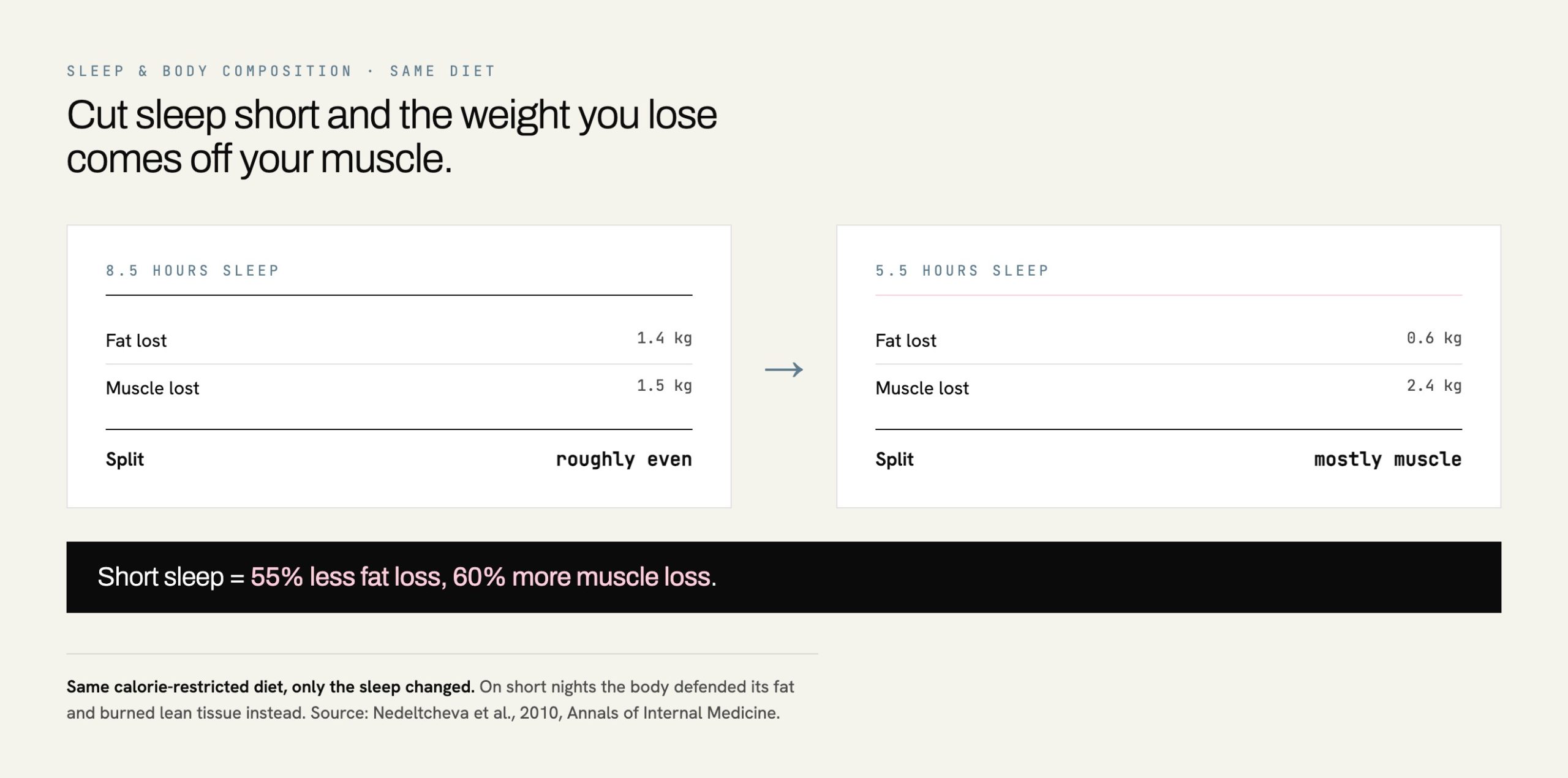
So the food follows the recovery, not the other way round. Two practical shifts I made once I crossed the line:
- A slow protein before bed. A casein-style dose overnight keeps the repair going while you sleep. A bowl of skyr does it beautifully — my brazil nut and berry skyr bowl is slow-digesting Icelandic dairy with a real protein hit, and the brazil nuts bring selenium and good fat along for the ride. It’s the last thing I eat most nights.
- Carbs earn their keep around training and sleep. I stopped fearing an evening portion of rice or potato on a heavy training day. Carbs help you wind down and refill the muscle for tomorrow’s session. Aiming them — not avoiding them — is the older lifter’s move.
The tell for me wasn’t the mirror — it was the morning after leg day. In my competition years back in Sweden I’d squat heavy, sleep like the dead, and be fine by breakfast. This past winter I turned fifty, trained legs the way I always have, then slept badly because one of my daughters had a fever and the house was up half the night. Three days later I was still walking down stairs sideways. Nothing was wrong with me. I’d just spent fifty years learning that food builds the muscle and finally met the other half of the sentence: sleep is when it actually gets built. Now I guard my nights the way I guard my protein. Same recipe, one more ingredient I used to get for free.
What changes: digestion, joints, and the quiet stuff
Two smaller changes round out the left column, and building-muscle-over-50 nutrition gets easier once you name them.
Digestion slows down a touch. Big, dense, dry protein loads can sit heavier than they used to. The fix isn’t less protein — it’s smarter delivery. I lean on softer, faster proteins more than I did at thirty: dairy, eggs, blended things, well-cooked fish. If a giant slab of dry chicken breast makes you feel like you swallowed a brick, that’s not a reason to skip the protein — it’s a reason to plate it as skyr, or salmon, or eggs instead. Chewability counts after fifty. Getting the grams in beats being a hero about the source.
Joints and bloodwork start talking back. This is where fat quality earns real money. Fatty fish does double duty for the older lifter: it feeds the joints and heart the omega-3s they want, and — this surprised me when I read it — omega-3 fat actually helps older muscle respond to protein. In a controlled trial, older adults given omega-3s showed a bigger muscle-protein-synthesis response to a protein-and-insulin stimulus than the control group.[4] That’s a rare case of a fat pulling muscle-building weight, and it only shows up clearly in older bodies. So I build fish into the week on purpose. A plate like salmon with sweet potato and asparagus is the shape of it — omega-3 fat, a real protein dose, potassium and fiber from the sides, nothing fried riding along.
A 200-gram salmon fillet is about 40 grams of protein plus a couple grams of omega-3 fat. Do that two or three times a week and you’ve handled your per-meal protein floor and your joint-and-heart fats in the same pan. After fifty, meals that solve two problems at once are the ones you build the week around.
What doesn’t change: the rules you were told got rewritten (they didn’t)
Now the right column — and this is where I get firm, because the fear here does more damage than the aging does. Men hit fifty and start believing their body runs on different physics. It doesn’t. Three things are exactly as true as they ever were.
Calories still rule. To add muscle you need to eat enough — a small surplus over what holds your weight, not a starvation plan and not a free-for-all. You cannot build much in a real deficit at any age, and the men who stay stuck at fifty are almost always undereating across the day, not overeating. Eat like you’re still trying to shrink from your forties and the muscle simply won’t come. The scale should drift up slowly over months while the mirror and the barbell tell you it’s mostly muscle. Testosterone, therapy, none of it repeals this. Nobody’s hormones ever counted a calorie for them.
Whole-food protein still works — you don’t need anything exotic. There’s no senior-citizen supplement that beats a steak. The meta-analysis on protein and training landed at about 1.6 g/kg per day as the point where extra protein stops adding muscle — the same ceiling for a fifty-year-old as a thirty-year-old.[5] You clear it with meat, fish, eggs, and dairy. A ribeye is not less anabolic because you’re older. My ribeye with sauteed spinach is a fifty-plus muscle meal precisely because it’s the same honest plate it always was — a big leucine-dense protein, iron, greens, done in one pan.
Progressive overload still builds the muscle; food only answers the ask. The research showing older adults gaining muscle is resistance-training research — in a pooled analysis of lifters over fifty, the average gain was 1.1 kg of real lean mass, and the harder-training programs built more.[6] Your muscle at fifty-five reads the same signal it read at twenty-five: load it, feed it, rest it, and it grows. What changed is the volume knob on how loudly it hears the food. Turn that up with bigger per-meal doses and you’re back in business. The mechanism didn’t change. The dose did.
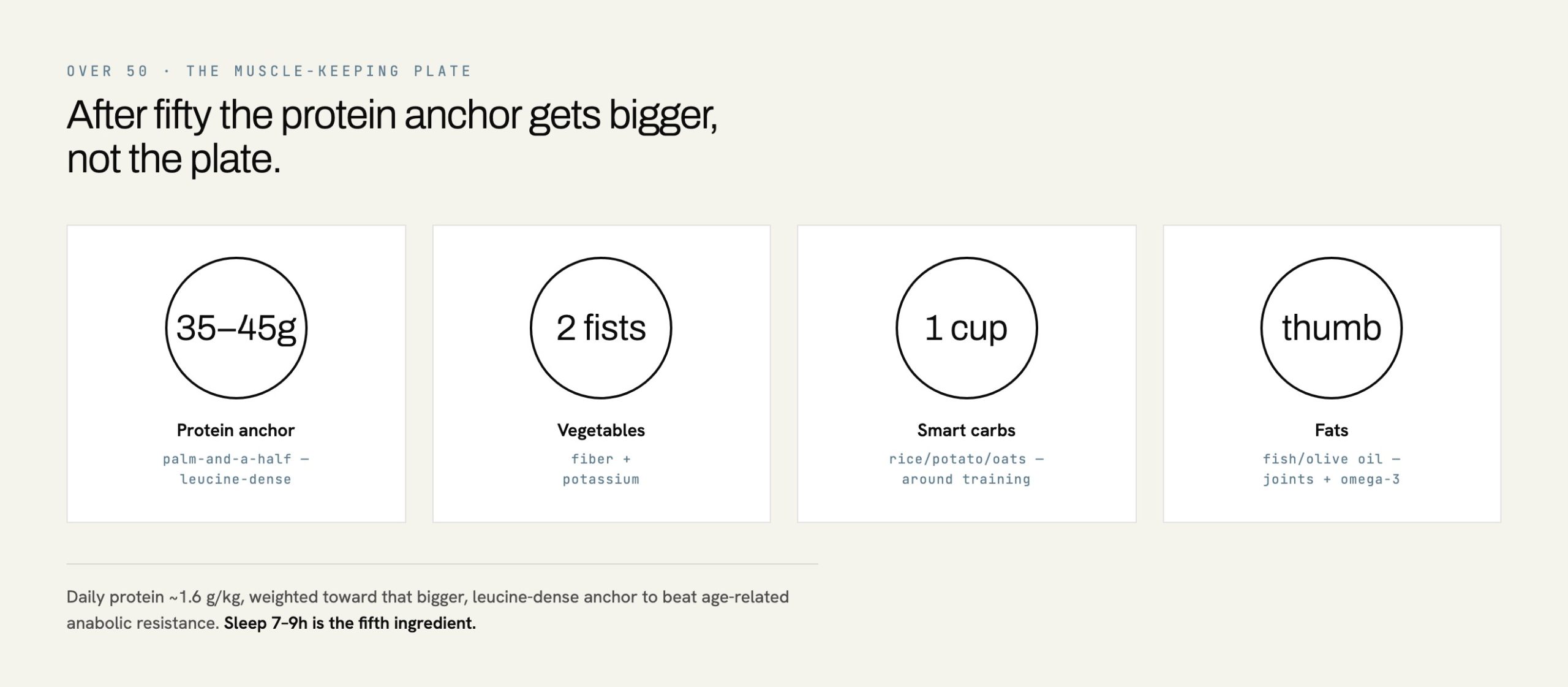
How eating for muscle growth after 50 looks on a real plate
Put both columns together and the plate almost builds itself. Anchor every meal with a real protein dose — that’s the tax on the left. Then keep the fundamentals on the right honest: enough total food, whole-food sources, greens and smart carbs, good fats from fish. Add the two ingredients that used to be free — sleep and recovery — and you’ve got the whole system.
A plain day for a 90 kg man looks like this. Breakfast: eggs with a real protein anchor, or the skyr bowl if I trained early and want something slow. Lunch: the ribeye and spinach, or a big chicken plate. Dinner: salmon, sweet potato and asparagus, so the day’s fats lean toward the joints and heart. And a slow dairy dose before bed if I’m chasing growth. Four hits, none of them a sprinkle, spaced across the waking hours. Repeat the shape, swap the proteins so you don’t get bored, and aim your carbs at your training.
That’s not a special diet. There’s no such thing as a special diet for a fifty-year-old — there’s a genuinely good one, held a little more honestly than you had to hold it at thirty. If you’d rather have the targets and the four-meal structure set for you instead of doing the arithmetic, my free 7-day plan lays it out with the protein and portions already built in. It’s the fastest way to see the shape of everything above on actual plates.
The long game after fifty
Fifteen years on TRT, and fifty years in this body, here’s what I’ve landed on: the fundamentals never betrayed anyone. What betrays men over fifty is abandoning the fundamentals because a number on a birthday card scared them. The muscle still comes. It comes slower than at twenty-five, it costs a bigger protein dose and a protected night’s sleep, and it rewards consistency over months the way it always did.
So cook. Real protein at every meal, enough total food to grow, fish through the week, greens on the side, and sleep you actually defend. Keep an eye on your bloodwork with a doctor who knows you — that part’s between the two of you, not me. Do that for a year instead of a week and you’ll be the fifty-something who makes younger men ask what you’re on. The answer is usually a plate. Come get fed, big man. I’ve got you.
Questions men actually ask
What’s the biggest change in eating for muscle growth after 50?
The per-meal protein dose. Because of anabolic resistance, an older muscle needs a bigger single hit of protein to fully switch on growth — roughly 0.40 g/kg of bodyweight per meal, versus about 0.24 for a younger man. In practice that means 35 to 45 grams of quality protein three or four times a day, no sprinkle meals. The daily total matters, but the size of each dose is what most men over fifty get wrong.
Do calories still matter for building muscle over 50?
Completely. This is the thing that doesn’t change. To add muscle you need to eat enough — a small surplus over maintenance — at fifty exactly as at thirty. Most stuck older lifters are undereating across the day, not overeating. Age and hormones change the exchange rate on your food; they never repeal the math. Eat too little and the muscle won’t come no matter how well you train.
Does sleep really affect muscle growth after 50?
More than most men realize. In a controlled diet study, people sleeping 5.5 hours instead of 8.5 lost 55% less fat and burned significantly more muscle on the identical calorie deficit. After fifty, when you’re already fighting anabolic resistance, poor sleep is a tax you can’t afford. Treat seven to nine hours as an ingredient in the plan, not an optional extra. Recovery is where the muscle actually gets built.
Do I need special supplements or a special diet after 50?
No. There’s no senior-specific magic plan and no powder that beats a steak. Whole-food protein — meat, fish, eggs, dairy — still does the job, and the research ceiling of about 1.6 g/kg per day is the same for you as for a younger lifter. Creatine and a protein powder can be useful convenience, but the plate comes first. What changes is the dose and the recovery, not the fundamentals.
Why do big dry protein meals feel harder to digest now?
Digestion slows a touch with age, so dense, dry loads can sit heavier. The fix isn’t less protein — it’s smarter delivery. Lean more on softer, leucine-dense sources: dairy and skyr, eggs, blended shakes, well-cooked fish. If a giant slab of dry chicken feels like a brick, plate the same protein as salmon or a skyr bowl instead. Getting the grams in beats being a hero about the source.
Do fats matter more for building muscle after 50?
Fat quality does. Fatty fish pulls double duty for older lifters — omega-3s support the joints and heart, and in a controlled trial omega-3 supplementation actually improved older adults’ muscle-building response to protein. So build fish into the week on purpose and get most of your fat from fish, olive oil, nuts and avocado rather than the fryer. It’s one of the few places where a fat helps the muscle directly.
References
- Nutrition & Metabolism — Breen & Phillips, Skeletal muscle protein metabolism in the elderly: interventions to counteract the ‘anabolic resistance’ of ageing (2011)
- The Journals of Gerontology: Series A — Moore et al., Protein ingestion to stimulate myofibrillar protein synthesis requires greater relative protein intakes in healthy older versus younger men (2015)
- Annals of Internal Medicine — Nedeltcheva et al., Insufficient sleep undermines dietary efforts to reduce adiposity (2010)
- American Journal of Clinical Nutrition — Smith et al., Dietary omega-3 fatty acid supplementation increases the rate of muscle protein synthesis in older adults: a randomized controlled trial (2011)
- British Journal of Sports Medicine — Morton et al., A systematic review, meta-analysis and meta-regression of the effect of protein supplementation on resistance training-induced gains in muscle mass and strength (2018)
- Medicine & Science in Sports & Exercise — Peterson et al., Influence of resistance exercise on lean body mass in aging adults: a meta-analysis (2011)

Magnus Olafsson
The cook behind Slim Diet Era. Former Swedish stage competitor (B&K Classic Body Show, Swedish Grand Prix), on TRT since 35, cooking high-protein food in Chicago for his husband, two kids, and you. He counts the macros so you don’t have to.
More about Magnus →Hungry for a plan, not just a post?
Start with the free plan — macros counted, grocery list written, in your inbox. You cook and eat; I’ll do the math.